athenaOne: An Overview
athenaOne is a cloud-based suite designed for ambulatory care that combines electronic health record (EHR), practice management, revenue cycle management (RCM), and patient engagement tools on a single platform. It emphasizes network-enabled workflows that let practices leverage shared data across payers, labs, and other providers to reduce administrative burden and speed up billing and referrals.
Compared with enterprise EHR suites like Epic and Cerner, athenaOne targets independent practices and ambulatory groups with a lighter cloud-first deployment and built-in RCM services rather than a heavyweight on-premises implementation. Against ambulatory-focused vendors such as NextGen Healthcare and eClinicalWorks, athenaOne stands out for its connected network and embedded services that combine software with managed revenue cycle operations.
All of this makes athenaOne particularly well suited to independent physician practices, specialty groups, and small health systems that need an integrated ambulatory product with external service options. It does well at reducing claim complexity, offering specialty-specific workflows, and providing network effects that can improve collections and administrative efficiency.
How athenaOne Works
athenaOne runs as a cloud-native platform where core modules communicate through a unified patient record and shared services. Clinicians use the EHR for documentation and orders, front-office staff use practice management for scheduling and eligibility, and billing teams use the RCM tools to manage claims, denials, and collections in one coordinated system.
Workflows are augmented by network services and automation: automated insurance selection and rules engines reduce denial rates, embedded ambient documentation reduces physician typing time, and analytics pull operational and clinical metrics from the network for population management. Implementation typically includes data migration, workflow configuration for specialties, and optional managed services for parts of billing or credentialing.
athenaOne features
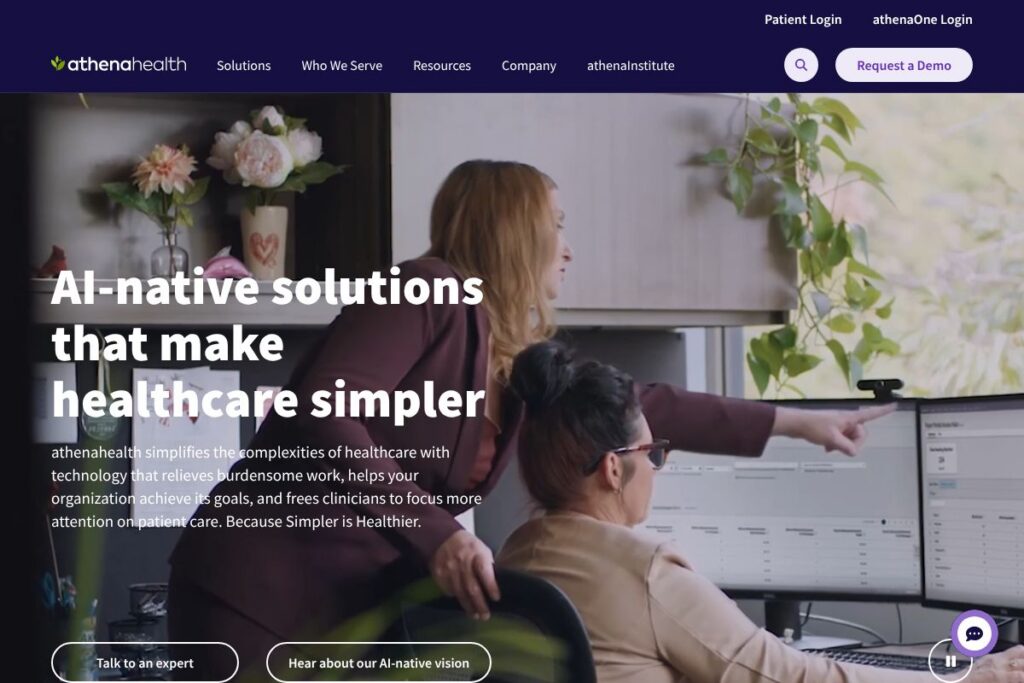
athenaOne bundles EHR, practice management, revenue cycle, patient engagement, and analytics into a single platform, and it has recently emphasized ambient documentation and AI-assisted automation alongside its existing network services.
Electronic Health Record (EHR)
The EHR provides charting, order entry, and clinical decision support optimized for ambulatory workflows. Specialty templates and configurable note structures help clinicians capture relevant data faster and maintain more complete problem lists and medication records.
Practice Management
Scheduling, patient eligibility, and front-desk workflows are handled within the practice management module to reduce appointment friction and speed check-in. Integrated eligibility checks and patient statements aim to reduce administrative rework for staff.
Revenue Cycle Management (RCM)
RCM includes claims submission, denial management, payment posting, and patient billing tools that work across the network to shorten collections cycles. Practices that adopt athenaOne commonly see measurable improvements in collections and reduced overhead through automated rules and managed services.
Ambient Clinical Documentation
An embedded ambient solution captures visit details to reduce physician documentation time while producing structured notes suitable for billing and quality reporting. This capability is positioned to lower clinician burden and improve coding accuracy.
Specialty-Specific Workflows
The platform offers tailored workflows and charting templates for a range of specialties so clinicians can work in contexts that reflect their typical visits and procedures. Specialty support helps reduce customization time and keeps charts clinically relevant.
Analytics and Reporting
Population health and operational analytics pull data from the connected network to provide dashboards on revenue cycle performance, clinical quality measures, and practice operations. These reports help managers prioritize denials, outreach, and care gaps.
Network Services and Marketplace
Athenahealth’s network connects practices, payers, labs, and pharmacies to automate eligibility, referrals, and claim adjudication steps. The developer and partner ecosystem expands integrations and third-party tools through a marketplace model.
With these capabilities, the biggest benefit of athenaOne is the combination of integrated software plus network-enabled services that reduce administrative complexity and help practices focus clinical time on patient care.
athenaOne pricing
athenaOne uses an enterprise SaaS and services pricing approach with custom quotes based on practice size, specialty needs, and selected managed services. Pricing is not presented as fixed public tiers because implementations and service bundles are tailored to each organization’s operational and billing requirements.
For current pricing options and to request a tailored proposal, contact athenahealth through their sales and demo channels. View athenahealth’s contact and demo request pages to arrange a personalized pricing discussion and product walkthrough.
What is athenaOne Used For?
athenaOne is commonly used to run the clinical and administrative operations of ambulatory practices, including documentation, scheduling, billing, and patient communications. Practices use it to centralize charting, streamline front-office tasks, and outsource parts of revenue cycle work when desired.
Specialty practices use athenaOne to implement workflow-specific templates and coding rules, while multi-site groups use the platform to standardize processes across locations and benefit from network-scale services like automated insurance selection and data-driven denial prevention.
Pros and cons of athenaOne
Pros
- Integrated clinical and financial platform: The suite combines EHR, practice management, and RCM so teams work from a single patient record rather than stitched-together systems, reducing handoffs and data duplication.
- Network-enabled automation: Built-in rules engines and connectivity to payers and labs reduce denials and speed administrative tasks, which can translate into improved collections and lower overhead for many practices.
- Specialty support and ambient documentation: Specialty-specific workflows and an embedded ambient documentation feature lower clinician documentation time and help maintain coding accuracy.
Cons
- Enterprise-style onboarding: Implementation and optimization require planning and staff training, which can be a multi-week effort for larger or multi-site practices with complex workflows.
- Custom pricing model: Because pricing is customized, small practices must engage sales to understand total costs and may need to compare bundled service options closely to assess value.
- Feature breadth vs depth for some specialties: While many specialties are supported, highly niche workflows may still require additional configuration or third-party tools to meet every unique need.
Does athenaOne Offer a Free Trial?
athenaOne does not offer a public free plan, but provides demos and personalized pilot or trial options for qualified practices. Potential customers can request a tailored demo and discuss pilot programs or short-term evaluations through athenahealth’s demo request and sales channels.
athenaOne API and Integrations
athenaOne exposes developer APIs and integration options through athenahealth’s developer portal, including support for modern interoperability standards that enable data exchange with labs, pharmacies, and third-party apps. The athenahealth developer portal hosts API documentation and guides for building integrations using available endpoints.
The platform also includes prebuilt integrations with common practice tools and third-party services to support billing partners, telehealth vendors, and patient engagement platforms, enabling a connected ambulatory ecosystem without extensive custom integration work.
10 athenaOne alternatives
Paid alternatives to athenaOne
- Epic — Enterprise EHR with deep clinical feature sets and extensive hospital and ambulatory integrations; typically used by large health systems.
- Cerner — Comprehensive clinical and financial platform oriented toward hospitals and health systems with ambulatory modules.
- NextGen Healthcare — Ambulatory-focused EHR and practice management suite with specialty workflows and RCM services.
- eClinicalWorks — Cloud-based EHR and practice management with a focus on ambulatory practices and telehealth capabilities.
- Allscripts — EHR and practice management solutions across ambulatory and inpatient settings, with options for RCM and population health.
- DrChrono — Cloud and mobile-first EHR with strong billing integrations and a modern API for smaller practices.
- AdvancedMD — Integrated PM, EHR, and RCM for independent practices and medical groups.
Open source alternatives to athenaOne
- OpenEMR — A widely used open source EHR and practice management system that can be self-hosted and customized for ambulatory care.
- OpenMRS — A modular open source medical record system aimed at global health and flexible clinical workflows.
- GNU Health — Health and hospital information system with open source components for clinical and administrative use.
- Bahmni — An open source hospital system built on top of OpenMRS, suitable for outpatient and inpatient workflows in low-resource settings.
Frequently asked questions about athenaOne
What is athenaOne used for?
athenaOne is used for managing ambulatory clinical workflows, practice management, and revenue cycle operations. Practices use it to centralize charting, scheduling, billing, and patient communication on one platform.
Does athenaOne integrate with other systems?
Yes, athenaOne supports integrations via its developer APIs and marketplace. The platform connects to labs, pharmacies, payers, and third-party clinical and administrative tools through standard interoperability mechanisms.
How much does athenaOne cost?
athenaOne uses customized enterprise pricing rather than public tiered plans. Pricing depends on practice size, specialty, module selection, and any managed services chosen; contact athenahealth for a tailored quote.
Can athenaOne support specialty practices?
Yes, athenaOne offers specialty-specific workflows and templates. The platform includes configurable charts and visit templates designed to match common specialty requirements and coding rules.
Does athenaOne offer API access for developers?
Yes, athenaOne provides API access and developer resources. Developers can use the athenahealth developer portal to find API documentation and integration guides.
Final Verdict: athenaOne
athenaOne excels at combining ambulatory EHR, practice management, and revenue cycle features with networked services that reduce administrative complexity for independent practices and specialty groups. Its ambient documentation and rules-driven RCM help lower clinician burden and improve claim outcomes in ways that are particularly valuable for organizations that want a single vendor for both software and operational services.
Compared with a large enterprise system like Epic, athenaOne offers a lighter cloud-first implementation and bundled RCM service options that can be more accessible for smaller health systems and independent practices. While Epic is often chosen by large hospitals for deep in-hospital functionality and an extensive feature set, athenaOne provides a focused ambulatory experience with network-enabled automation and managed services that justify its custom pricing model for many outpatient organizations.