What is BigCommerce
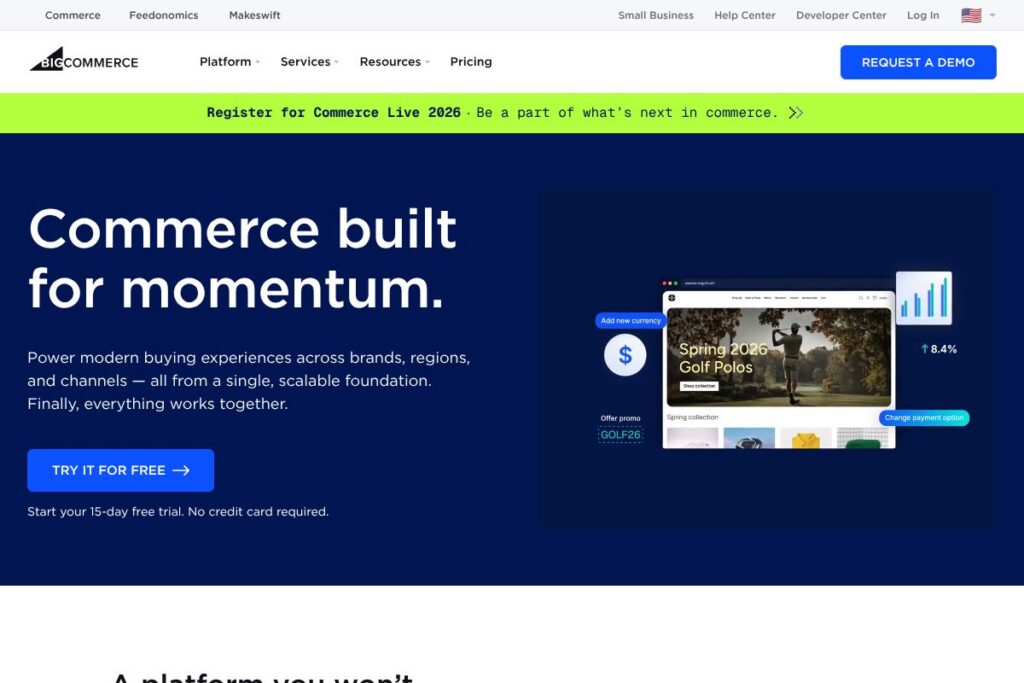
BigCommerce is a cloud commerce platform designed to power storefronts, marketplaces, and wholesale operations from one core system. It focuses on scaling businesses that need multi-brand and multi-region capabilities, comprehensive checkout options, and integrations with ERP, PIM, and headless front ends.
Compared with Shopify, BigCommerce emphasizes built-in enterprise features like multi-storefront management and B2B functionality, reducing the need for third-party apps for large catalogs and complex pricing. Versus Adobe Commerce (Magento), BigCommerce offers a managed SaaS approach that minimizes hosting and maintenance overhead while still supporting headless and API-driven experiences. Against Salesforce Commerce Cloud, BigCommerce typically provides more flexible third-party integrations and a more open API-first model for teams that want to mix best-of-breed services.
All of this makes BigCommerce particularly strong for merchants who expect steady growth across brands or markets and want to avoid rebuilding commerce infrastructure as complexity increases. The platform is a practical choice for manufacturers, distributors, and mid-market to enterprise retailers that require both B2C and B2B capabilities in one system.
How BigCommerce Works
BigCommerce runs as a SaaS platform where the core commerce engine manages catalog, pricing, checkout, orders, and fulfillment while exposing APIs for storefronts and integrations. Merchants can choose a hosted storefront using built-in themes and page builders, or implement a headless front end that calls BigCommerce APIs for product data, cart, and checkout.
Operational workflows typically start with catalog import and enrichment, then configuration of channels and storefronts, and finally connection of payments, tax, and shipping providers. For B2B customers, teams configure customer-specific catalogs, custom pricing, and approval workflows inside the platform or via the B2B Edition for unified wholesale functionality.
Developers extend and automate BigCommerce through its REST APIs, webhooks, and the app marketplace. That makes it straightforward to integrate ERP and PIM systems, add custom checkout flows via Custom Checkout, or sync product data to marketplaces with partners like Feedonomics.
BigCommerce features
The platform centers on scalable product and order management, flexible checkout and payments, multi-storefront support, and developer-friendly APIs. Recent platform investments focus on custom checkout, B2B features, and better channel feed management to reduce duplicated systems and manual processes.
Headless and API-first commerce
BigCommerce provides REST APIs for catalog, cart, checkout, and orders enabling headless architectures and custom front ends. This benefits teams that want to use modern frameworks for storefronts while keeping a centralized commerce engine for business logic.
Custom Checkout
Custom Checkout lets merchants tailor the checkout flow and UI, connect preferred payment providers, and optimize conversion without rebuilding backend order logic. That reduces friction and enables localized payment methods across regions.
B2B Edition
B2B Edition adds capabilities for customer-specific catalogs, contract pricing, purchase approvals, and quote-to-order workflows. These features help manufacturers and distributors run a unified B2B experience without heavy custom development.
Multi-storefront and multi-region management
The platform supports running multiple brands and regional storefronts from a single control plane, sharing catalog or maintaining separate catalogs as needed. That simplifies expansion and reduces the need to duplicate backend systems when entering new markets.
Payments and payment provider options
BigCommerce integrates with numerous payment gateways and supports regional payment methods to reduce checkout drop-off. Merchants can choose from many providers and implement payment logic that matches customer preferences and compliance needs.
Catalog and marketplace feed management
Product data tools and integrations keep catalog, inventory, and pricing synchronized across channels, reducing manual updates and listing errors. Integrations with feed management partners help publish consistent product data to marketplaces and advertising channels.
Developer tools and integrations
The developer ecosystem includes SDKs, webhooks, API documentation, and an app marketplace for extensions and connectors. This makes it easier to connect ERP, CRM, tax engines, and specialty services without heavy custom builds.
With these capabilities, BigCommerce helps teams reduce duplicate systems, optimize checkout conversion, and scale commerce operations across channels and regions. The platform’s biggest benefit is its combination of enterprise commerce features with a managed SaaS model that lowers infrastructure overhead.
BigCommerce pricing
BigCommerce uses a subscription and enterprise pricing model tailored to company size and requirements, with custom enterprise contracts for large deployments. Publicly listed plan details and enterprise rates are not centralized on a single pricing page in every region, so organizations generally request quotes to get exact terms based on features, transaction volume, and support needs.
For current pricing structure and to request a custom quote, view BigCommerce’s pricing and plans. Sales and partner teams can provide tailored pricing for multi-store, B2B Edition, and enterprise implementations.
What is BigCommerce Used For?
BigCommerce is used to run online stores and omnichannel commerce programs for brands selling direct to consumers, wholesale customers, and through marketplaces. Typical deployments include single-brand retailers scaling into multiple regions, manufacturers adding direct channels, and B2B distributors that need contract pricing and quote workflows.
Teams also use BigCommerce as the central commerce engine in headless architectures, feeding product and order data to mobile apps, custom storefronts, and third-party marketplaces. Its integrations make it a practical choice when connecting ERP, PIM, tax, and logistics systems is critical to operations.
Pros and Cons of BigCommerce
Pros
- Scalable multi-store management: Built-in tools let you run multiple brands and regional storefronts from a single platform which reduces duplication and simplifies governance.
- Strong B2B features: Customer-specific catalogs, pricing, and quote workflows support manufacturers and distributors without heavy custom development.
- API-first and extensible: Robust REST APIs, webhooks, and an app marketplace make integrations with ERP, PIM, and payment providers straightforward.
- Flexible checkout and payments: Custom Checkout and support for many payment providers help reduce checkout friction and improve conversion.
Cons
- Enterprise orientation can be complex: Organizations with simple, single-store needs may find some enterprise-level features unnecessary and more complex than lightweight alternatives.
- Custom pricing approach: Because enterprise pricing is tailored, comparing costs across vendors requires direct quotes which can slow procurement for small teams.
- App ecosystem dependency for niche features: While core commerce features are comprehensive, some specialized capabilities still require third-party apps or custom development.
Does BigCommerce Offer a Free Trial?
BigCommerce offers trial and demo options for evaluation. Prospective merchants can sign up for trial accounts or request a demo to explore platform features, test storefronts, and validate integrations, and sales teams can provide guided evaluations for enterprise needs.
BigCommerce API and Integrations
BigCommerce provides a documented developer platform with REST APIs and webhooks for catalog, cart, checkout, orders, and customer data. Review the BigCommerce developer documentation for endpoints, SDKs, and best practices for building headless storefronts and integrations.
The platform integrates with ERP and PIM systems, major payment gateways, marketplaces, and feed managers; common integrations include marketplaces via partners like Feedonomics and payment providers such as Stripe, PayPal, and regional gateways. The BigCommerce App Store lists third-party extensions and connectors.
10 BigCommerce alternatives
Paid alternatives to BigCommerce
- Shopify — A hosted commerce platform focused on ease of use and ecosystem breadth; good for fast launches and retailers who prefer a large app marketplace.
- Shopify Plus — Enterprise-grade Shopify with higher limits and more customization options, commonly chosen by high-volume merchants seeking simplified operations.
- Salesforce Commerce Cloud — An enterprise solution with deep CRM integration and strong marketing capabilities for global retail operations.
- Adobe Commerce — A flexible, self-hosted or managed commerce platform with deep customization and large developer community, suitable for complex catalogs.
- SAP Commerce Cloud — An enterprise platform for large organizations needing deep enterprise integrations, complex pricing, and extensive product catalogs.
- commercetools — A headless commerce platform focused on APIs and microservices for teams that want pure composable architectures.
Open source alternatives to BigCommerce
- Magento Open Source — A widely used open source commerce platform offering full control over customization and hosting for teams with development resources.
- Saleor — A modern GraphQL-first open source platform suited to headless storefronts and developers building composable stacks.
- PrestaShop — An open source platform with a large international community and extensible module ecosystem.
- Sylius — A Symfony-based open source commerce framework targeted at developers who need a flexible, API-oriented foundation.
Frequently asked questions about BigCommerce
What is BigCommerce used for?
BigCommerce is used to run online stores and omnichannel commerce programs for B2C and B2B sellers. Businesses use it to centralize catalog, pricing, checkout, and order management across storefronts and channels.
Does BigCommerce integrate with ERP systems?
Yes, BigCommerce integrates with ERP systems through native connectors and third-party apps. Integrations help synchronize inventory, orders, and customer data between commerce and back-office systems.
Can BigCommerce handle B2B selling?
Yes, BigCommerce supports B2B selling with features for customer-specific catalogs, contract pricing, and quote workflows. The B2B Edition adds tools to standardize wholesale processes across brands and regions.
Is BigCommerce suitable for headless commerce?
Yes, BigCommerce is well suited for headless architectures. Its API-first design allows front ends built with React, Vue, or other frameworks to consume catalog and cart services.
How do I get pricing for BigCommerce?
BigCommerce provides tailored pricing based on business needs and deployment scale. Contact their sales or request a custom quote through BigCommerce’s site to get pricing for specific requirements.
Final verdict: BigCommerce
BigCommerce stands out as a pragmatic platform for merchants that need to scale across brands, regions, and channels while keeping commerce logic centralized. It balances enterprise-grade capabilities such as multi-storefront management and B2B workflows with an API-first approach that supports headless architectures and deep integrations.
Compared with Shopify Plus, which commonly starts at $2,000/month, BigCommerce is positioned to offer similar enterprise capabilities with a more open integration model and flexible checkout customization. For teams prioritizing multi-brand management and built-in B2B features without full self-hosting, BigCommerce is a strong choice that reduces rebuild risk as business complexity grows.