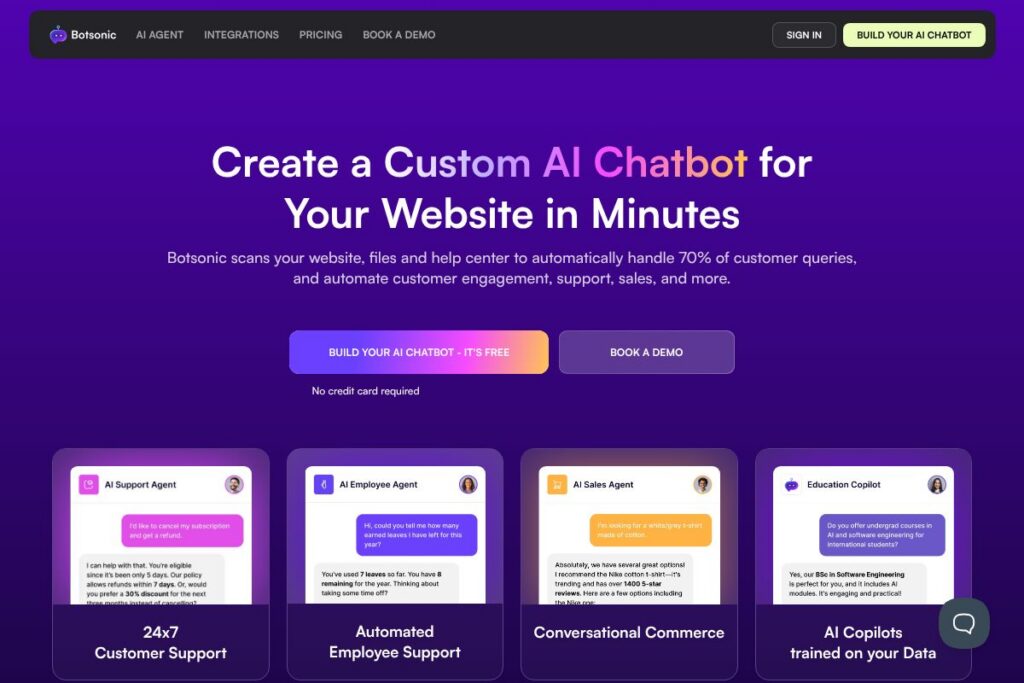
What is Botsonic
Botsonic is a no-code AI chatbot builder that ingests your website content, support articles, and documents to create conversational agents for web, messaging, and internal channels. It focuses on quick deployment, multilingual responses, and factual answers tied to your source data, rather than generic conversational output.
Compared with Intercom and Drift, Botsonic emphasizes knowledge-driven AI agents trained directly on a company’s content instead of centering on live chat and CRM features. Compared with Dialogflow and other developer-focused platforms, Botsonic reduces the need for engineering resources by providing a visual builder and instant training workflows. All of this makes Botsonic a practical option for teams that need fast, evidence-backed conversational automation rather than a fully custom NLU engineering project.
Botsonic does well at rapid knowledge ingestion, multilingual customer engagement, and connecting automated conversations to human handoff. It is well suited for customer support teams, marketing and sales squads that want conversational lead capture, and HR or internal IT groups that need quick access to company policies.
How Botsonic Works
The platform scans and indexes your website, help center, and uploaded documents to build a searchable knowledge base that drives the chatbot’s responses. You upload data, optionally label or redact sensitive fields, and initiate training so the agent can answer with citations to source content.
After training, you customize the bot’s behavior and appearance using a visual editor, set routing rules for handoffs, and choose which channels to activate such as web widgets, WhatsApp, SMS, or other messaging endpoints. Botsonic uses a model gateway to route requests among multiple LLMs, which helps balance latency and output quality while keeping you vendor-agnostic.
Operationally, conversations are monitored through analytics dashboards that track resolution rates, average handling time, and CSAT impact, and you can export audit logs for compliance checks. Live agent escalation is supported so complex queries move to humans with context preserved.
Botsonic features
Botsonic centers on knowledge-driven conversational AI, fast no-code setup, multilingual responses, and enterprise-grade security controls. Recent updates emphasize model-agnostic routing and more channel connectors to deploy bots across web and messaging platforms.
Knowledge ingestion and training
Botsonic automatically crawls sites and ingests documents so agents can answer from your content, with training completed in minutes for common workflows. This reduces manual intent mapping and helps the bot produce verifiable answers anchored to source material.
No-code visual builder
A drag-and-drop editor lets non-technical users shape conversation flows, message styles, and escalation rules without writing code, enabling business teams to iterate quickly. You can preview conversations and test variations before publishing to production.
Multichannel deployment
Agents can be deployed on a web widget and extended to messaging channels such as WhatsApp and SMS, enabling consistent conversational experiences across customer touchpoints. Channel connectors include routing and formatting options to match each platform’s requirements.
Model-agnostic routing (GPT Router)
The GPT Router manages multiple LLM providers and routes requests to the most appropriate model for speed and accuracy, improving reliability and allowing organizations to avoid single-vendor lock-in. This also enables fallback strategies if one model underperforms or experiences latency.
Enterprise security and compliance
Data encryption at rest and in transit, row-level workspace segregation, audit logging, and configurable retention policies provide controls required by compliance-focused teams. Botsonic offers SOC 2 Type 2 alignment and features to support GDPR and HIPAA-sensitive environments.
Analytics and resolution tracking
Conversation monitoring includes metrics for automated resolution rates, CSAT impact, and handoff frequency, which helps teams quantify ROI and iterate on knowledge content. Dashboards surface trending queries and gaps in the knowledge base.
With these capabilities, Botsonic aims to let companies build and operate knowledge-first chatbots quickly while maintaining enterprise controls and cross-channel reach.
Botsonic pricing
Botsonic uses a subscription-based model with tiered offerings and enterprise plans tailored to scale and security requirements. Public, detailed plan pricing is not posted in the material provided, so organizations typically evaluate needs for seat counts, message volumes, and enterprise features before choosing a plan.
For current pricing and plan comparisons, view the current pricing options on the Botsonic site or contact sales to get a quote tailored to your usage and compliance requirements.
What is Botsonic Used For?
Botsonic is commonly used for automated customer support where the chatbot resolves common questions directly from a company’s documentation, reducing agent load and improving first-contact resolution. It is designed to handle a large share of routine inquiries while routing complex cases to human agents.
Beyond support, Botsonic is used for conversational commerce to recommend products, qualify leads, and facilitate upsells across web and messaging channels. Internal use cases include employee help desks for HR and IT, onboarding assistants, and role-based copilots that surface policy or payroll information in the user’s language.
Pros and Cons of Botsonic
Pros
- Rapid knowledge training: The platform ingests website and document content and produces a trained agent in minutes, which reduces time to value and lowers the barrier for non-technical teams.
- Multichannel reach: Deployments on web, WhatsApp, SMS, and other channels let teams meet customers where they are and maintain consistent conversational behavior.
- Enterprise security posture: SOC 2 Type 2 alignment, AES-256 encryption, TLS 1.3 in transit, row-level data segregation, and audit logs address common compliance requirements.
- Model-agnostic routing: The GPT Router enables routing across multiple LLMs for resilience and improved output quality without vendor lock-in.
Cons
- Custom pricing for large deployments: Enterprise deployments require custom quotes, which means public price transparency is limited for organizations that want quick cost comparisons.
- Platform vs full CRM feature set: Compared with full customer engagement platforms, Botsonic focuses on conversational AI and knowledge automation; teams needing deep CRM or billing features may need additional tools.
- Dependence on source quality: Accuracy depends on the quality and structure of ingested documents; teams must maintain documentation to keep answers current.
Does Botsonic Offer a Free Trial?
Botsonic offers a free plan that lets teams build and test a basic AI agent, with paid plans unlocking higher volumes, advanced integrations, and enterprise controls. For details on limits, trial durations, and upgrade paths, check the current pricing options.
Botsonic API and Integrations
Botsonic provides developer-facing integration points and connectors for web widgets and messaging channels; you can use APIs and webhooks to exchange conversational context with backend systems. The API documentation outlines endpoints for message routing, user context, and conversation logs.
Key integrations include customer messaging platforms, CRM systems, and analytics tools so the bot can surface product data, create leads, and feed insights into existing workflows. The platform also supports single sign-on and enterprise identity integrations for secure deployments.
10 Botsonic alternatives
Paid alternatives to Botsonic
- Intercom — A customer messaging platform with chat, product tours, and CRM features focused on conversational support and sales workflows.
- Drift — A conversational marketing and sales platform that emphasizes lead qualification and routing conversations into sales pipelines.
- Zendesk — A customer service suite that includes bots, ticketing, and agent routing integrated with broader support operations.
- Ada — A no-code AI chatbot builder focused on automating customer service with prebuilt templates and analytics.
- HubSpot — Offers chatflows and conversational tools integrated into a broader CRM and marketing automation ecosystem.
- LivePerson — An AI-powered conversational cloud that integrates messaging, AI, and automation for customer care.
- Freshdesk (Freshchat) — Combines chatbots and human agent workflows inside a customer support platform with CRM integrations.
Open source alternatives to Botsonic
- Rasa — An open source conversational AI framework for teams that want full control over NLU pipelines and hosting.
- Botpress — A developer-friendly platform that provides a visual flow builder and on-premises hosting options for conversational bots.
- Chatwoot — An open source customer engagement suite with messaging channels and basic automation features.
- Rocket.Chat — While primarily a team chat platform, Rocket.Chat supports bot integrations and customizable conversational flows for internal support.
Frequently asked questions about Botsonic
What is Botsonic used for?
Botsonic is used to build AI chatbots trained on your website and documents for customer support, sales, and internal employee assistance. Organizations deploy agents to answer FAQs, route leads, and automate common workflows across channels.
Does Botsonic integrate with WhatsApp and SMS?
Yes, Botsonic supports deployment to messaging channels including WhatsApp and SMS. Channel connectors let you format responses per platform and maintain shared conversational context across channels.
How does Botsonic handle data privacy and compliance?
Botsonic offers encryption, row-level data segregation, audit logs, and configurable retention policies to meet compliance needs. The platform aligns with SOC 2 Type 2 controls and provides tools to support GDPR and HIPAA requirements.
Can Botsonic be used without technical resources?
Yes, Botsonic includes a no-code visual builder for creating and customizing bots. Non-technical teams can upload documents, train agents, and publish to channels with minimal engineering involvement.
Does Botsonic support multiple languages?
Botsonic supports responses in over 50 languages. Multilingual capabilities allow teams to serve global customers and localize conversation styles.
Final verdict: Botsonic
Botsonic is a practical choice for teams that need a fast, knowledge-first chatbot without heavy engineering overhead. Its strengths are rapid content ingestion, multilingual support, and enterprise security controls, combined with model-agnostic routing that improves reliability and output quality.
Compared with a vendor like Intercom, Botsonic leans more toward automated, knowledge-driven responses and a no-code training experience, while Intercom provides deeper CRM and live chat features. Pricing for Botsonic tends to be subscription-based with a free entry tier and custom enterprise quotes, so teams should evaluate usage needs and compliance requirements when comparing total cost and capabilities.
Overall, Botsonic is well suited for organizations that prioritize accurate, source-backed conversational answers and quick deployment across web and messaging channels, especially when multilingual support and enterprise security are required.