What is Dixa
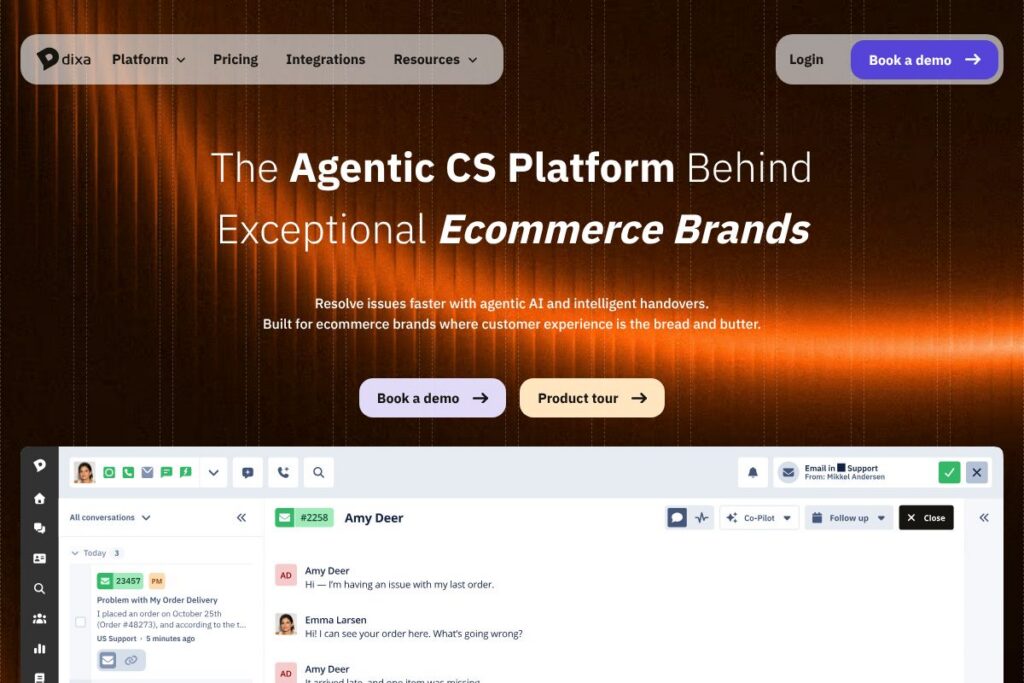
Dixa is an agentic customer service platform built for ecommerce brands, combining an AI agent (Mim) that resolves routine inquiries, intelligent routing that assigns conversations to the best person automatically, and a unified workspace that keeps order data and customer history in one place. It is purpose-built to reduce repetitive work, cut response times, and let teams handle spikes without proportional headcount growth.
Compared with traditional helpdesk tools like Zendesk, which treat customer contacts as tickets, Dixa focuses on live conversations and automatic routing so agents keep full context rather than switching between ticket queues. Against chat-first platforms such as Intercom, Dixa places more emphasis on backend actions for ecommerce workflows like refunds, order changes, and tracking. Compared with ecommerce-focused CRMs like Gorgias, Dixa emphasizes a single-screen agent workspace and visual automation for routing and QA across all channels.
All of this makes Dixa particularly strong at handling high-volume ecommerce workflows where transactions must be completed inside the support flow and teams need fast onboarding. It is best suited for fast-growing retailers, multi-brand operations, and teams that want to reduce manual triage and increase automation without sacrificing customer context.
How Dixa Works
Conversations from chat, email, phone, WhatsApp, and social channels arrive in a unified queue with full customer history and order context. Intelligent routing then evaluates skill, language, VIP status, and custom rules to send each conversation to the right agent or to the AI agent, reducing manual assignment.
Mim, Dixa’s autonomous AI agent, handles routine requests like refunds, tracking, and order modifications by connecting to your knowledge base and backend systems; it escalates and hands off complex issues with full context when human attention is required. Agents work from a single Team Hub screen where orders, loyalty status, and AI-suggested replies appear alongside conversation history, which shortens training time and decreases handling time.
Supervision and continuous improvement are handled by automated QA and analytics that score conversations against your criteria, surface trends, and highlight coaching opportunities so managers can act without manually sampling tickets.
Dixa features
Dixa’s core capabilities are organized around unified conversations, visual automation, agent productivity, and AI-driven resolution. The platform recently emphasized autonomous AI agents and auto-QA to reduce manual work while improving visibility across channels.
The platform includes several powerful capabilities worth highlighting:
Unified Conversations
All customer contacts across chat, email, phone, WhatsApp, and social channels appear in one place with a full activity history. That means customers avoid repeating themselves and agents retain context instantly, which reduces back-and-forth and shortens response time.
Dixa Conversation Engine (Workflow Automation)
Visual routing rules let teams route conversations by skill, language, priority, or custom attributes without coding. This reduces manual triage and allows teams to respond faster during peak periods by directing work automatically to the right queue or agent.
Dixa Team Hub (Agent Workspace)
Agents see orders, past conversations, loyalty status, and AI-suggested replies in a single view so they spend less time switching systems. The unified workspace accelerates onboarding and increases per-agent throughput by providing the right information at the point of reply.
Dixa Discover (Performance & QA)
Auto-QA scores every conversation against your criteria, surfacing trends and coaching opportunities without manual review. Managers can track quality and performance across teams and channels, and use the data to iterate on knowledge and routing rules.
Mim AI Agent
Mim resolves routine inquiries across chat and email end-to-end using your knowledge base and backend integrations, handling refunds, tracking lookups, and order changes autonomously. It hands off complex issues with the full conversation context intact, reducing repetitive work and ensuring continuity when agents take over.
AI Co-Pilot
AI assistance appears inside every conversation to suggest replies, improve drafts, translate messages, and surface relevant knowledge articles. Co-Pilot reduces cognitive load on agents and helps maintain consistent responses across the team.
With these capabilities Dixa reduces manual work while preserving conversational context and giving managers the analytics they need to improve operations.
Dixa pricing
Dixa offers flexible, enterprise-oriented pricing tailored to different business sizes and support needs; pricing is not published on a public pricing page. For plan details, feature comparisons, and custom quotes, view Dixa’s current pricing options on the Dixa website or contact their sales team to discuss requirements and implementation timelines.
What is Dixa used for
Dixa is used to manage customer conversations for ecommerce brands that need to handle refunds, order changes, tracking inquiries, and high contact volume across multiple channels. Teams use it to automate repetitive queries with Mim, route conversations to the right agents automatically, and provide agents with a single workspace containing order data and history.
It’s also used by multi-brand operators and retailers with seasonal spikes who need to scale support without a linear increase in headcount. Leaders use the platform’s Auto-QA and analytics to identify root causes of contacts and to measure the operational impact of automation and routing changes.
Pros and cons of Dixa
Pros
- Conversation-first routing: Routing happens at the conversation level and sends work to the best-available agent, which reduces context switching and improves resolution times.
- Autonomous AI agent: Mim resolves routine ecommerce tasks end-to-end, reducing load on human agents and enabling 24/7 handling for common inquiries.
- Unified agent workspace: Agents access orders, loyalty status, and conversation history in one screen, which speeds onboarding and lowers handle time.
- Auto-QA and analytics: Automatic scoring and trend detection save managers time and surface coaching opportunities without manual review.
Cons
- Enterprise-focused pricing model: The platform is optimized for growing ecommerce brands and may represent a larger initial investment compared with simple ticketing systems.
- Migration effort: Moving historical data and reconfiguring routing rules takes planning, so organizations should budget time for migration and optimization.
- Platform complexity for small teams: Small support teams with very low contact volume may not need the full breadth of automation and analytics Dixa provides.
Does Dixa Offer a Free Trial?
Dixa offers a free trial and demonstration options that let teams evaluate AI automation, routing, and the unified agent workspace with their own data and use cases. To arrange a demo or trial period that includes Mim and the Team Hub, contact Dixa’s sales team or request a trial through Dixa’s customer pages.
Dixa API and Integrations
Dixa provides API access and a library of prebuilt integrations so you can connect order systems, CRMs, ecommerce platforms, and analytics tools. Explore Dixa’s integration options and developer resources on the Dixa integrations and API pages to see supported connectors and endpoints.
Key out-of-the-box integrations typically include ecommerce platforms, shipping and order systems, and workplace tools so agents see orders and context inside the conversation. For bespoke integrations, the API documentation explains authentication, endpoints for conversation and user data, and webhooks for automation.
10 Dixa alternatives
Paid alternatives to Dixa
- Zendesk — A widely used ticketing and customer service platform with modular plans and an extensive app marketplace suitable for many business sizes.
- Intercom — Chat-first customer messaging platform with product-led growth workflows and in-app messaging features for conversational support.
- Gorgias — Ecommerce-focused helpdesk that integrates tightly with Shopify and other ecommerce platforms to handle refunds and orders from the agent screen.
- Freshdesk — Ticketing and automation platform that scales from small teams to enterprise with omnichannel support and workflows.
- Help Scout — Lightweight shared inbox and knowledge base platform designed for small-to-midsize teams focused on email-first support.
- Front — Shared inbox and collaboration layer for teams that need shared visibility across channels and tight agent collaboration.
- Gladly — Customer service platform that emphasizes customer profiles and long-lived conversations for retail and service brands.
- Salesforce Service Cloud — Enterprise-grade customer service solution with deep CRM integration and extensive customization for large organizations.
- Kustomer — Conversation-driven CRM and support platform oriented toward personalized service and workflow automation.
- HubSpot Service Hub — Support tools tightly integrated with HubSpot CRM and marketing automation for cross-team visibility.
Open source alternatives to Dixa
- Zammad — Open source helpdesk with ticketing, email integration, and a web-based agent interface that teams can self-host.
- osTicket — A widely used open source ticketing system with community plugins and self-hosting options for teams on a budget.
- Faveo Helpdesk — Open source helpdesk built for startups and SMBs with ticket management and knowledge base features.
- Helpy — Open source customer support platform focused on multichannel support and community-driven extensions.
Frequently asked questions about Dixa
What is Dixa used for?
Dixa is used to manage multi-channel customer conversations for ecommerce brands. It centralizes chat, email, phone, WhatsApp, and social interactions and adds routing, AI automation, and a unified agent workspace.
Does Dixa integrate with ecommerce platforms like Shopify?
Yes, Dixa integrates with common ecommerce platforms and order systems. Integrations surface order and customer data inside the agent workspace so agents can act within the conversation.
How does Dixa’s AI agent Mim work?
Mim resolves routine inquiries autonomously and hands off complex cases with full context. It learns from your knowledge base, performs refunds and tracking lookups, and reduces human intervention on repetitive tasks.
Can Dixa handle multiple brands from one account?
Yes, Dixa supports multiple brands and market configurations within a single platform. Each brand can have its own routing, knowledge base, and AI settings while sharing an agent pool and consolidated reporting.
How long does it take to implement Dixa?
Most customers implement and go live within two to four weeks. The platform emphasizes configuration by CX teams without developer involvement, and Dixa offers migration playbooks for common sources like Zendesk.
Final verdict: Dixa
Dixa stands out for combining autonomous AI resolution with conversation-first routing and a single-screen agent experience, which is particularly useful for ecommerce brands that need backend actions inside support flows. Its strengths include reducing repetitive work through Mim, visual routing that reduces manual triage, and automated QA that provides actionable insights without heavy manual review.
Compared with a traditional ticketing vendor like Zendesk, Dixa places more emphasis on automation and end-to-end conversational resolution rather than ticket volume management. For teams prioritizing automation and reduced headcount growth, Dixa’s approach can deliver operational savings, while organizations focused on basic ticket workflows may find established per-agent models from other vendors more familiar. For full pricing and product fit, contact Dixa to schedule a demo and trial tailored to your ecommerce operation.