IBM in a Nutshell
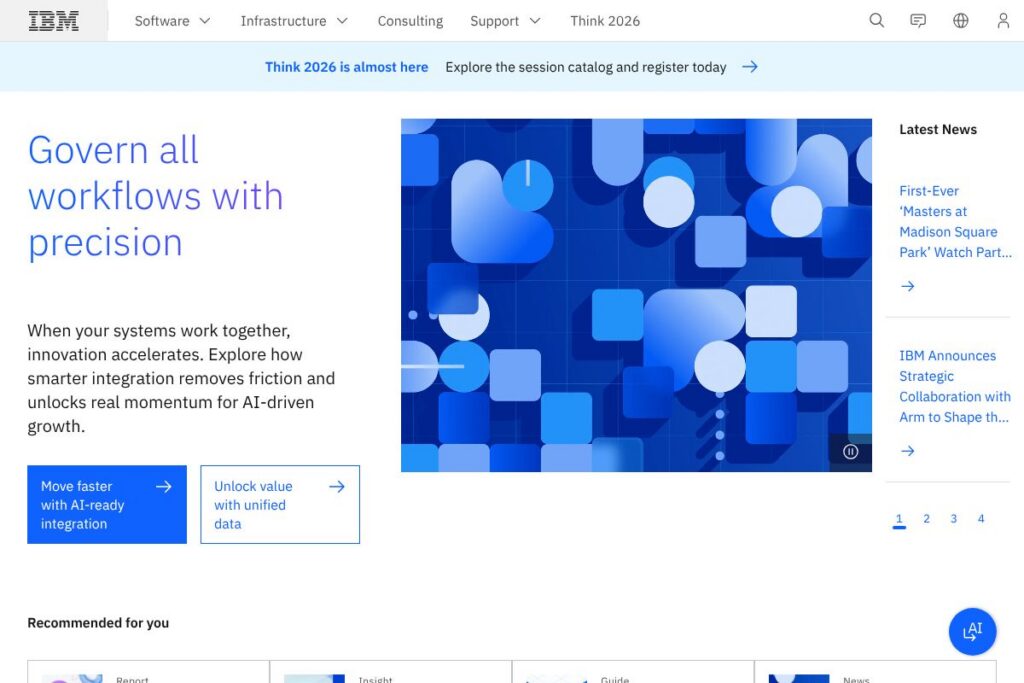
IBM is a global technology company that delivers a mix of software, cloud infrastructure, AI models, and professional services focused on enterprise needs. Its portfolio covers AI and automation, hybrid cloud infrastructure, data management, analytics, and security, combined with consulting and industry-specific solutions.
Compared with Microsoft and Amazon Web Services, IBM differentiates by emphasizing hybrid cloud and on-premise integration as well as deep industry consulting through IBM Consulting. Unlike Google Cloud, which emphasizes data analytics and open source-first tooling, IBM pairs platform offerings with hands-on systems integration and professional services for regulated industries.
IBM excels at delivering end-to-end enterprise solutions where integration, compliance, and consulting are required. This makes it a strong choice for large organizations seeking vendor support for complex migrations, regulated data environments, or hybrid cloud architectures.
How IBM Helps Enterprises
IBM brings together software platforms, prebuilt AI models, and consulting teams to help organizations design and operate large-scale systems. Typical engagements start with discovery and architecture, then proceed to build and deploy AI-enabled applications, data platforms, or hybrid cloud infrastructures.
Teams often use IBM Cloud and IBM Consulting together: IBM Cloud provides the infrastructure and platform services, while IBM Consulting handles integration, custom development, and operational runbooks. For example, enterprises modernize legacy workloads to run on hybrid infrastructure, then add governance and security controls through IBM security solutions.
IBM features
IBM’s core offering set centers on enterprise AI, hybrid cloud, data governance, and professional services. Recent focus areas include providing optimized business-ready AI models, tighter hybrid cloud management, and security and compliance tooling that work across on-premises and cloud environments.
AI productivity
IBM offers prebuilt AI models and tools for automating workflows, building intelligent agents, and generating business insights. These capabilities are designed to integrate with enterprise data sources so teams can automate routine tasks and speed decision-making.
Data management
The platform provides data integration, cataloging, and governance tools to unify data across environments and enforce policies. This supports trusted, real-time AI by ensuring data lineage, quality, and access controls for analytics and machine learning.
Security and governance
IBM includes security controls, identity services, and compliance tooling that operate across cloud and on-premises systems. These features help enterprises maintain regulatory compliance, respond to incidents, and implement consistent security policies.
Integration and resilience
Integration capabilities connect applications, data, and services across heterogeneous environments to create resilient, orchestrated systems. Built-in middleware and integration runtime help reduce custom integration code and improve reliability.
Hybrid infrastructure management
Tools for provisioning, monitoring, and managing hybrid cloud stacks let teams run workloads on public cloud, private cloud, and on-premises hardware. This supports workload portability and consistent operations across environments.
AI models
IBM provides business-ready AI models optimized for enterprise scale and compliance, with options for fine-tuning on private data. These models are offered alongside management APIs and deployment options suitable for production use.
Analytics
Analytics platforms enable dashboards, reporting, and embedded insights for operational and strategic decisions. They connect to governed data sources so analytics output can be traced and validated for accuracy.
Consulting
IBM Consulting works with clients to design, build, and operate custom solutions, from cloud migrations to AI strategy and industry-specific applications. Consulting engagements commonly include change management and managed services for long-term operations.
Training for what’s next
IBM offers professional and foundational training, as well as student pathways, to help teams develop cloud, AI, and data skills. Training options include certifications and role-based learning to support organizational adoption.
With these capabilities, the biggest benefit is that IBM bundles platform technology with consulting and training, enabling enterprises to adopt AI and hybrid cloud in a controlled, supported way.
IBM pricing
IBM uses enterprise and consumption-based pricing models that vary by product, deployment model, and service level. Pricing is typically customized for large deployments and enterprise agreements rather than published flat-rate consumer plans.
For specific pricing and licensing options, view IBM’s enterprise offerings on the IBM official site or contact IBM sales to get tailored quotes and volume discounts. Enterprise buyers should expect pricing to reflect factors such as deployment footprint, chosen service tiers, support levels, and any consulting engagement fees.
What is IBM Used For?
IBM is commonly used to modernize legacy systems, deploy hybrid cloud architectures, and build AI-driven applications that must meet enterprise security and compliance requirements. Industry use cases include financial services risk models, healthcare data platforms, manufacturing automation, and public sector data analytics.
Organizations also use IBM for large-scale data governance and analytics programs where trusted data management is essential, or when they need professional services to design and operate complex integrations across multiple vendors and environments.
Pros and Cons of IBM
Pros
- Broad enterprise portfolio: IBM offers integrated capabilities across AI, cloud, analytics, security, and consulting, enabling end-to-end programs without stitching together many vendors. This reduces vendor coordination for complex enterprise projects.
- Hybrid cloud focus: Deep tools and expertise for hybrid environments make IBM a strong choice when workloads must span on-premises and public cloud with consistent operations and governance.
- Industry consulting and compliance: IBM Consulting brings industry-specific experience and change-management services that accelerate deployments in regulated sectors and complex IT landscapes.
Cons
- Enterprise pricing and procurement: Enterprise-grade contracts and professional services can be complex and lead times for procurement and onboarding may be longer than cloud-native startups.
- Breadth can increase complexity: The wide range of products and services may require significant architectural decisions and vendor coordination, which can be a challenge for smaller teams without dedicated vendor management.
Does IBM Offer a Free Trial?
IBM offers a mix of free tiers and trial options for developer and cloud services while its enterprise offerings are typically paid. Developers can experiment with lightweight services using the IBM Cloud free tier, while enterprise solutions and consulting engagements are priced through tailored agreements.
IBM API and Integrations
IBM provides developer APIs and SDKs across many of its product lines, with API references and developer resources consolidated on the IBM Cloud API documentation and the IBM Developer site. These resources include endpoints for AI, data, and infrastructure services.
IBM integrates with a broad ecosystem of enterprise apps and platforms such as Slack, Salesforce, Microsoft Teams, SAP, and other common enterprise systems, enabling data and workflow connectivity across existing toolchains.
10 IBM alternatives
Paid alternatives to IBM
- Microsoft — Comprehensive cloud, AI, and productivity offerings with strong integration to Office 365, extensive hybrid cloud tooling, and clear per-service pricing models.
- Amazon Web Services (AWS) — Large portfolio of cloud infrastructure and managed services with a broad partner ecosystem and a pay-as-you-go pricing approach for compute, storage, and AI services.
- Google Cloud — Strong in data analytics and machine learning with open source-friendly tooling and scalable managed services for data platforms and AI workloads.
- Accenture — Global consulting firm focused on systems integration, managed services, and business transformation engagements for large enterprises.
- Oracle Cloud — Cloud infrastructure and enterprise applications with a focus on databases, ERP systems, and industry cloud suites.
- Salesforce — SaaS-first platform for CRM and customer data with expanding AI and integration capabilities for customer-facing processes.
- SAP — Enterprise applications and data management platforms tailored to ERP and industry-specific business processes.
Open source alternatives to IBM
- OpenStack — Open source platform for building private and hybrid clouds, commonly used by organizations that want full control over infrastructure.
- Kubernetes — Container orchestration for cloud-native workloads that supports hybrid deployments and a large ecosystem of tools for scaling applications.
- Apache Hadoop — Framework for distributed storage and processing of large data sets, still used for large-scale batch analytics and data lakes.
- TensorFlow — Open source machine learning library for building and deploying models, often used as a core component of custom AI stacks.
- Prometheus — Open source monitoring and alerting toolkit commonly used for observability in cloud-native deployments.
Frequently asked questions about IBM
What does IBM do for hybrid cloud?
IBM provides hybrid cloud platforms, tools, and professional services to run workloads across public cloud, private cloud, and on-premises environments. These include infrastructure management, workload portability tools, and consulting to design hybrid architectures.
Does IBM offer AI models for businesses?
Yes, IBM offers prebuilt and customizable AI models that can be deployed in enterprise environments. Models are provided alongside tooling for governance, deployment, and integration into existing data systems.
How much does IBM cost for enterprise solutions?
IBM uses tailored pricing for enterprise solutions and consulting engagements. Costs depend on product selection, deployment size, service tiers, and the scope of any consulting or managed services; contact IBM sales to request a quote.
Can IBM integrate with existing enterprise applications like Salesforce?
Yes, IBM integrates with common enterprise applications such as Salesforce, SAP, and collaboration platforms. Integration options include connectors, APIs, and middleware to link data and workflows across systems.
Does IBM provide training and certification?
Yes, IBM offers professional training, foundational skills courses, and certification paths for cloud, AI, and data roles. Training is available through structured programs and self-paced learning on the IBM training portals.
Final Verdict: IBM
IBM stands out for combining enterprise-grade technology with consulting and training, which helps organizations adopt AI and hybrid cloud in a governed and supported way. Its strength is in addressing complex, regulated, or industry-specific challenges where integration, compliance, and long-term operational support matter.
Compared with Microsoft, IBM emphasizes hybrid cloud integration and professional services, while Microsoft often provides more transparent per-service pricing and tighter integration with productivity suites. For organizations that need deep consulting and hybrid deployment expertise, IBM is a strong option; for teams preferring clearer per-service pricing and extensive SaaS integration, Microsoft may be more straightforward.
Overall, IBM is well-suited for large enterprises and public sector organizations that need a partner for complex modernization, regulated data programs, and production-grade AI deployments. For pricing and tailored engagements, contact IBM through their enterprise channels on the IBM official site.