What is Kahoot!
Kahoot! is a cloud-based platform for game-based learning that lets users create, host, and join interactive quizzes, polls, and lessons. It is used in classrooms, corporate meetings, and social gatherings to make instruction, training, and events more participatory through timed questions, leaderboards, and multimedia prompts.
Kahoot! competes with tools like Quizlet, Nearpod, and Mentimeter. Compared with Quizlet, which focuses on flashcards and individual study workflows, Kahoot! centers on live group participation and classroom-style engagement. Against Nearpod, Kahoot! is simpler to set up for quick formative checks but offers fewer built-in lesson sequencing and long-form content delivery tools. Compared with Mentimeter, Kahoot! emphasizes game mechanics and scoring while Mentimeter prioritizes presentation polling and open-ended feedback.
All of this makes Kahoot! particularly strong for instructors and presenters who want a low-friction way to run live, competitive activities that drive attention and quick feedback. It is well suited to K-12 and higher education teachers, corporate trainers who run interactive sessions, and families or friends who want playful quizzes.
How Kahoot! Works
Teachers or hosts build a kahoot by adding multiple-choice questions, true/false prompts, open-ended challenges, or polls, and can attach images, videos, and diagrams. Sessions run live in a browser or via the Kahoot! app where participants join with a game PIN on any device; hosts control pacing while participants answer on their phones or laptops.
Kahoot! also supports self-paced study modes where instructors assign kahoots as homework and track completion. For workplaces, presenters integrate kahoots into meetings or training modules to measure comprehension and gather instant feedback, with options to export results for reporting.
Kahoot! features
Kahoot! centers on interactive, multiplayer quizzes and learning games with authoring tools, templates, and media embedding. Core capabilities include live game hosting, self-paced challenges, library access to ready-made kahoots, reporting on participant responses, and integrations for classroom and workplace systems. The platform continues to add premium content and educator-focused resources to expand ready-to-run activities.
Quiz creation and templates
Create quizzes, surveys, and polls using a visual editor with support for images, video, and answer timers. Templates and curated kahoots speed authoring for common topics, and branching question types let hosts vary difficulty and engagement during sessions.
Live game hosting and player pacing
Run synchronous sessions where hosts control question flow and timing while participants compete or collaborate in real time. Leaderboards and points keep players engaged, and hosts can pause or repeat questions to manage pace during lessons or meetings.
Self-paced challenges
Assign kahoots as homework or asynchronous practice so learners complete activities on their own schedule. Self-paced mode captures scores and completion data which instructors can review for formative assessment and differentiation.
Reporting and analytics
After sessions, access response reports showing per-question performance, individual scores, and time-to-answer metrics. Reports help identify knowledge gaps, inform lesson planning, and provide evidence of learning over time.
Media-rich question support
Embed images, YouTube clips, and diagrams into questions to support visual learning and context-rich prompts. Multimedia questions increase engagement and allow instructors to test application and interpretation as well as recall.
Library of ready-made content and courses
Tap into a large repository of publicly shared kahoots and premium content for curriculum-aligned topics and corporate training modules. Ready-made content reduces prep time and provides examples for instructors who are new to game-based learning.
With these features, Kahoot! helps hosts deliver fast, repeatable interactive experiences that scale from small classroom activities to large live events.
Kahoot! pricing
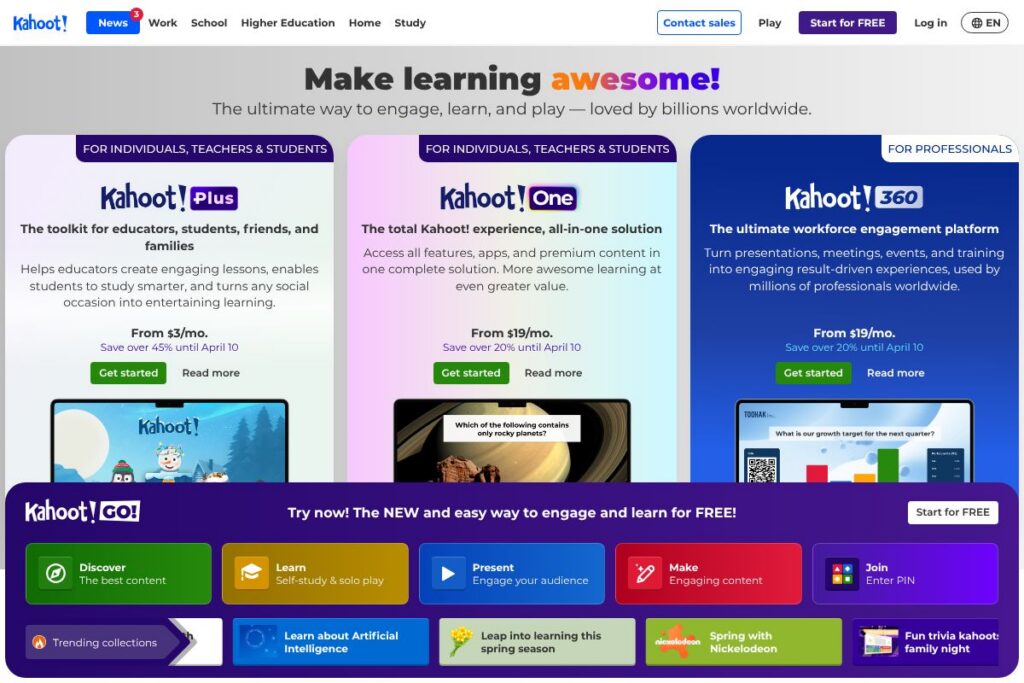
Kahoot! uses a subscription-based pricing model with a free tier and paid plans aimed at individuals, educators, and professionals. Paid plans start at $3/mo for basic paid features and rise for all-in-one or business-level subscriptions, with periodic promotional discounts available.
Individuals and educators
Individuals (Starter) – $3/mo (Basic quiz creation, play, and limited library access)
All-in-one (Full access) – $19/mo (Access to all apps, premium content, advanced reporting)
Professionals and workplaces
Professionals – $19/mo (Workplace features, meeting engagement tools, team access, advanced analytics)
Annual Billing:
Annual billing typically reduces the monthly effective cost for paid plans; promotional savings are often available during limited-time offers. For current plan options and any available discounts, check the Kahoot! homepage for up-to-date pricing and promotions.
What is Kahoot! Used For?
Kahoot! is used for live formative assessment in classrooms, helping teachers check understanding and make lessons interactive through quick quizzes and polls. Educators use it for warm-ups, exit tickets, unit reviews, and low-stakes practice that provides immediate feedback.
In the workplace, trainers and presenters use Kahoot! to break up meetings, run knowledge checks in training sessions, and increase participation at events. Families and social groups use it for trivia nights and casual learning games that are easy to set up and join on mobile devices.
Pros and Cons of Kahoot!
Pros
- High engagement through gamification: Kahoot! uses points, timers, and leaderboards which significantly increase participation and attention during live sessions.
- Low barrier to entry: Participants join via a simple game PIN on any device, and hosts can assemble a functional activity in minutes using templates and the ready-made library.
- Flexible modalities: Both synchronous live games and self-paced challenges are supported, so Kahoot! fits classroom, homework, and remote training workflows.
- Large content ecosystem: A broad library of publicly shared kahoots and premium course packs reduces preparation time for common topics.
Cons
- Limited depth for long-form lessons: Kahoot! is optimized for quick interactions rather than extended lesson sequencing or complex adaptive learning paths.
- Reporting depth varies by plan: Advanced analytics and roster integrations are typically gated behind paid tiers; smaller teams may find free reporting sufficient but limited for large-scale assessment.
- Potential classroom management overhead: Large live sessions with many players require clear rules and pacing from the host to avoid distraction.
Does Kahoot! Offer a Free Trial?
Kahoot! offers a free plan and time-limited promotions for paid tiers. The free tier allows creating and joining kahoots without a credit card, while paid subscriptions and promotional trials provide access to premium templates, expanded reporting, and additional content; visit the Kahoot! homepage to sign up and see current promotional offers.
Kahoot! API and Integrations
Kahoot! provides integrations for common education and workplace platforms, including Google Classroom and Microsoft Teams, and supports single sign-on for organizational accounts. Explore the Kahoot! integrations information on their site for details on connecting to learning management systems and productivity tools.
Some partner and developer resources are available for organizations that need deeper automation or custom integrations; contact Kahoot! sales or developer relations via their site to discuss API access and partner programs.
10 Kahoot! alternatives
Paid alternatives to Kahoot!
- Quizlet — Flashcards and study modes focused on individual learning, with student- and teacher-focused subscriptions for study and practice.
- Nearpod — Interactive lessons and assessments with slide-based delivery, ideal for teachers who want integrated lesson sequencing and student devices synced to a lesson.
- Mentimeter — Presentation polling and audience interaction tool that emphasizes open-ended feedback, word clouds, and live charts for meetings and events.
- Socrative — Real-time formative assessment tool focused on classroom quizzes and exit tickets with instant reporting for teachers.
- Poll Everywhere — Live audience polling and Q&A for events and classrooms, with rich presentation integration and enterprise-grade features.
- Gimkit — Game-based quiz platform with a focus on student engagement and in-game economy mechanics for classroom competition.
- AhaSlides — Interactive presentation slides with polls, quizzes, and Q&A features built for live audiences.
Open source alternatives to Kahoot!
- Moodle — Open source learning management system with quiz and activity modules that can be used to build interactive assessments and assignments.
- H5P — Open content standard for creating interactive HTML5 activities, including quizzes and interactive videos that can be embedded in LMSs like Moodle.
- Sakai — Open source learning platform offering assessments, quizzes, and collaborative tools for higher education.
- Chamilo — Open source e-learning platform with course creation and quiz functionality for small to medium organizations.
Frequently asked questions about Kahoot!
What is Kahoot! used for?
Kahoot! is used for live and self-paced interactive quizzes and learning games. Educators and presenters use it to increase engagement, run quick checks for understanding, and collect formative data.
Does Kahoot! have a free plan?
Yes, Kahoot! includes a free plan. The free plan allows creating, hosting, and joining basic kahoots without a credit card, with paid tiers unlocking premium content and advanced reporting.
Can Kahoot! integrate with Google Classroom or Microsoft Teams?
Yes, Kahoot! integrates with Google Classroom and Microsoft Teams. These integrations streamline rostering and assignment of self-paced kahoots and allow easier distribution to students and colleagues.
How does Kahoot! work in a classroom setting?
Kahoot! runs as live sessions or self-paced assignments. Teachers launch a session and students join with a PIN on their devices for real-time quizzes, or teachers assign kahoots for homework and review the results later.
Is Kahoot! suitable for corporate training?
Yes, Kahoot! is used for meetings, workshops, and training sessions. Professionals use it to increase participation, deliver knowledge checks, and gather instant feedback during events.
Final verdict: Kahoot!
Kahoot! excels at turning lessons and meetings into interactive, game-like experiences that boost attention and provide immediate feedback. Its low setup time, strong multiplayer mechanics, and library of ready-made content make it a practical choice for educators and presenters who need to run high-energy, formative activities.
Compared to Quizlet, which emphasizes independent study and flashcards and generally has lower-cost individual study subscriptions, Kahoot! at $3/mo focuses on live group engagement and classroom management features. For organizations prioritizing real-time competition and event-style interactions, Kahoot! offers a better out-of-the-box experience, while tools like Quizlet or Nearpod may be preferable for study-focused workflows or structured lesson sequencing.
Overall, Kahoot! is a reliable choice for anyone who wants to add playful, measurable interactivity to teaching, training, or social learning events. For current plan comparisons and promotional details, review the Kahoot! homepage.