What is LiveChat?
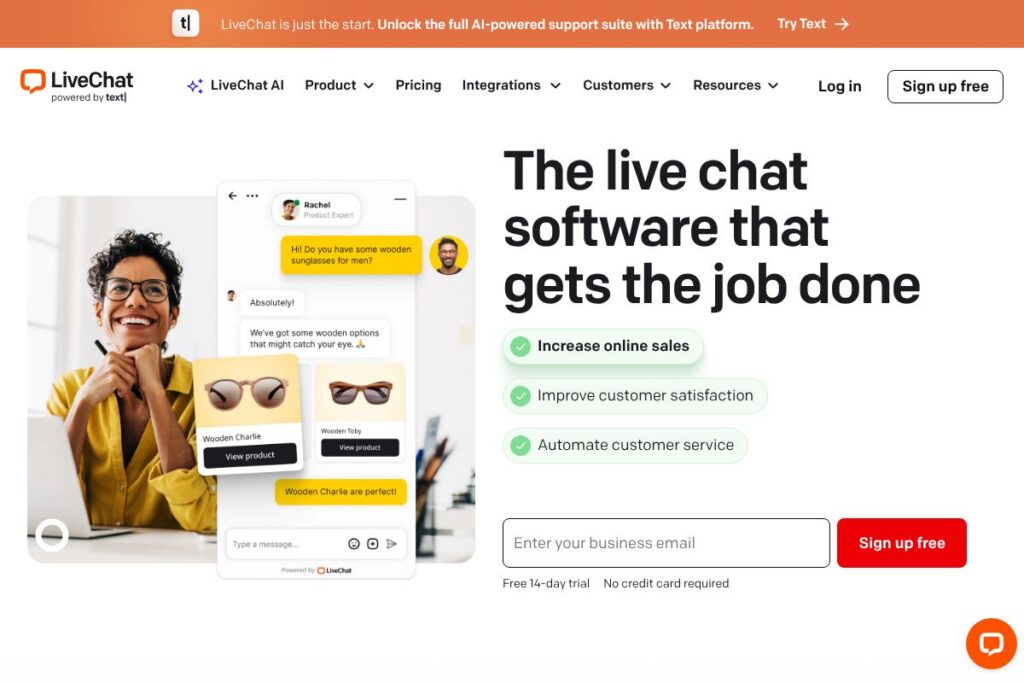
LiveChat is a customer messaging platform designed to provide real-time help on websites, combine automated conversations with human handoff, and connect chat activity to sales and support workflows. It runs as a web app, desktop app, and mobile app, and integrates with ecommerce platforms, CRMs, and marketing tools to keep customer context in one place.
Compared with Intercom, Zendesk, and Drift, LiveChat emphasizes a lightweight, fast-to-deploy chat widget and clear reporting for sales and support teams. Intercom offers a broad conversational marketing suite that blends product messaging with support, Zendesk bundles ticketing and omnichannel support at scale, and Drift focuses on conversational marketing for B2B lead generation; LiveChat positions itself between these options with simpler setup, ecommerce integrations, and AI add-ons.
All of this makes LiveChat a practical choice for online retailers, small to mid-size B2B teams, and support centers that need rapid deployment, good analytics, and a balance of automation and live agent control. It is particularly well suited to teams that want a dedicated live chat experience tuned toward increasing conversion and providing fast service.
How LiveChat Works
LiveChat provides a chat widget that you install on your website and a companion app your agents use to respond to messages. The widget captures visitor context, page history, and cart information so agents and bots can make personalized recommendations and resolve issues faster.
Automation is layered via chatbots and an in-app Copilot, which handle routine questions, qualify leads, or draft responses so agents can focus on higher-value conversations. Conversations, tags, and metrics sync with connected tools so reporting and follow-up happen without manual exports.
Typical workflows include proactive messages triggered by customer behavior, bot-first handling of common support queries with human escalation, and sales use cases where agents share product links, apply discounts, or guide purchase completion directly in chat.
What does LiveChat do?
LiveChat is organized around real-time messaging, AI-powered automation, ecommerce integrations, and analytics. Core capabilities include the website chat widget, chatbot automation via ChatBot, an in-app AI Copilot for agents, omnichannel messaging, and built-in reporting that shows response times, conversion impact, and agent performance.
The platform includes several powerful capabilities:
Chat widget and messaging
The chat widget supports proactive invitations, file sharing, canned responses, and custom branding so teams can start and manage conversations directly from the website. It also captures visitor metadata and session details that agents can use to personalize support and sales outreach.
ChatBot automation
ChatBot integration lets you route common questions to bots, collect lead data, and escalate to humans when needed, reducing repetitive work for agents and keeping response times low. Bots can be configured for product recommendations, returns handling, and FAQ resolution.
AI Copilot for agents
Copilot offers in-app suggestions, response drafting, and quick context summaries so agents handle conversations faster with consistent messaging. It helps newer agents maintain quality and speeds up replies for recurring requests.
Omnichannel routing
LiveChat aggregates chats from your website, Facebook Messenger, Instagram, and other channels into a single agent workspace so teams manage messages without switching tools. That centralized inbox reduces response fragmentation and simplifies ownership.
Ecommerce integrations
Pre-built integrations with platforms like Shopify, WooCommerce, and Magento surface order and cart data inside chats so agents can recommend products, check order status, and complete sales without leaving the conversation. These connections enable measurable sales uplift when agents intervene at the right moment.
Reporting and analytics
Real-time and historical reports track metrics such as response time, chat volume, conversion rate from chat, and agent ratings, making it straightforward to measure ROI and operational efficiency. Reports can be used to optimize staffing, script updates, and proactive campaigns.
Security and compliance
LiveChat supports access controls, audit logs, and data handling practices suitable for business use, and it can be configured with additional security options for enterprise needs. These controls help teams meet internal policies and regulatory requirements.
With a mix of synchronous messaging, automation, and analytics, LiveChat’s biggest benefit is enabling teams to turn website conversations into measurable sales and improved customer satisfaction without heavy engineering work.
LiveChat pricing
LiveChat uses a subscription-based SaaS pricing model with an entry-level option and custom enterprise plans, and it offers a trial period so teams can evaluate the platform before committing. The vendor highlights a starting monthly price and provides enterprise-level pricing and support for larger deployments.
Monthly Billing:
Starting plan: – $19/mo (entry-level live chat features, 14-day free trial, basic integrations and reporting)
Annual Billing:
Annual subscriptions are available and generally reduce the effective monthly cost compared with monthly billing; exact annual rates and savings depend on selected plan and seat count. For details, view LiveChat’s current pricing options on their website.
Enterprise
Enterprise: Custom pricing (advanced security, single sign-on, dedicated onboarding, priority support, and volume discounts). For enterprise needs contact LiveChat through their enterprise request form to get a tailored quote.
What is LiveChat Used For?
LiveChat is commonly used for ecommerce conversion optimization, where agents and bots engage shoppers, answer product questions, and guide visitors through checkout. Teams see value from proactive chat invites, targeted product suggestions, and cart recovery flows that reduce abandonment.
B2B sales and lead qualification are other frequent uses, with chat used to capture contact data, schedule meetings, and qualify prospects before handing them to a sales rep. Support teams use LiveChat to provide instant responses to technical or account questions while keeping ticketing and post-chat follow-up organized.
Smaller businesses use LiveChat as a single customer communication hub, connecting website chat to email, social messaging, and helpdesk systems so staff can manage all inbound conversations in one place.
Pros and Cons of LiveChat
Pros
- Fast setup and ease of use: LiveChat installs quickly on most websites and the agent interface is intuitive, which reduces ramp time for small teams and non-technical users.
- Ecommerce-friendly integrations: Deep connections to platforms like Shopify and WooCommerce surface cart and order data inside chats, making it easier to close sales and provide order-specific support.
- AI automation plus human handoff: The combination of chatbots and an in-app Copilot lowers routine workload while letting agents handle complex queries with context.
- Clear reporting for ROI: Built-in analytics show conversion impact and agent performance, which helps justify investments in staffing and chat campaigns.
Cons
- Feature depth vs enterprise suites: Larger organizations that need extensive workflow automation or custom reporting may find the built-in features less comprehensive than a full support suite such as Zendesk.
- Potential cost at scale: Pricing grows with seats and add-ons, and high-volume or enterprise deployments may require a custom plan to include advanced security and SLAs.
- Dependence on integrations for some workflows: Certain workflows rely on third-party integrations; teams without developer support may need help connecting complex systems.
Does LiveChat Offer a Free Trial?
LiveChat offers a 14-day free trial with no credit card required. The trial provides hands-on access to the chat widget, basic integrations, and reporting so teams can validate conversion and support workflows before purchasing.
LiveChat API and Integrations
LiveChat provides a developer API and an extensible integrations marketplace so teams can connect chat activity with CRMs, ecommerce platforms, and automation tools. The LiveChat API documentation describes endpoints for conversations, visitors, and webhooks to automate workflows.
Key integrations include ecommerce platforms, Slack for agent notifications, CRM systems for contact sync, and social messaging channels to centralize conversations. For automation and bot workflows explore the ChatBot integration options and the LiveChat apps marketplace to see pre-built connectors.
10 LiveChat alternatives
Paid alternatives to LiveChat
- Intercom — Conversational platform that combines support, product messaging, and marketing automation for customer engagement.
- Zendesk — Comprehensive helpdesk and omnichannel support suite with ticketing, chat, and robust reporting for enterprise teams.
- Drift — Conversational marketing and sales-focused chat platform designed for B2B lead qualification and account-based engagement.
- Freshdesk — Freshworks’ customer support platform with multichannel inbox, chat, and ticketing aimed at small and mid-size teams.
- Tidio — Chat and chatbot platform tailored toward ecommerce stores with easy setup and affordable pricing.
- Olark — Simple live chat tool focused on straightforward chat features and team collaboration.
- Help Scout — Email-first helpdesk with a shared inbox, chat add-on, and robust knowledge base features for support teams.
Open source alternatives to LiveChat
- Rocket.Chat — Open source team chat and customer messaging platform that can be self-hosted and customized for privacy and control.
- Chatwoot — Open source customer engagement suite with multichannel messaging, conversation assignment, and automation rules.
- Mibew Messenger — Lightweight open source live chat that can be self-hosted for simple website chat use cases.
- LiveHelperChat — Self-hosted open source chat with visitor tracking and basic ticketing features.
Frequently asked questions about LiveChat
What is LiveChat used for?
LiveChat is used for real-time customer support and sales on websites. Teams use it to answer questions, guide purchases, qualify leads, and reduce response times across channels.
Does LiveChat offer an API?
Yes, LiveChat provides a developer API. The LiveChat API documentation includes endpoints for conversations, visitors, agents, and webhooks to integrate chat data with other systems.
How much does LiveChat cost per month?
LiveChat starts at $19/month for the entry-level plan. Enterprise pricing is custom and varies by seat count, required features, and support level; request a quote through LiveChat’s enterprise contact options.
Can LiveChat handle ecommerce orders and carts?
Yes, LiveChat integrates with major ecommerce platforms. Integrations surface cart and order context inside chats so agents can recommend items, check order status, and assist with checkout.
Is LiveChat suitable for small businesses?
Yes, LiveChat is suitable for small businesses and mid-size teams. Its quick setup, trial access, and ecommerce integrations make it practical for merchants and service providers looking to add real-time support and increase conversions.
Final verdict: LiveChat
LiveChat is a focused live chat and messaging platform that does real-time website conversations, AI-assisted automation, and ecommerce integrations well. Its combination of a fast-to-deploy widget, ChatBot automation, and in-app Copilot gives smaller teams an accessible path to both faster support and measurable sales impact.
With a starting price of $19/month and a 14-day trial, LiveChat is priced competitively for teams that need straightforward chat features without the complexity of larger suites. Compared with Intercom, which bundles wider conversational marketing and product messaging features and typically carries a higher entry price as teams scale, LiveChat provides a lower-cost on-ramp and a clear upgrade path toward enterprise features when needed.
Overall, LiveChat is a strong choice for ecommerce merchants, B2B sales teams, and support groups that want reliable real-time messaging, practical automation, and clear reporting without heavy engineering overhead. For enterprise buyers who require advanced workflows or custom SLAs, engaging LiveChat’s enterprise team will surface the right options and pricing.