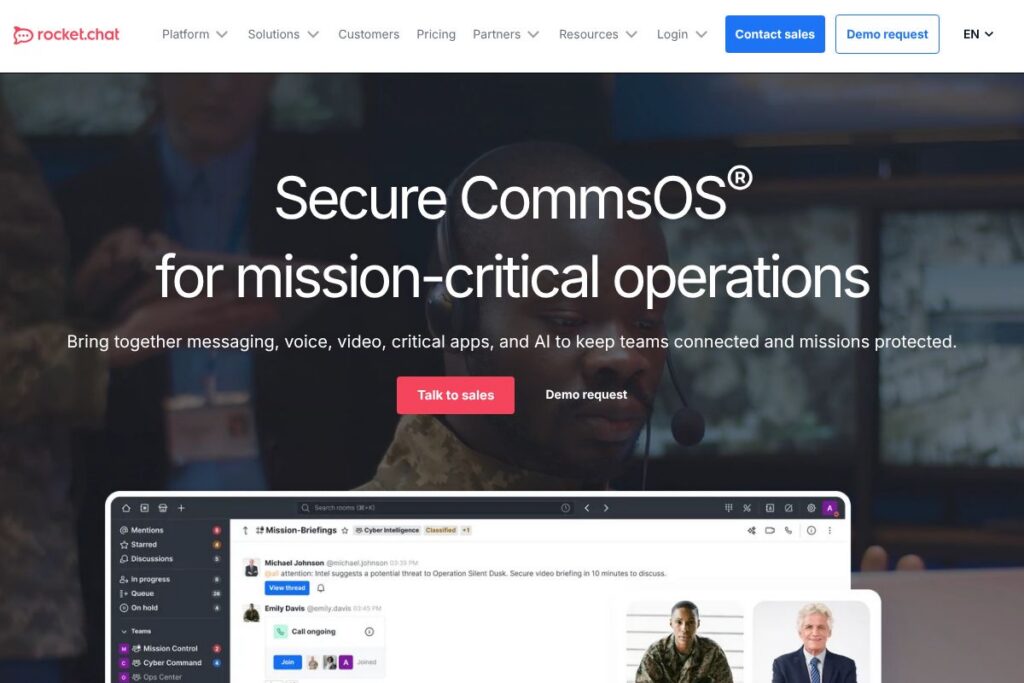
Rocket.Chat Explained
Rocket.Chat is a communications platform that brings messaging, voice, video, app integrations, and AI capabilities into a single, extensible environment. It supports both self-hosted and cloud deployments, and provides tools for secure, auditable conversations across internal teams and external partners, including support for federated messaging and fine-grained access controls.
Compared with Slack and Microsoft Teams, Rocket.Chat emphasizes deployment flexibility and control over data since teams can self-host and run the platform inside their own networks. Compared with Mattermost, Rocket.Chat provides core federation capabilities and an integrated voice and video stack out of the box, making it a stronger fit where cross-organization coordination is required.
What Rocket.Chat does especially well is enable secure, cross-boundary collaboration for regulated or mission-critical operations where data sovereignty, auditability, and federation matter. It is a good fit for government agencies, defense and public safety organizations, healthcare providers, and enterprises that require custom integrations or offline/on-premise deployments.
How Rocket.Chat Works
Rocket.Chat operates as a unified communications layer that connects users through channels, direct messages, and threaded conversations. It exposes REST and real-time APIs plus SDKs so developers can embed chat, voice, and video into existing apps or build custom workflows and bots using the platform’s event and webhook model.
Teams typically deploy Rocket.Chat either on their own infrastructure for maximum control or use Rocket.Chat’s cloud hosting for faster onboarding. Common workflows include secure mission rooms for joint operations, federated channels between partner domains for cross-organization coordination, and automation pipelines where AI or bots summarize conversations and surface actionable items.
Rocket.Chat features
Rocket.Chat’s feature set focuses on real-time collaboration, security, federation, and extensibility. Core capabilities include chat channels, voice and video conferencing, role-based access controls, federation across servers, developer APIs and SDKs, and built-in support for bot automation and AI-assisted workflows.
Let’s talk Rocket.Chat’s Features
Real-time Chat and Threading
Channels, direct messages, and threaded replies let teams organize conversations by topic or mission. Fine-grained permissions and moderation tools help manage participation and visibility across internal and external stakeholders.
Voice and Video Conferencing
Integrated voice and video provide one-click calls from chat, support for multi-party meetings, and recording options where permitted. Embedding calls directly into chat reduces context switching and keeps mission data within the same platform.
Federation and Cross-Domain Messaging
Federation enables secure, auditable channels between separate Rocket.Chat servers so different agencies or partners can exchange messages without consolidating data into a single tenant. This supports joint decision-making while preserving local control over logs and compliance.
Security and Compliance Controls
Role-based access control, SAML/OAuth integration, single sign-on, audit logging, and encryption options support regulatory and operational requirements. Administrators can configure retention policies and exportable audit trails for incident reviews and compliance reporting.
Extensibility, Apps, and SDKs
A marketplace of pre-built apps and a developer framework let teams extend the platform with custom integrations, slash commands, and UI customizations. SDKs for web and mobile make embedding chat capabilities into other systems straightforward.
Bot Automation and AI Features
Built-in bot support and connectors to AI services automate routine tasks, summarize threads, and surface relevant intelligence from conversations. Automations reduce manual handoffs and accelerate decision cycles during high-tempo operations.
Deployment Flexibility
Deployments can be self-hosted on private infrastructure, run in private cloud environments, or consume Rocket.Chat’s managed cloud offerings. This flexibility helps organizations meet data residency, network isolation, or offline operation requirements.
With these capabilities Rocket.Chat is particularly strong at providing a single platform for secure, auditable communication that can be tailored to strict operational and compliance needs.
Rocket.Chat pricing
Rocket.Chat offers an open-source core that can be self-hosted without licensing fees, plus commercial hosting and enterprise support packages with custom pricing tailored to organizational needs. The open-source option is useful for teams that want to avoid per-seat licensing and retain full control over data and infrastructure.
For enterprise-grade SLAs, managed hosting, advanced compliance features, and commercial support, Rocket.Chat publishes details via its enterprise contact channels and product pages; view the enterprise offerings to request a quote or discuss deployment options. For developer and deployment details consult the official documentation to compare feature sets between the Community edition and commercial plans.
What is Rocket.Chat Used For?
Rocket.Chat is used for secure team collaboration, cross-organization coordination, and embedding communication into business or mission workflows. Teams use it to create mission rooms for incident response, set up federated channels with partner organizations, and deliver operator-to-operator voice and video links without exposing data to third-party SaaS that they do not control.
It is also used by customer service and development teams to consolidate conversations, host bots that automate tasks, and connect workflows to CI/CD, monitoring, and case management systems. Organizations that require audit logs, retention policies, or specialized authentication commonly choose Rocket.Chat for the control it offers.
Rocket.Chat’s Benefits and Limitations
Pros
- Deployment flexibility: Rocket.Chat can be self-hosted, run in private cloud, or used as a managed cloud service, which lets organizations meet data residency and isolation requirements.
- Federated communications: Federation supports secure channels between independent servers, enabling collaboration across agencies and partner organizations while preserving local control.
- Extensible platform: A developer-friendly API, SDKs, and an app framework allow teams to build custom integrations, bots, and workflows that match operational processes.
- Open-source core: The Community edition provides a cost-effective way to run a fully functional communication stack without per-seat licensing, and source code access supports deep customization.
Cons
- Enterprise feature gap for out-of-the-box SaaS: Organizations seeking a turnkey SaaS experience with per-seat billing and polished workspace management may find some SaaS competitors provide faster setup out of the box.
- Operational overhead for self-hosting: Self-hosting requires internal expertise to manage scaling, backups, high availability, and security hardening, which can increase operational burden for smaller teams.
- Commercial support needed for mission SLAs: To secure enterprise-level SLAs, advanced compliance features, and priority support, organizations typically must purchase commercial plans or managed services.
Does Rocket.Chat Offer a Free Trial?
Rocket.Chat offers a free Community edition for self-hosting and commercial trials or pilot programs for its hosted and enterprise services. The Community edition is available for download and deployment, while the managed cloud and enterprise offerings can be trialed or piloted by contacting sales to arrange time-limited access and evaluation environments.
Rocket.Chat API and Integrations
Rocket.Chat provides REST and real-time APIs as well as client SDKs for web and mobile that let teams integrate chat, calls, and notifications into other systems. The API documentation describes endpoints for user management, messaging, presence, and webhooks.
Common integrations include identity providers (LDAP, Active Directory, SAML, OAuth), single sign-on systems, CI/CD and incident tools, and third-party business systems for CRM and case management. Webhooks and a marketplace of apps make connecting to services like Google Workspace, Salesforce, and monitoring platforms straightforward.
10 Rocket.Chat alternatives
Paid alternatives to Rocket.Chat
- Slack — A SaaS-first team messaging platform with a large app ecosystem, per-seat pricing, and strong integrations for cloud-native teams.
- Microsoft Teams — Part of Microsoft 365, integrates tightly with Office apps, Exchange, and Azure Active Directory for identity and compliance needs.
- Zoom — Primarily a conferencing platform, used alongside chat for real-time meetings and large-scale webinars with robust video performance.
- Cisco Webex — Enterprise conferencing and collaboration suite with strong emphasis on security, hardware integration, and global support.
- Twilio (Programmable Chat / Flex) — A communications platform-as-a-service that teams can use to build custom chat and contact center experiences with usage-based pricing.
- Google Chat (part of Google Workspace) — Integrated chat for organizations that use Google Workspace, with direct ties to Drive, Meet, and Calendar.
Open source alternatives to Rocket.Chat
- Mattermost — An open-source messaging platform focused on developer and operations collaboration, with self-hosted and enterprise editions.
- Matrix / Element — A decentralized, open standard for real-time communication; Element is a client that supports federation across Matrix homeservers.
- Zulip — Open-source chat with a unique threading model that helps manage high-volume conversations for engineering and support teams.
- Jitsi — Open-source video conferencing focused on secure, self-hosted meetings and integration into existing chat platforms.
- Nextcloud Talk — Part of the Nextcloud ecosystem, provides self-hosted audio, video, and messaging tightly integrated with file sharing and collaboration.
Frequently asked questions about Rocket.Chat
What is Rocket.Chat used for?
Rocket.Chat is used for secure team and cross-organization communication. Organizations use it to run chat, voice, and video services with full control over data, compliance, and integrations.
Can Rocket.Chat be self-hosted?
Yes, Rocket.Chat can be self-hosted. The Community edition is available for on-premise deployment and private cloud installations to meet data residency and network isolation requirements.
Does Rocket.Chat provide an API for developers?
Yes, Rocket.Chat exposes REST and real-time APIs and provides SDKs. Developers can use the API documentation to build integrations, bots, and embedded messaging experiences.
Does Rocket.Chat support federation between organizations?
Yes, Rocket.Chat supports federated channels between independent servers. Federation enables secure, auditable exchanges across partner organizations while preserving local control of logs and policies.
How does Rocket.Chat handle enterprise support and SLAs?
Enterprise support, managed hosting, and SLAs are available through Rocket.Chat’s commercial offerings. Organizations seeking guaranteed response times, compliance features, or managed deployments should contact the enterprise team via the enterprise offerings page.
Final Verdict: Rocket.Chat
Rocket.Chat stands out as a communication platform for organizations that need strong control over data, flexible deployment, and federation across partners. Its open-source core combined with commercial hosting and enterprise support offers a path from experimental self-hosting to production-grade, SLA-backed deployments without forcing teams into a strictly SaaS-only model.
Compared with Slack, which is primarily a cloud SaaS with per-seat licensing and a polished out-of-the-box experience, Rocket.Chat provides more options for self-hosting and federation, which can reduce licensing costs and improve data residency control for regulated organizations. If your priority is strict operational control, cross-domain federation, and the ability to customize the platform deeply, Rocket.Chat is a strong candidate; if you prefer a fully managed SaaS experience with minimal operational overhead, a SaaS-first competitor may be a better fit.