Tidio: An Overview
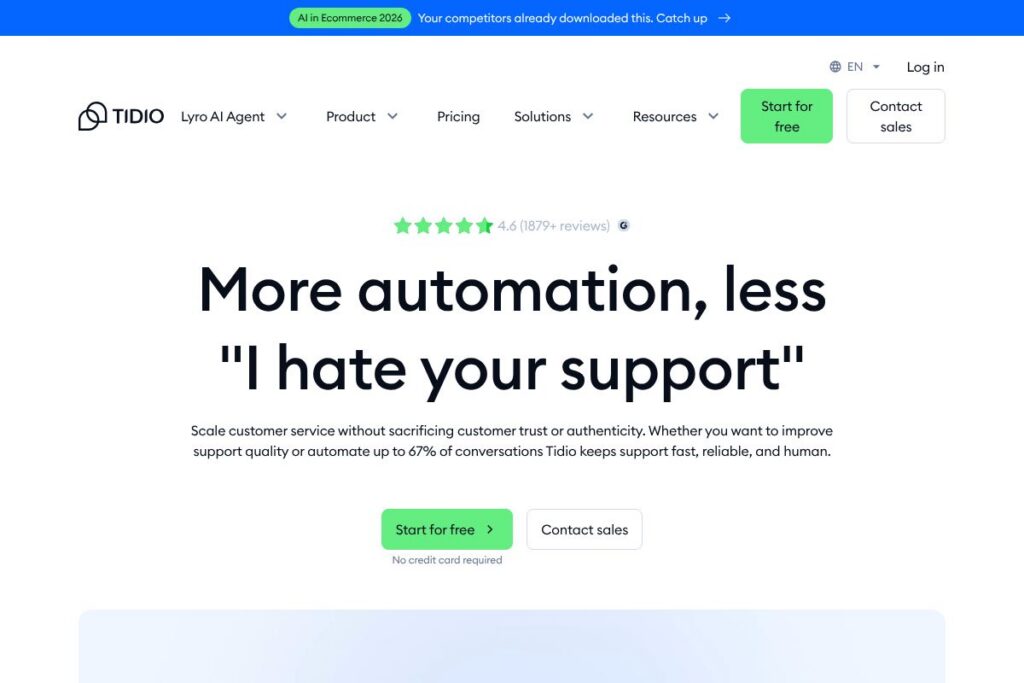
Tidio is a customer service platform that pairs a trainable AI agent with live chat and help desk tools to automate routine support while preserving a human tone. The platform emphasizes trustworthy, brand-aligned responses via its Lyro AI agent, a unified inbox for agents, and proactive automations to capture leads and resolve issues without manual intervention. Tidio positions itself for teams that want automation without sacrificing customer trust, and for businesses aiming to reduce repetitive workload while keeping agents focused on higher-value interactions.
Tidio competes directly with customer service platforms such as Zendesk, Intercom, and Freshdesk. Compared with Zendesk, Tidio is often chosen for faster live chat setup and tighter chatbot to live chat handoff. Compared with Intercom, Tidio focuses more on alignment between its AI agent and help desk workflows rather than building an all-in-one growth platform. Compared with Freshdesk, Tidio puts more emphasis on conversational automation and a friendly live chat experience for small to mid-market teams.
What Tidio does particularly well is combine a trainable AI assistant with an agent-centered help desk, so automation improves without breaking brand voice. This makes it a practical choice for ecommerce, SaaS, and small to medium support teams that want to automate high-volume requests while keeping complex or high-value customers handled by humans. Explore Tidio’s homepage to see product demos and feature overviews.
How Tidio Works
Lyro, Tidio’s AI agent, is added to your existing setup and trained on verified sources such as help articles, order histories, and custom guidance to ensure answers stay accurate and brand-aligned. The AI handles common queries automatically and escalates complex conversations to human agents, preserving conversation context so handoffs feel seamless.
Agents work from a shared inbox and help desk interface that consolidates chat, email, and form submissions, while Flows and Smart Actions automate outreach, lead capture, and routine responses. Typical workflows include automated order status replies, pre-qualifying leads with pre-chat forms and sequences, and routing priority tickets to senior agents for personal follow-up.
What does Tidio do?
Tidio bundles conversational AI, live chat, and help desk features to reduce manual support workload and improve response quality. Core capabilities focus on automation, omnichannel message routing, and an agent workspace that combines AI suggestions with human oversight.
Here are some key features worth highlighting:
Lyro AI Agent
Lyro is a trainable conversational AI that uses verified company data to generate responses in your brand voice. It provides suggestions to agents, can act autonomously on straightforward queries, and surfaces improvement tips to raise CSAT and resolution effectiveness.
Shared Inbox and Help Desk
A unified workspace consolidates live chat conversations, email threads, and support tickets so agents see context and history in one place. The help desk supports tags, internal notes, and SLA-like workflows to keep tickets organized and priorities clear.
Flows and Proactive Automations
Flows let you design decision trees and automated sequences for qualification, lead capture, and re-engagement. Smart Actions and time-based automations increase conversion opportunities and ensure no lead or query is missed when agents are offline.
Live Chat Widget and Offline Capture
Customizable chat widgets collect visitor data, trigger targeted messages, and capture messages while your team is offline. Widgets can route visitors into the right Flows or queue them for human follow-up when an agent becomes available.
Integrations and Connectors
Tidio connects to a wide range of systems including ecommerce platforms, CRMs, and email tools to pull verified data for Lyro and sync conversations across systems. The integrations make it possible to use order status, customer records, and product catalogs to improve response accuracy.
Analytics and Resolution Guarantees
Built-in reporting tracks response times, resolution rates, and CSAT to measure automation performance. Tidio highlights its industry-leading resolution rate and offers support for optimizing agents and automations to increase effectiveness.
Overall, Tidio’s biggest benefit is blending an AI agent with agent-centric tools so automation improves throughput without degrading the quality of customer interactions. That combination helps teams reduce repetitive work, improve first-contact resolutions, and keep support aligned with brand tone.
Tidio Pricing
Tidio uses a subscription-based SaaS model with tiered plans and add-ons to match different business sizes and needs; specifics and current plan details are available on the Tidio pricing overview. For businesses evaluating fit, the vendor’s site provides plan comparisons, feature breakdowns, and enterprise options for higher volume or bespoke support needs.
What is Tidio Used For?
Tidio is commonly used for automating routine customer inquiries such as order tracking, FAQ answers, and basic troubleshooting, freeing agents to focus on complex issues and high-value customers. Marketing and sales teams also use Tidio’s proactive automations and chat flows to capture leads and book calls when the site is busy or agents are offline.
Ideal users include ecommerce stores that need fast order and shipping responses, SaaS companies that want to scale support without growing headcount linearly, and small to mid-sized businesses seeking a single platform to combine chatbots, live chat, and ticketing. The platform suits teams that prioritize customer trust and need an AI agent that can be trained on internal resources.
Tidio’s Benefits and Limitations
Pros
- Trainable AI agent: Lyro can be aligned with verified data sources to produce reliable answers and maintain brand voice, which reduces incorrect or off-brand responses.
- Unified agent workspace: The shared inbox and help desk bring chat, email, and ticketing together, making handoffs and context retention straightforward for agents.
- Proactive automations: Flows and Smart Actions capture leads, book calls, and reply when agents are offline, increasing conversion opportunities without human intervention.
- Fast setup and integrations: Prebuilt connectors and a lightweight chat widget allow teams to get started quickly and integrate with CRMs and ecommerce platforms.
Cons
- Limited advanced reporting for some teams: Organizations needing enterprise-grade analytics and custom dashboards may find reporting less flexible than dedicated analytics platforms.
- Customization may require extra work: Creating highly tailored AI guidance or complex Flows can require time or professional services to reach peak performance.
- Enterprise features by request: Large organizations with strict compliance or advanced security needs may need a custom enterprise plan to access the required features.
Does Tidio Offer a Free Trial?
Tidio offers a free plan with basic chat and chatbot features, and paid plans or trials are available for teams that need advanced AI, automation, or higher message volumes. The free tier lets you test core conversational features, while paid tiers add more automation, Lyro training capacity, and advanced integrations; see current pricing options for plan limits and trial availability.
Tidio API and Integrations
Tidio provides an integrations directory and developer tools to connect the chat widget and AI to CRMs, ecommerce platforms, and analytics systems. Visit the Tidio integrations catalog to review supported connectors and common use cases.
For teams that need custom automations or data syncs, Tidio exposes developer endpoints and webhook support; the developer documentation outlines available APIs, event hooks, and examples for building custom flows or syncing customer data.
10 Tidio alternatives
Paid alternatives to Tidio
- Zendesk — A broad customer service suite with ticketing, messaging, and enterprise workflow tools suitable for larger support organizations.
- Intercom — Conversational platform that combines product tours, messaging, and a bot-first approach for customer engagement and support.
- Freshdesk — An integrated help desk with ticketing, automation, and multichannel support designed for growing support teams.
- Drift — Focused on conversational marketing and sales, with chatbots that route leads to sales reps and book meetings.
- HubSpot Service Hub — A service-focused offering that ties tickets, knowledge base, and customer data into HubSpot’s CRM ecosystem.
- LiveChat — Lightweight live chat solution with agent routing and e-commerce integrations for quick visitor engagement.
- Olark — Simple chat solution with real-time reporting and integrations aimed at small businesses.
Open source alternatives to Tidio
- Chatwoot — Open source customer messaging platform with inbox, automation, and multi-channel support for self-hosting.
- Rasa — Developer-oriented conversational AI framework for building custom, on-premise chatbots with fine-grained control over NLU.
- Botpress — Modular open source chatbot platform that supports complex conversational flows and developer customization.
- Rocket.Chat — Team communication platform that can be extended for customer messaging and self-hosted for data control.
- Zammad — Open source help desk and ticketing system that can be paired with chat integrations for self-hosted support.
Frequently asked questions about Tidio
What is Tidio used for?
Tidio is used for live chat, conversational AI, and help desk workflows to automate routine support and improve response quality. Businesses use it to handle FAQs, collect leads, and route complex issues to human agents.
Does Tidio integrate with CRMs and ecommerce platforms?
Yes, Tidio integrates with many CRMs and ecommerce systems through its integrations directory. These integrations let Lyro access order details and customer records to provide accurate, context-aware replies.
How does Tidio’s Lyro AI stay accurate?
Lyro is trained on verified company sources and can be guided with custom documentation and rules. Teams can supply help articles, order data, and structured guidance to limit hallucinations and keep responses on brand.
Can Tidio be used without coding?
Yes, Tidio is designed for non-technical setup with prebuilt widgets and Flow builders. Advanced integrations and customizations are available for teams that want deeper connectivity through APIs or professional services.
Is Tidio suitable for small businesses?
Tidio works well for small businesses that need quick live chat deployment and conversational automation. The free plan and modular paid features make it practical to scale as support volume grows.
Final verdict: Tidio
Tidio delivers a practical mix of a trainable AI agent, live chat widget, and a shared help desk that helps teams reduce repetitive work while maintaining a human tone. Its focus on trustworthy AI responses and proactive automations makes it well suited to ecommerce and SMBs that need reliable automation without replacing human agents.
Compared with a more enterprise-focused product like Zendesk, Tidio tends to be faster to deploy and more focused on conversational automation, while Zendesk offers broader enterprise workflow and reporting capabilities. If you need deep enterprise controls and advanced analytics, Zendesk could be the better fit; if you want a conversational-first platform that pairs AI with agent workflows and a gentler learning curve, Tidio is a strong option. For plan details and to compare tiers, check Tidio’s pricing and plans.