What is Wix
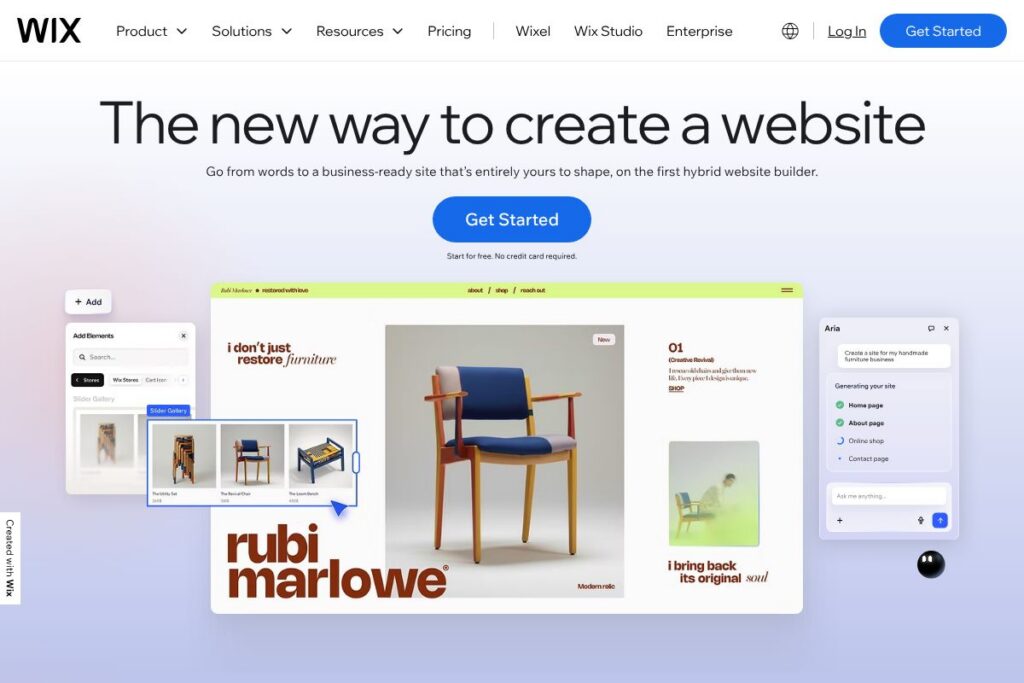
Wix is a freemium website builder that combines an AI-powered site generator with a visual drag-and-drop editor, a large template library, and a suite of business tools for eCommerce, bookings, marketing, and analytics. It hosts sites on multi-cloud infrastructure and bundles security, performance optimizations, and content management in one platform. Explore Wix’s main product offerings on the Wix homepage.
Wix competes directly with builders such as Squarespace, Shopify, and Webflow. Compared with Squarespace, Wix offers a more flexible free tier and a more visual drag-and-drop editor; compared with Shopify, Wix provides an easier path for small stores inside a general website builder; compared with Webflow, Wix prioritizes ease of use and built-in business features over designer-level layout control.
Wix does well when you want to launch a polished site quickly without managing hosting or separate services, while still having the option to scale into online stores, bookings, memberships, and automation. It is most suitable for small businesses, creators, freelancers, and teams that want an all-in-one platform with low technical overhead.
How Wix Works
Wix combines two creation modes: an AI-driven site generator for fast, conversational setup, and a visual Editor for detailed, pixel-level design changes. You can start by describing your business to the AI builder to get a complete site scaffold, or choose from over 2,000 templates and then customize with drag-and-drop controls and responsive editing.
Typical workflows include choosing a template or generating a site with Wix AI, configuring pages and navigation in the Editor, adding business features from the App Market, connecting a custom domain, and enabling SEO and analytics. For developers and custom logic, Wix provides the Velo by Wix developer platform to add backend code, APIs, and integrations.
What does Wix do?
Wix packages site creation, hosting, security, eCommerce, marketing, and CRM into a single dashboard so you can design, publish, and grow a website without connecting multiple vendors. Core capabilities include AI site generation, a drag-and-drop Editor, a template library, an app ecosystem, online payments and order management, booking and scheduling, email automation, and integrated analytics.
Let’s talk Wix’s Features
AI Site Generation (Aria)
Wix’s AI assistant can generate a tailored website from simple prompts, produce content drafts, and suggest layouts and images based on your answers. This speeds up initial setup and gives non-designers a usable starting point that can be refined in the Editor.
Template Library
There are over 2,000 designer-made templates across industries, each fully editable and mobile-optimized. Templates accelerate setup while still allowing full customization so you can preserve brand consistency as the site grows.
Drag-and-Drop Editor
The Editor provides pixel-level placement, layering, and responsive view control so you can fine-tune layouts without code. It suits users who want complete visual control while keeping the interface approachable for non-technical editors.
eCommerce and Payments
Wix includes storefront tools for product catalogs, inventory, shipping, tax settings, and order management with built-in payment options. It is designed to handle small to mid-size stores with promotional and sales features integrated into the dashboard.
Scheduling and Bookings
Wix supports appointment booking, staff management, payments for services, and client notifications, making it suitable for consultants, salons, classes, and service-based businesses. These tools integrate with calendars and payment workflows to minimize manual coordination.
Marketing, SEO and Email
Built-in SEO guides, AI-assisted meta generation, and integrations with Google Search Console help improve discoverability. Email campaigns, social post scheduling, and paid-ad management can be run from the same dashboard to coordinate launch and growth efforts.
App Market and Integrations
The App Market provides Wix-made and third-party extensions for analytics, forms, payments, and marketing automation. Popular integrations include Google Analytics, Facebook Pixel, and Zapier connectors available through the Wix App Market.
Hosting, Security, and Performance
Sites are hosted on a multi-cloud infrastructure with CDN, HTTPS, and DDoS protections, along with automated backups and monitoring for reliability and speed. These infrastructure features help keep sites available during traffic spikes and ensure basic security compliance.
With Wix you get an end-to-end site platform that reduces the number of separate tools you need to design, publish, and run an online presence.
Wix pricing
Wix uses a freemium subscription model: a free plan lets you build, publish, and test a website with a Wix-branded domain, while Premium plans add custom domains, eCommerce, marketing features, and advanced business capabilities. For detailed current plans and upgrade options, see Wix’s current pricing options.
What is Wix Used For?
Wix is used for launching business websites, portfolios, blogs, online stores, event pages, and service booking portals quickly and with minimal technical setup. Small businesses and creators use it to centralize website content, payments, bookings, and marketing in a single dashboard so they can manage operations from one place.
Agencies and freelancers also use Wix to prototype sites fast or to manage multiple client sites, and larger organizations may use Wix for microsites and event landing pages where speed and simplicity are priorities over full custom development.
Pros and Cons of Wix
Pros
- Large template and component library: A broad selection of over 2,000 templates and thousands of free components, graphics, and animations make it fast to assemble a professional-looking site. This reduces design time and helps non-designers achieve polished layouts.
- Multiple ways to build: You can use AI site generation for speed, pick a template for guided setup, or start from scratch with the drag-and-drop Editor. That flexibility fits users with different comfort levels and project needs.
- Integrated business tools: eCommerce, bookings, email marketing, CRM, and analytics are available inside the same dashboard, lowering the need for separate subscriptions and integration work.
- Developer extensibility: The Velo by Wix developer platform enables custom backend code and API access when projects require bespoke logic or integrations.
Cons
- Platform lock-in for advanced customizations: Deep customizations and complex logic often rely on Wix-specific tools or Velo, which can make migrating large sites to other platforms more involved. Migration typically requires rework and export limitations.
- Template switching constraints: Switching templates after the site is live is not seamless; complex sites may require manual rework to move content to a different design. That can limit rapid redesign workflows for some teams.
- Advanced enterprise features behind upgrades: Larger businesses may need to move to premium or enterprise-level plans to access advanced performance, commerce, and support features, which increases overall cost relative to the free tier.
Does Wix Offer a Free Trial?
Wix offers a free plan and optional trial access to Premium features via account upgrades. The free tier allows you to build and publish on a Wix-branded domain with access to templates and the Editor; Premium plans unlock custom domains, eCommerce, and advanced marketing tools. Check Wix’s current pricing options to compare tiers and trial specifics.
Wix API and Integrations
Wix provides developer capabilities through Velo by Wix, which exposes APIs, serverless functions, and a runtime for building custom interactions, data models, and third-party integrations. Velo is aimed at teams that need custom forms, backend workflows, or API-driven features beyond the visual Editor.
For non-developers, the Wix App Market connects third-party services like Google Analytics, Facebook Pixel, payment gateways, and automation tools such as Zapier to extend site functionality with minimal setup.
10 Wix alternatives
Paid alternatives to Wix
- Squarespace — A design-forward website builder known for polished templates and consistent styling, often favored by creatives and small businesses that prioritize aesthetics and built-in commerce.
- Shopify — An eCommerce-first platform that scales from small stores to enterprise retail operations, offering advanced payment, shipping, and inventory features.
- Webflow — A visual builder with designer-level layout control and CMS capabilities, preferred by teams that need fine-grained control over interactions and exported code.
- Weebly — A straightforward site and store builder with simple commerce tools and a gentle learning curve for first-time site owners.
- GoDaddy Website Builder — A fast setup option integrated with domain and hosting services, suitable for quick business pages and basic online stores.
- BigCommerce — A commerce-focused platform that targets larger online stores with advanced transaction, tax, and ERP integrations.
- WordPress.com — A hosted version of WordPress with plan tiers that offer managed hosting, themes, and plugin support for growing blogs and business sites.
Open source alternatives to Wix
- WordPress (self-hosted) — The most popular self-hosted CMS, offering complete control, thousands of themes and plugins, and a developer ecosystem for custom sites.
- Joomla — A flexible CMS with a middle ground between WordPress and Drupal, suitable for content-heavy sites and portals.
- Drupal — A highly extensible CMS for complex, enterprise-grade websites that require custom data models and access control.
- Hugo — A static site generator favored for speed and simplicity when you want to manage content with a static workflow and host on any CDN.
- Grav — A flat-file CMS that delivers a lightweight self-hosted option without the need for a database, useful for developers who prefer file-based content.
Frequently asked questions about Wix
What is Wix used for?
Wix is used to build and host websites for businesses, portfolios, blogs, and online stores. Users rely on Wix to design pages, run eCommerce, accept bookings, and manage marketing from a single dashboard.
Can I sell products on Wix?
Yes, Wix supports eCommerce functionality. You can create product catalogs, accept payments, manage inventory, and configure shipping and tax settings through the Wix eCommerce tools.
Does Wix integrate with third-party tools?
Yes, Wix integrates with many third-party services through the App Market and APIs. Common integrations include Google Analytics, Facebook Pixel, payment gateways, and automation connectors like Zapier.
Is Wix suitable for people who do not know how to code?
Yes, Wix is designed for non-technical users. The drag-and-drop Editor and AI site generation let you create a professional site without writing code, while Velo is available if you need custom development.
How do I improve SEO on a Wix site?
Wix provides built-in SEO tools and AI guidance. Use the SEO settings, structured data features, AI-generated meta tags, and integrations with Google Search Console to optimize pages for search engines.
Final Verdict: Wix
Wix is a comprehensive, user-friendly website platform that balances rapid site creation with the ability to scale into commerce, bookings, and marketing operations. Its strength is combining AI-assisted generation, an expansive template library, an intuitive Editor, and integrated business tools in one place, which reduces the need to stitch multiple services together.
Compared with Squarespace, Wix stands out for offering a free plan and a wider set of built-in business features and third-party integrations, while Squarespace emphasizes more consistent design templates and a simpler styling model. For users who value a free entry point, flexible editing, and an all-in-one business dashboard, Wix is a practical choice; teams that need ultra-polished design defaults or a commerce-first stack may prefer alternatives such as Squarespace or Shopify.