What is Writesonic
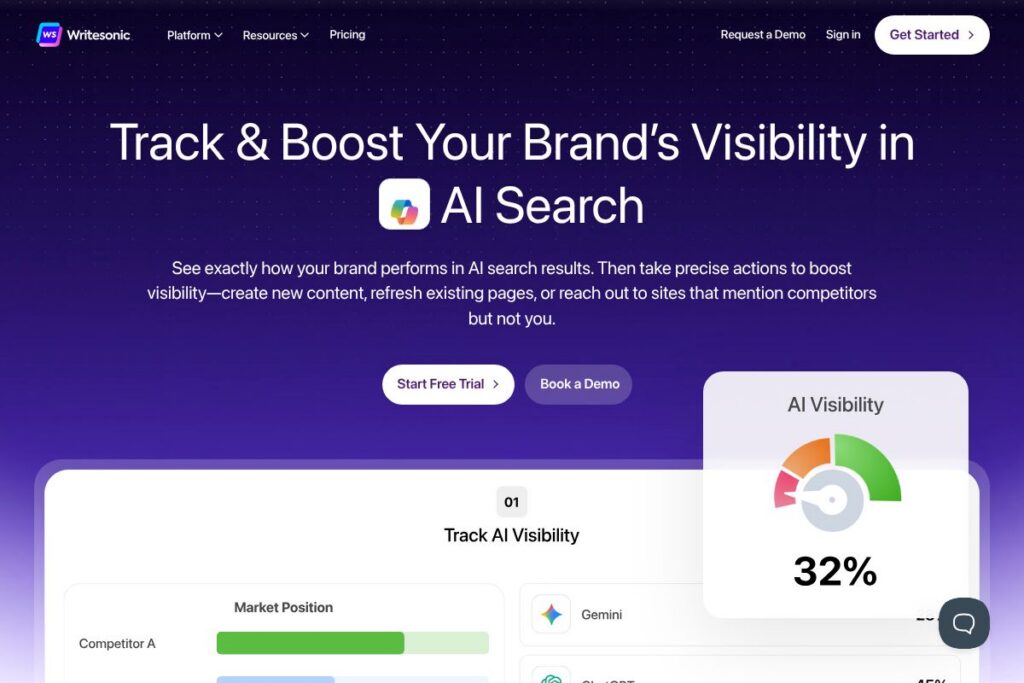
Writesonic is an AI search visibility platform built to track how generative AI systems surface brands, answers, and web content. It monitors visibility across ChatGPT, Gemini, Perplexity, and more than ten AI platforms, correlates those signals with traditional SEO metrics, and translates findings into concrete actions such as content creation, refreshes, and outreach.
Compared with tools like Semrush, which focuses on traditional search metrics and keyword research, and Ahrefs, which emphasizes backlink and organic search analysis, Writesonic centers on AI-first visibility and citations. Compared with content-focused assistants like Jasper, Writesonic combines tracking, competitive analysis, and technical fixes rather than only content generation. All of this makes it useful for teams that must be visible in both traditional search and AI-generated answers.
Writesonic does visibility measurement well and pairs analytics with prescriptive workflows. It is best suited for SEO teams, content operations, and enterprise marketing groups that need to understand and influence how AI systems reference their content in answers and recommendations.
How Writesonic Works
The platform continuously queries multiple AI models and indexes real AI answers to build an AI visibility dataset. It maps mentions, citations, sentiment, and answer excerpts back to your pages and competitor URLs so you can see where you appear and where you do not.
Once gaps and opportunities are identified, Writesonic generates action items such as content briefs, update recommendations, schema fixes, and outreach targets. Teams can take those actions inside the platform or export tasks to their content and SEO workflows.
Operational workflows typically combine three steps: monitor AI visibility and prompt-level volume, diagnose citation and technical issues, and execute targeted actions such as creating content, refreshing pages, or pursuing citation outreach to high-authority sites.
What does Writesonic do?
Writesonic bundles AI visibility tracking, SEO signals, technical audits, a content engine, and outreach tools into one workflow so teams can go from insight to execution. It combines real prompt-level volume from AI conversations with traditional sources like Keyword Planner and Ahrefs to prioritize work that actually changes AI behavior.
The platform includes several powerful capabilities:
AI Visibility Tracking
Tracks where your brand and pages appear across AI models, records citations and answer snippets, and reports visibility scores and sentiment. This helps you quantify AI share of voice and detect when AI favors competitors instead of your content.
Citation Gap Detection
Identifies high-value sites that cite competitors but not you, and surfaces opportunities to win citations. The feature produces outreach targets and suggested messaging templates to speed up citation acquisition.
Content Engine
Generates briefs and draft content optimized for both Google and AI citation, with fact-checking, internal linking suggestions, and EEAT signals. It supports refreshing existing pages with data-driven update recommendations to retain AI visibility.
SEO Integrations and Keyword Intelligence
Combines prompt-level AI volumes with traditional SEO metrics from tools like Google Keyword Planner and Ahrefs to prioritize topics. This hybrid approach helps teams target prompts that drive both organic traffic and AI citations.
Technical SEO Fixes
Scans sites for schema, robots, crawl, and other technical issues that block AI indexing and citations, and produces suggested fixes. Where applicable, the platform can generate code snippets or step-by-step instructions to resolve problems quickly.
Social and UGC Monitoring
Finds Reddit threads, Quora questions, and forum conversations where your customers ask product-related prompts, enabling targeted participation and content seeding. This helps teams influence AI training signals and community-driven answer sources.
Reporting and Alerts
Provides dashboards and real-time alerts for visibility drops, competitor wins, and new citation opportunities. Reports can be used to prioritize sprints and to measure the impact of content and outreach actions over time.
With these features combined, the biggest benefit is a closed loop from measurement to action: you can see where AI surfaces content, understand why, and deploy targeted fixes that are tied to measurable AI visibility outcomes.
Writesonic pricing
Writesonic offers flexible pricing tailored to individual creators, marketing teams, and enterprise contracts, with seat-based and usage-based options for larger organizations. For up-to-date plan details, licensing structures, and enterprise contract options, view the Writesonic homepage and contact their team.
What is Writesonic Used For?
Writesonic is used to monitor and improve how AI models surface a brand or content in answer outputs. Teams use it to find where AI cites competitors instead of their site, to detect pages losing visibility, and to target new prompts where presence would drive value.
It is also used to inform content strategy: generate briefs tailored to prompts that show real user intent, refresh pages before visibility drops, and coordinate outreach to authoritative sites that matter for AI citations. The platform is ideal for SEO professionals, content operations, and digital PR teams focused on both traditional search and AI-driven discovery.
Pros and Cons of Writesonic
Pros
- AI-first visibility data: The platform stores and analyzes prompt-level AI queries and answers so you can act on what AI actually recommends, not just keyword estimates.
- Action-oriented workflows: Insight-to-action features include content briefs, outreach templates, and technical fix recommendations that reduce the time between discovery and implementation.
- Hybrid SEO signals: Combines AI conversation volumes with traditional SEO metrics for prioritized, high-impact work across AI and Google.
- Enterprise-grade compliance: Offers security and compliance features designed for larger teams and regulated industries, supporting SOC 2, GDPR, and HIPAA alignment.
Cons
- Niche focus: Businesses primarily interested in classic organic keyword tracking with no need to optimize for AI answers may find some features redundant compared with pure SEO suites.
- Implementation effort: To capture full value you need coordinated content, technical SEO, and outreach processes; smaller teams may need to invest in workflow changes.
- Custom pricing for enterprises: Enterprise capabilities such as large-scale dataset exports, private ingestion, or dedicated onboarding are typically handled via custom agreements which require sales engagement.
Does Writesonic Offer a Free Trial?
Writesonic offers free access options and trial entry points so teams can test AI visibility tracking and the content engine before committing to paid plans. The platform provides limited free credits for initial exploration, and paid plans unlock higher volumes and enterprise features; sign up and plan details are available on the Writesonic homepage.
Writesonic API and Integrations
Writesonic provides developer-focused API access for content generation, automation, and integration with internal systems; see the Writesonic API documentation for endpoints, authentication, and usage patterns. The API enables automated content creation, retrieval of visibility data, and integration into reporting pipelines.
The platform also integrates with SEO and productivity tools such as Google Search Console, Google Keyword Planner, Ahrefs data connectors, Slack, and automation platforms like Zapier to fit into existing workflows and reporting stacks. Explore their integration options for exact connectors and setup guides.
10 Writesonic alternatives
Paid alternatives to Writesonic
- Semrush — A comprehensive SEO and competitive research suite with strong keyword research, site audits, and content marketing tools that focus on traditional organic search performance.
- Ahrefs — Known for backlink analysis and organic traffic research, useful for teams that need in-depth link data and keyword competition analysis.
- Surfer SEO — Content optimization platform that analyzes top-ranking pages to offer structure and on-page recommendations for organic ranking improvements.
- Frase — Content brief and optimization tool that combines SERP analysis with content generation to speed content production.
- MarketMuse — An AI-driven content planning and optimization tool focused on topical authority and content quality scoring.
- Conductor — Enterprise SEO platform geared toward large marketing organizations with deep site analytics and workflow integrations.
Open source alternatives to Writesonic
- Hugging Face Transformers — Open-source models and libraries you can use to build custom prompt-tracking or answer-generation systems when combined with analytics pipelines.
- OpenSearch — Community-driven search and analytics suite for indexing and querying large datasets, useful for building bespoke visibility tracking solutions.
- Scrapy — A Python-based web crawling framework that can be combined with custom analytics to collect citation and mention data from forums and web sources.
- Matomo — Self-hosted analytics platform that can complement visibility tracking when integrated with custom logs and reporting for organic traffic signals.
Frequently asked questions about Writesonic
What is Writesonic used for?
Writesonic is used to track and improve brand visibility inside AI-generated answers. It maps citations, detects gaps, and produces actions such as content updates and outreach to increase AI citations and presence.
Does Writesonic have an API?
Yes, Writesonic provides an API for automation and content workflows. Developers can use the API to generate content, pull visibility reports, and integrate results into internal dashboards; refer to the API documentation for details.
How does Writesonic price its service?
Writesonic uses flexible plans that vary by usage, seats, and enterprise requirements. For the latest plan tiers and to request enterprise pricing, review the information on the Writesonic homepage or contact their sales team.
Can Writesonic help fix technical SEO issues?
Yes, Writesonic includes technical audits and suggested fixes for schema, crawl, and robots issues. The platform pinpoints problems that may block AI citations and provides actionable remediation steps that content and engineering teams can implement.
Is Writesonic suitable for enterprise teams?
Yes, Writesonic supports enterprise use cases with compliance and security controls. The platform offers SOC 2 Type II alignment, GDPR considerations, and HIPAA compliance options, and it provides enterprise onboarding and dedicated support for larger deployments.
Final verdict: Writesonic
Writesonic fills a distinct gap between traditional SEO tools and the emerging need to be present in AI-generated answers. Its strength is combining prompt-level AI visibility with actionable workflows that guide content creation, outreach, and technical fixes aimed at increasing AI citations rather than only improving organic rankings.
Compared with a competitor such as Semrush, which focuses on conventional search performance and transparent plan tiers, Writesonic focuses on AI search signals and prescriptive actions to earn citations from AI models. For teams that must influence how AI recommends their brand, Writesonic offers a more targeted toolset; for teams focused only on classic organic search, a traditional SEO suite may remain more familiar and broadly applicable.
Overall, Writesonic is a practical choice for SEO and content teams that want to measure AI visibility and convert those measurements into prioritized, trackable work across content, technical SEO, and outreach channels. For plan details and a hands-on trial, visit the Writesonic homepage.