What is 6sense
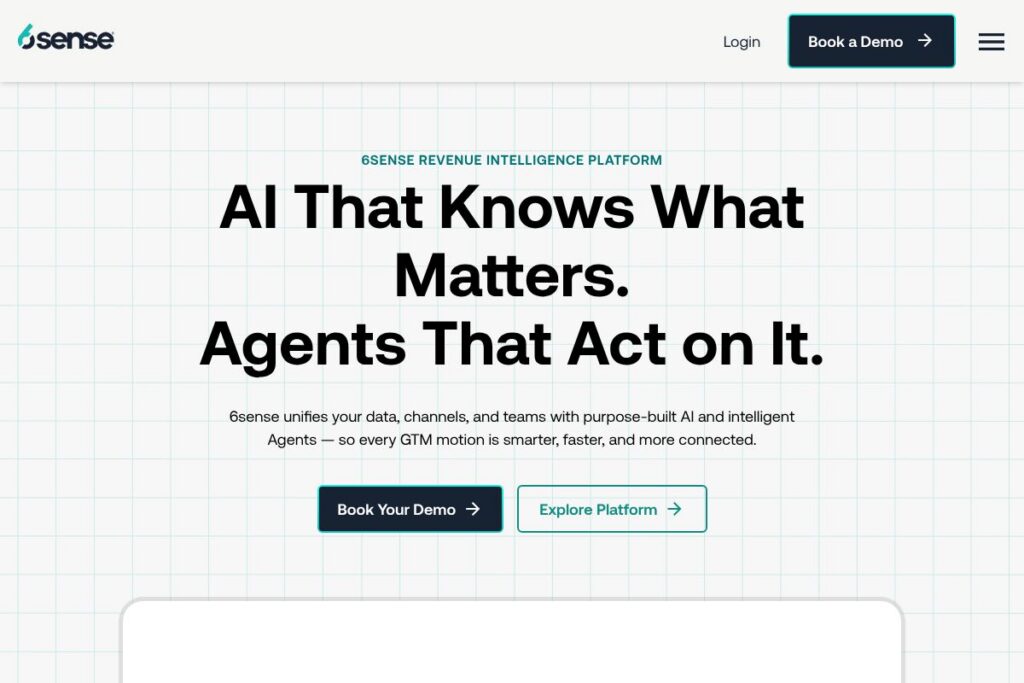
6sense is an enterprise account-based revenue intelligence platform that combines intent signals, account modeling, and orchestration to guide sales and marketing actions across channels. The platform centralizes first- and third-party signals into a unified dataset, applies predictive AI to surface likely buyers, and provides workflows that activate those signals across ads, email, web, and CRM.
Compared with Demandbase, 6sense places heavier emphasis on predictive AI and behavioral modeling to prioritize accounts, while Demandbase focuses more on audience-based advertising and account discovery. Against ZoomInfo, 6sense emphasizes intent timelines and orchestration for multi-channel plays, while ZoomInfo is stronger on contact and company data enrichment. All three target enterprise B2B teams but differ by strength: data enrichment, advertising, or predictive orchestration.
All of this makes 6sense well suited for revenue teams that need end-to-end account visibility and automated activation. The platform is aimed at mid-market to enterprise B2B organizations that require predictive scoring, omnichannel campaign orchestration, and seller-facing insights to close higher-quality pipeline.
How 6sense Works
6sense ingests signals from the web, CRM, marketing automation, and intent providers into the Signalverse, a normalized data layer that maps accounts and contacts to buying behavior. That data is cleaned, deduplicated, and modeled by 6AI to generate account scores, predicted buying stages, and recommended actions tailored to your business.
Users build Intelligent Workflows on a drag-and-drop canvas to convert AI signals into automated plays across channels. Workflows can trigger ad audiences, email sequences, web personalization, and CRM tasks so marketing and sales act in a coordinated manner without switching tools.
Sales Copilot delivers prioritized account lists, contact suggestions, and automated research directly into seller workflows so reps receive buyer-ready signals where they work. The Copilot surfaces who to call, what content to use, and which accounts are moving in-market based on predictive models.
6sense features
6sense centers on revenue intelligence, predictive account scoring, intent signal aggregation, and omnichannel activation. Core capabilities include the Signalverse for unified intent data, 6AI modeling for predictions, an Intelligent Workflows engine for orchestration, and Sales Copilot for seller enablement. The platform also includes measurement and attribution features to tie activity back to pipeline and revenue.
What 6sense Brings to the Table
Signalverse (intent and behavioral data)
Signalverse aggregates first- and third-party intent and engagement signals to map when accounts are researching topics related to your products. Teams use this to spot emerging buying behavior and prioritize outreach to accounts showing intent across multiple channels.
6AI predictive modeling
6AI analyzes historical outcomes, engagement patterns, and firmographic data to generate account scores and predicted buying stages. These models help reduce guesswork in prioritization by ranking accounts most likely to convert based on your own customers and outcomes.
Intelligent Workflows
The drag-and-drop Intelligent Workflows engine converts predictive signals into automated plays that run across ads, email, web personalization, and CRM actions. Marketers can build full-funnel campaigns that adapt as accounts shift in intent and buying stage.
Sales Copilot
Sales Copilot turns complex buying signals into prioritized accounts, recommended next steps, and automated research for reps inside their workflow. The feature reduces time spent on account qualification and helps sellers focus on accounts that are ready to engage.
Orchestration and activation
Orchestration tools let teams sync audiences to advertising platforms, trigger nurture sequences in MAPs, and create personalized web experiences for target accounts. This centralized activation removes manual coordination between separate ad, email, and web teams.
Measurement and attribution
Attribution reports tie activities and campaigns back to pipeline and revenue so teams can see which plays drive measurable results. This helps refine playbooks and focus investment on high-performing channels and workflows.
With these capabilities, 6sense helps teams convert intent signals into prioritized pipeline and repeatable plays that improve forecasting and seller efficiency.
6sense pricing
6sense uses an enterprise subscription model with custom pricing that varies by organization size, data needs, and required features. Pricing is typically tailored to seat counts, data access levels, and the scope of orchestration and AI features.
Because 6sense does not publish a standard price list, contact sales or review the vendor site for current plan options and licensing details. View the 6sense Revenue Intelligence Platform to request pricing information and a demo.
What is 6sense Used For?
6sense is used to discover which accounts are actively researching relevant topics, prioritize accounts with predictive scoring, and automate multi-channel engagement. Marketing teams use it to build targeted, full-funnel ABM campaigns while sales teams use it to identify ready buyers and focus outreach.
Typical use cases include account prioritization for outbound programs, intent-driven ad targeting, seller enablement through prioritized lists and research, and measurement of campaign-to-revenue impact. The platform is especially useful for organizations running account-based motions across large account sets or complex buying committees.
Pros and Cons of 6sense
Pros
- Predictive account scoring: The platform provides data-driven account prioritization that cuts through manual qualification and surfaces accounts most likely to convert.
- Omnichannel orchestration: Intelligent Workflows enable coordinated plays across ads, email, web, and CRM which reduces tool switching and manual handoffs.
- Seller enablement: Sales Copilot turns signals into actionable recommendations for reps, improving time-to-value for sales teams.
- Unified intent data: Signalverse centralizes multiple signal sources to give a clearer view of account behavior and buying intent.
Cons
- Enterprise focus and cost: Pricing and implementation are geared toward mid-market and enterprise teams which can put it out of reach for small businesses. The platform typically requires budget and executive buy-in for full deployment.
- Implementation complexity: Getting full value often involves integrating CRM, MAP, and other systems plus initial model tuning which can require professional services or extended ramp time.
- Learning curve for advanced features: Intelligent Workflows and predictive tuning have a learning curve that may require training for marketing operations and sales enablement staff.
Does 6sense Offer a Free Trial?
6sense is a paid platform with custom trial or pilot programs available by contacting sales. Prospective customers typically arrange a demo or pilot through the vendor to validate predictive models and orchestration use cases; request trial details via the 6sense contact and demo page.
6sense API and Integrations
6sense provides integration options for common enterprise systems, including CRM platforms, marketing automation, ad platforms, and data warehouses to support activation and measurement. Typical connectors include Salesforce, Microsoft Dynamics, Marketo, HubSpot, and ad networks for audience activation.
For details on supported connectors and integration patterns, consult the 6sense platform documentation which outlines available integrations and recommended data flows for orchestration and analytics.
10 6sense alternatives
Paid alternatives to 6sense
- Demandbase — Enterprise ABM platform focused on audience-based advertising and account discovery with integrated analytics and activation tools. See the Demandbase platform overview for details.
- ZoomInfo — Market intelligence and contact data provider that combines company and contact data with intent signals and sales enablement features. Explore the ZoomInfo product suite.
- Terminus — ABM platform that emphasizes ad targeting, account-based journeys, and analytics to help B2B teams engage target accounts across channels. Learn more at the Terminus platform page.
- RollWorks — Account engagement platform that provides account scoring, ad targeting, and orchestration for mid-market to enterprise ABM programs. Review the RollWorks offering.
- Bombora — Intent data provider that supplies company-level content consumption signals which can be used alongside activation platforms to inform ABM strategies. See the Bombora intent data solutions.
- HubSpot — CRM and marketing platform with ABM tools for SMBs and growing enterprises, combining contact management, marketing automation, and reporting in one suite. See the HubSpot ABM features.
Open source alternatives to 6sense
- Mautic — An open source marketing automation platform that supports campaign orchestration, segmentation, and personalization for teams that want a self-hosted alternative to commercial MAPs. Visit Mautic.org.
- Odoo (Community Edition) — Open source ERP and CRM with marketing and sales modules that can be adapted for account tracking and campaign management in smaller deployments. See Odoo Community.
- Metabase — Open source analytics and BI tool that teams can use to analyze intent signals and campaign performance when paired with custom data pipelines. Explore Metabase.
Frequently asked questions about 6sense
What is 6sense used for?
6sense is used for account-based revenue intelligence and orchestration. It helps teams identify in-market accounts, prioritize outreach through predictive scoring, and automate cross-channel campaigns.
Does 6sense integrate with Salesforce and HubSpot?
Yes, 6sense integrates with major CRMs including Salesforce and HubSpot. Integrations enable two-way data flow so predictive signals and account scores appear in the CRM and CRM activity informs modeling.
Can 6sense help with attribution to revenue?
Yes, 6sense includes measurement and attribution capabilities to connect campaigns to pipeline and revenue. Those reports help teams understand which plays and channels are driving outcomes.
How does 6sense use AI in its platform?
6sense uses AI for data cleaning, deduplication, predictive scoring, and recommendations. The platform applies models to surface accounts most likely to buy and suggests actions for marketing and sales.
Is 6sense suitable for small businesses?
6sense is primarily aimed at mid-market and enterprise B2B teams. Smaller organizations may find the platform powerful but should consider budget and implementation needs before adopting.
Final verdict: 6sense
6sense stands out for combining intent data, predictive AI, and workflow orchestration into a single revenue intelligence platform that connects marketing and sales actions to pipeline outcomes. Its strength lies in turning signals into prioritized accounts and automated plays that reduce manual coordination and improve seller focus.
Compared with Demandbase, which also targets enterprise ABM with custom pricing and strong advertising capabilities, 6sense differentiates on predictive modeling and seller-facing tools like Sales Copilot. Both vendors use custom enterprise pricing, but 6sense leans more on AI-driven activation while Demandbase emphasizes audience-based advertising and account discovery.
Overall, 6sense is a strong choice for B2B revenue teams that need predictive account prioritization, omnichannel orchestration, and seller enablement in a unified platform. For organizations seeking those capabilities at scale, 6sense offers a cohesive approach to converting intent into measurable pipeline.