ActiveCampaign: An Overview
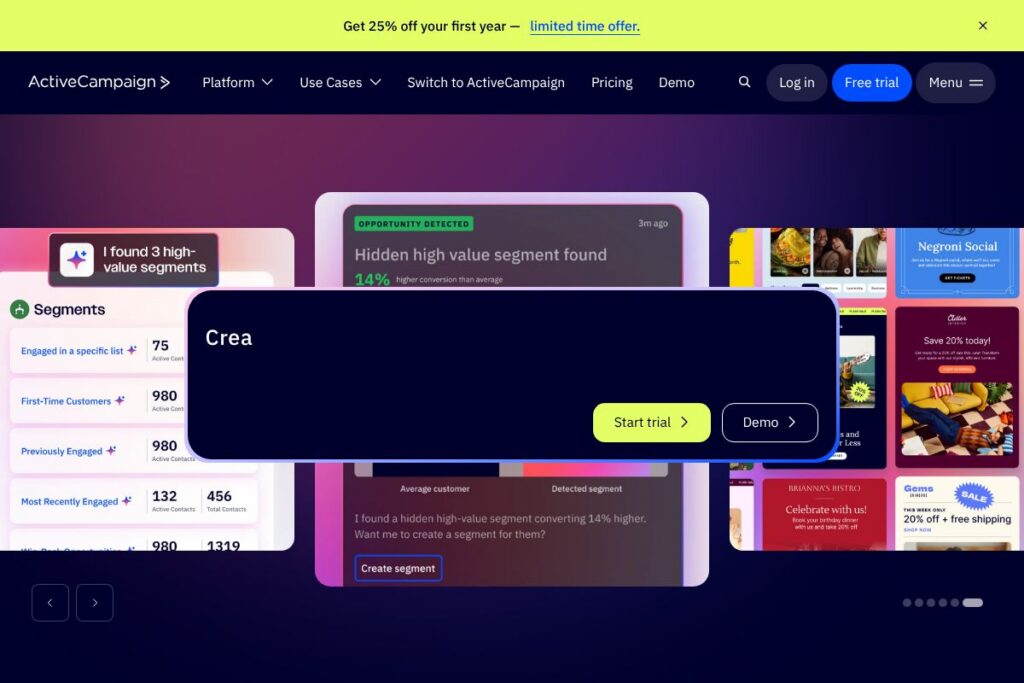
ActiveCampaign is a SaaS marketing automation platform focused on running multi-channel campaigns with an emphasis on automation and AI-driven decisioning. It combines email marketing, SMS, WhatsApp messaging, CRM features, and customer data integrations to automate campaign strategy, audience segmentation, and message delivery.
Compared with competitors such as HubSpot and Mailchimp, ActiveCampaign places heavier emphasis on workflow automation and predictive insights rather than purely creative or CMS features. HubSpot is stronger when you need an all-in-one CRM plus inbound marketing hub with extensive CMS and sales tooling, while Mailchimp targets simpler email-first workflows and small business needs. ActiveCampaign sits between those options, offering deeper automation than Mailchimp and a more affordable automation-first alternative to HubSpot for many mid-market teams.
All of this makes ActiveCampaign particularly well suited for marketing teams that want to reduce manual campaign work and scale personalized outreach across channels. Its strength is automation logic and data-driven orchestration for email, SMS, and messaging workflows, making it a practical choice for businesses that rely on lifecycle marketing and integrated CRMs.
How ActiveCampaign Works
ActiveCampaign centralizes customer records and behavior signals, then uses automation recipes to map audience journeys and trigger messages across channels. Marketers define goals and automation flows; the platform handles segmentation, message sequencing, and delivery timing based on triggers such as site visits, purchases, or tag changes.
Workflows can combine email, SMS, and messaging, plus conditional splits, waits, and scoring to create complex customer journeys that run without manual intervention. Teams commonly start with a template or visual automation builder, connect their CRM or ecommerce data, then refine flows using performance metrics and the platform’s AI suggestions.
What does ActiveCampaign do?
ActiveCampaign is organized around autonomous campaign orchestration and multi-channel messaging. Core capabilities include a visual automation builder, channel support for email, SMS, and WhatsApp, CRM and lead scoring, and integrations across marketing stacks. The platform has expanded automation with AI-driven insights that help generate content ideas, optimize send times, and prioritize segments.
Let’s talk ActiveCampaign’s Features
Visual Automation Builder
The visual builder enables drag-and-drop creation of conditional workflows, timed waits, and multi-step sequences. It benefits teams by making complex journeys understandable and editable, which speeds up setup and reduces errors for multi-channel campaigns.
Email Marketing
Email tools include campaign and transactional templates, A/B testing, personalization tokens, and dynamic content based on contact data. These features help teams deliver targeted messages at scale and improve engagement with segmentation and behavioral triggers.
SMS Messaging
SMS capabilities support personalized one-off messages and ongoing automated campaigns with delivery reporting. SMS is useful for time-sensitive prompts, reminders, and short-form outreach that complements email sequences.
WhatsApp Automation
WhatsApp automation enables conversational-style messaging tied to contact records and automation flows. It helps teams reach customers in a channel many users already prefer, while retaining automation controls and tracking.
CRM and Lead Scoring
Built-in CRM features track deals, tasks, and contact activity, while lead scoring ranks prospects based on behavior and attributes. This enables sales and marketing teams to coordinate follow-up and prioritize high-value contacts automatically.
Integrations and App Ecosystem
ActiveCampaign connects with CRMs, ecommerce platforms, analytics tools, and over 1,000 third-party apps to unify customer data. Integrations reduce data silos and let automation act on events from tools you already use, improving campaign relevance and measurement.
Active Intelligence and AI Assistants
AI-driven capabilities suggest subject lines, content adjustments, and optimization tactics based on performance signals and aggregated data. These assistants aim to reduce manual testing and accelerate campaign iterations with data-backed recommendations.
With these capabilities ActiveCampaign helps reduce manual setup and maintenance across channels, enabling teams to focus on strategy while the platform manages execution and optimization.
ActiveCampaign pricing
ActiveCampaign uses a tiered SaaS subscription model that scales by features, contact volume, and support level, with enterprise options available for larger organizations. Pricing is structured to accommodate individuals and teams, with higher tiers adding advanced automation, CRM features, and dedicated support.
Plan and Billing Notes
ActiveCampaign offers flexible subscription plans and customized enterprise agreements; exact pricing varies by contact count and selected feature set. For current plan options and to compare features across tiers, see ActiveCampaign’s plans and pricing overview.
Enterprise and Custom Options
Larger organizations can negotiate enterprise-level contracts that include SSO, advanced deliverability support, and account services. Contacting the sales team is the recommended route for tailored deployments and volume-based pricing; use ActiveCampaign’s contact and sales resources to request a custom quote.
What is ActiveCampaign Used For?
ActiveCampaign is commonly used for lifecycle marketing, lead nurturing, and customer retention programs that require personalized, automated outreach. Teams use it to automate onboarding sequences, cart recovery, win-back campaigns, and event-triggered communications across email, SMS, and messaging channels.
It is ideal for small to mid-market businesses, ecommerce brands, and marketing teams that need scalable automation and integration with their CRM or ecommerce platform. Organizations with recurring campaigns and complex customer journeys benefit most from its automation-focused feature set.
ActiveCampaign’s Strengths and Weaknesses
Pros
- Powerful automation engine: The visual automation builder supports complex conditional flows, multi-step journeys, and cross-channel orchestration, making it possible to automate sophisticated lifecycle campaigns without custom development.
- Multi-channel messaging: Native support for email, SMS, and WhatsApp lets teams coordinate messages across channels from a single platform, improving campaign reach and cohesion.
- Extensive integrations: Connectors for CRM, ecommerce, analytics, and over 1,000 apps enable richer data-driven automation and reduce the need for manual data transfers.
- AI-assisted features: Built-in AI suggestions and Active Intelligence features reduce manual optimization, help generate content ideas, and can speed up campaign creation.
Cons
- Learning curve for advanced automations: Setting up very complex workflows can be time-consuming and may require training or consulting to implement best practices effectively.
- Delivery and compliance nuances: Managing deliverability and channel-specific compliance (for SMS and WhatsApp) requires attention to local regulations and carrier requirements, which can add operational overhead.
- Pricing scales with contacts: Costs can increase substantially as contact counts grow, so careful list hygiene and segmentation are necessary to control spend.
Does ActiveCampaign Offer a Free Trial?
ActiveCampaign offers a free trial and a 30-day satisfaction guarantee. New users can try the platform for 14 days with access to core features, and there is a 30-day money-back guarantee that allows you to request a refund if the platform does not meet your needs. For trial sign-up and guarantee details, visit ActiveCampaign’s trial and guarantee information.
ActiveCampaign API and Integrations
ActiveCampaign provides developer APIs and webhooks for automation, contact synchronization, and event tracking. The API documentation outlines endpoints for contacts, automations, deals, and more, useful for custom integrations and automation extensions.
The platform also lists prebuilt connectors and native integrations to popular tools such as CRMs, ecommerce platforms, and analytics services through its integrations directory. These integrations let teams route events into automations without custom code.
10 ActiveCampaign alternatives
Paid alternatives to ActiveCampaign
- HubSpot — An all-in-one CRM and marketing hub with built-in CMS, sales tools, and strong inbound marketing features suited to teams that need unified sales and marketing tooling.
- Mailchimp — An email-first platform that offers simple automation and ecommerce integrations, aimed at small businesses and simpler campaign needs.
- Klaviyo — Focused on ecommerce brands, Klaviyo emphasizes customer data, segmentation, and revenue analytics for email and SMS.
- Salesforce Marketing Cloud — Enterprise-grade marketing automation with deep CRM integration, advanced personalization, and large-scale campaign management.
- Sendinblue — Offers email, SMS, and basic automation with simpler pricing for teams that want multi-channel messaging without complexity.
- Drip — Ecommerce-focused automation with behavior-based workflows and integrations for retail-marketing use cases.
- Iterable — A growth marketing platform focused on cross-channel orchestration and advanced segmentation at scale.
Open source alternatives to ActiveCampaign
- Mautic — An open source marketing automation platform for email, campaigns, and contact management that can be self-hosted with full control over data and customization.
- Odoo (Community Edition) — Offers marketing automation modules as part of a larger open source ERP suite; useful if you want an integrated business management platform.
- Listmonk — A self-hosted newsletter and campaign manager designed for high-performance email sending and straightforward automation capabilities.
Frequently asked questions about ActiveCampaign
What is ActiveCampaign used for?
ActiveCampaign is used for multi-channel marketing automation and customer journey orchestration. Teams use it to automate email, SMS, and messaging campaigns, manage contacts, and coordinate sales and marketing workflows.
Does ActiveCampaign have an API?
Yes, ActiveCampaign provides a public API and webhooks for developers. The API documentation describes endpoints for contacts, automations, deals, and event tracking to support custom integrations.
Can ActiveCampaign send SMS and WhatsApp messages?
Yes, ActiveCampaign supports SMS and WhatsApp messaging alongside email. These channels can be integrated into automation workflows for time-sensitive and conversational outreach.
Is there a trial available for ActiveCampaign?
Yes, ActiveCampaign offers a 14-day free trial and a 30-day satisfaction guarantee. New users can test core features and request a refund within 30 days if not satisfied.
Who should consider using ActiveCampaign?
Marketing teams and small to mid-market businesses needing advanced automation should consider ActiveCampaign. It fits organizations that require multi-channel orchestration, CRM integration, and data-driven campaign workflows.
Final Verdict: ActiveCampaign
ActiveCampaign stands out for its automation-first approach and multi-channel orchestration, combining email, SMS, and messaging with built-in CRM and AI-assisted recommendations. It is particularly strong for teams that need to reduce manual campaign maintenance and scale personalized journeys across channels.
Compared with HubSpot, ActiveCampaign often delivers more automation capability at a lower entry cost for mid-market teams, while HubSpot excels at a combined CRM and inbound marketing experience with a broader suite of sales tools. For organizations prioritizing automation depth and channel flexibility, ActiveCampaign is a practical, automation-focused choice that integrates widely and supports growth-focused marketing programs.