Alchemer: An Overview
Alchemer is an online survey and customer experience platform designed to capture feedback across surveys, web and mobile channels, and third-party touchpoints. The product emphasizes connecting feedback to business systems through a large set of integrations and workflow automation, helping teams move from insight to action without manual data wrangling.
Alchemer sits between lightweight form builders like Typeform and enterprise research platforms such as Qualtrics. Compared with SurveyMonkey, Alchemer focuses more on integration depth and configurable workflows rather than just simple survey distribution and reporting. Against Qualtrics, Alchemer is often chosen for pragmatic enterprise use cases where extensive system connectivity and custom automations are required.
All of this makes Alchemer a strong option for product teams, customer experience groups, and operations teams who need surveys that plug into CRMs, analytics, and ticketing systems. Its strengths are the integration surface, workflow automation, and role-based reporting aimed at putting feedback directly into operational processes.
How Alchemer Works
Alchemer collects feedback via web and mobile surveys, in-app intercepts, and survey links that can be deployed in third-party channels. Responses can be routed in real time to downstream systems or used to trigger automated follow-ups and internal notifications so issues are addressed quickly.
Administrators design surveys with a feature-rich builder that supports logic, piping, custom scripting, and question libraries. Once data is captured, role-based dashboards and reporting tools make it possible to slice feedback by customer segment, product area, or operational metric and share findings with stakeholders.
Implementation usually follows a pattern of survey design, integration mapping to business systems, and then workflow configuration to route responses where they matter. Teams commonly use Alchemer to send event-triggered surveys from apps, capture website feedback, and feed survey data into CRM or analytics platforms for further action.
What does Alchemer do?
Alchemer organizes around feedback collection, integration, automation, and analysis. Core capabilities include a flexible survey builder, omnichannel feedback capture, over 400 integrations, workflow automation, AI-assisted analysis, and role-based dashboards. Recent product additions emphasize deeper automation and improved analytics to reduce manual steps between insight and action.
Survey Builder
The survey builder supports conditional logic, question piping, custom scripting, and reusable libraries so teams can create complex, targeted surveys without code. This benefits product and CX teams that need precise question flows and consistent question sets across projects.
Omnichannel Feedback
Alchemer enables feedback capture through standalone surveys, embedded website widgets, in-app intercepts, and links distributed across channels, helping teams gather feedback at the moment it matters. Omnichannel capture increases response rates and provides richer context for customer sentiment.
Integrations and Connectors
With more than 400 integrations, Alchemer connects survey data to CRMs, analytics, support tools, and data warehouses so feedback is accessible across the organization. Common integrations eliminate manual imports, enabling automated workflows tied to business systems; see the Alchemer integrations overview for examples of connected apps.
Workflow Automation
Automation rules let you route responses, create tickets, send conditional alerts, and update external records based on survey answers. This reduces the time between receiving feedback and taking action by automating routine follow-ups and escalations.
Analysis and Reporting
Role-based dashboards, ad hoc reporting, and export options support both tactical and strategic analysis of feedback. Built-in charts, segmentation, and CSV/Excel exports let analysts combine survey data with other sources for deeper insight.
AI-Assisted Insights
Purpose-built AI features help summarize open-ended responses, surface themes, and prioritize issues so teams can quickly identify common trends. AI assists reporting workflows by turning qualitative feedback into structured insights that inform product and support decisions.
Security and Compliance
Alchemer provides enterprise controls such as role-based access, audit trails, and encryption to meet data governance needs. These controls are important for regulated industries that need to manage respondent data and internal access carefully.
Alchemer’s biggest benefit is putting survey insights into the operational flow of a business through integrations and automation, reducing the gap between feedback and action.
Alchemer Pricing
Alchemer uses a commercial SaaS pricing model with plans and enterprise options tailored to organizational needs; pricing is generally structured around feature sets, user seats, and enterprise services. For the latest plan options and details on enterprise pricing, see the current pricing options on Alchemer’s site.
What is Alchemer Used For?
Alchemer is commonly used for customer experience programs, product research, employee feedback, and market research. Teams use it to run transactional NPS and CSAT surveys, conduct product concept testing, gather website and in-app feedback, and field bespoke research studies.
Organizations that need to operationalize feedback use Alchemer to trigger internal workflows, create support tickets from survey responses, and sync respondent data into CRMs and analytics platforms. It is well suited for mid-market and enterprise teams that require integration depth and workflow customization.
Pros and Cons of Alchemer
Pros
- Integration depth: Alchemer connects to a wide range of business systems, which reduces manual data transfers and helps teams take action faster. This is especially valuable for CX and product teams that depend on survey data inside CRMs and analytics tools.
- Flexible automation: The platform supports conditional automations that route responses and create downstream records, enabling real-time operational responses to feedback. Configurable workflows can reduce manual triage and speed up issue resolution.
- Advanced reporting and role-based dashboards: Alchemer provides tailored dashboards and reporting controls so stakeholders see relevant metrics without wading through raw data. This simplifies cross-team sharing and governance of insights.
Cons
- Enterprise orientation: The product favors enterprise use cases and integrations, which can make initial setup more complex for small teams seeking a lightweight survey tool. Smaller organizations may find the feature set more than they need.
- Learning curve for advanced features: Advanced logic, scripting, and automation require time to master and may need technical resources for highly customized implementations. Teams without technical support may need professional services for complex configurations.
Does Alchemer Offer a Free Trial?
Alchemer offers a free trial and self-serve signup options alongside paid plans so teams can test core capabilities before committing; the platform also provides enterprise demo and onboarding options for larger deployments. Visit Alchemer’s site to start a trial or request a demo and compare plan features on the Alchemer homepage.
Alchemer API and Integrations
Alchemer provides a developer API for programmatic access to surveys and responses, enabling custom integrations and automated workflows; the Alchemer API documentation describes available endpoints and authentication methods. The platform also offers a broad catalog of prebuilt integrations for CRMs, analytics, help desks, and data warehouses through the Alchemer integrations overview.
10 Alchemer alternatives
Paid alternatives to Alchemer
- Qualtrics — Enterprise-grade research and experience management platform with deep analytics, sophisticated sampling, and extensive professional services.
- SurveyMonkey — Widely used survey tool offering a mix of freemium plans and business tiers for basic to advanced survey needs and distribution channels.
- Typeform — Focuses on conversational forms and surveys with an emphasis on design and respondent experience for higher completion rates.
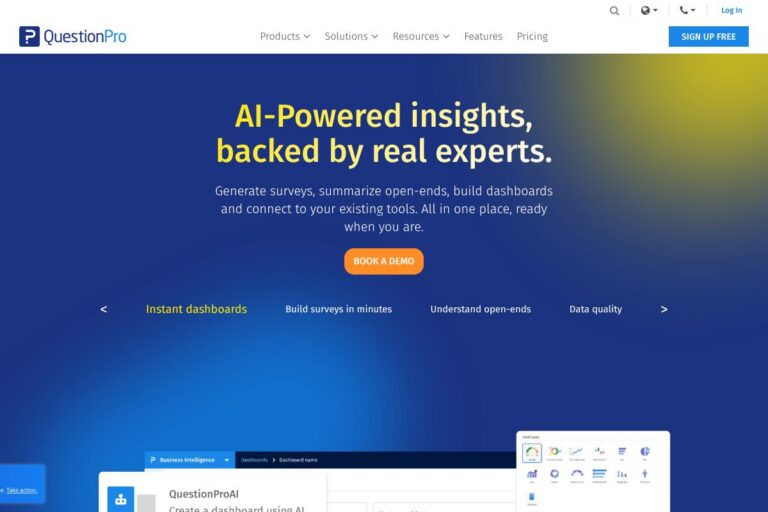
- QuestionPro — Offers enterprise surveying, panel management, and analytics tailored to customer experience and market research teams.
- Microsoft Forms — Simple survey and quiz tool integrated with Microsoft 365, useful for teams already using Microsoft services.
- SurveyGizmo (Momentive) — Provides advanced survey logic and reporting aimed at both business users and researchers.
- Formstack — Combines form building with workflow automation and document generation for operational use cases.
Open source alternatives to Alchemer
- LimeSurvey — Open source survey system with a robust feature set for questionnaire design, deployment, and response collection.
- SurveyJS — A JavaScript-based survey library that developers can embed and customize for web and mobile applications.
- Form.io — An open-source form and data management platform that includes API-driven form rendering and submission handling.
Frequently asked questions about Alchemer
What is Alchemer used for?
Alchemer is used for collecting and operationalizing customer, employee, and market feedback. Teams use it to run surveys, capture in-app and website feedback, and integrate responses into business systems for action.
Does Alchemer integrate with CRMs like Salesforce?
Yes, Alchemer offers integrations with CRMs such as Salesforce and other enterprise systems. Those integrations let organizations sync respondent data, create records, and trigger workflows based on survey responses.
Can Alchemer handle large enterprise deployments?
Yes, Alchemer supports enterprise deployments with role-based access, audit logs, and custom integrations. Enterprise plans include increased administrative controls and options for professional services and onboarding.
Does Alchemer provide API access for automation?
Yes, Alchemer provides a developer API for accessing surveys and responses. The API supports programmatic management of survey assets and automated ingestion of response data into external systems.
Is Alchemer suitable for product research?
Yes, Alchemer is suitable for product research and customer experience studies. Its conditional logic, open-text analysis, and integration capabilities help product teams gather targeted feedback and connect results to analytics and support workflows.
Final verdict: Alchemer
Alchemer is strongest where feedback must be connected to business systems and operational workflows. Its integration catalog, automation rules, and role-based reporting make it a practical choice for enterprises that need survey data to drive actions across support, product, and CRM systems.
Compared with SurveyMonkey, which often appeals to teams seeking a simpler freemium path, Alchemer targets organizations seeking deeper integrations and configurable automation. For teams that require enterprise controls and system connectivity rather than just basic survey distribution, Alchemer provides a more operationally focused solution.