What is Avaya
Avaya is an enterprise communications company that delivers contact center solutions, critical communications infrastructure, and unified communications for voice, video, and digital channels. The platform mixes on-premises and cloud components with AI-powered orchestration to support high-availability voice environments and omnichannel customer engagement.
Avaya competes directly with other contact center and enterprise communications vendors such as Genesys, Cisco Contact Center, and NICE. Compared with Genesys, Avaya emphasizes resilient voice infrastructure and hybrid deployment flexibility; compared with Cisco Contact Center, Avaya focuses more on contact-center-specific orchestration and third-party AI integrations; compared with NICE, Avaya offers a broader unified communications portfolio alongside workforce optimization capabilities.
All of this makes Avaya well suited for organizations that need mission-critical voice continuity, integrated contact center workflows, and large-scale hybrid deployments. It is commonly used by banks, healthcare systems, governments, and large enterprises that require regulated, always-on communications.
How Avaya Works
Avaya combines modular software components, hardware appliances, and cloud services to route, manage, and analyze customer interactions across voice and digital channels. Core elements include resilient voice switching for mission-critical sites, an experience platform for omnichannel routing, AI services for agent assist, and orchestration layers that connect systems and data across the enterprise.
In practice, Avaya can be deployed as on-premises appliances in high-availability configurations using Avaya Nexus for critical communications, or as hybrid cloud instances that route digital channels through Avaya Experience Platform Public Cloud while keeping voice on-premises. Typical workflows include intelligent routing based on customer history, real-time AI suggestions to agents, and post-interaction analytics that feed workforce optimization and compliance processes.
Avaya features
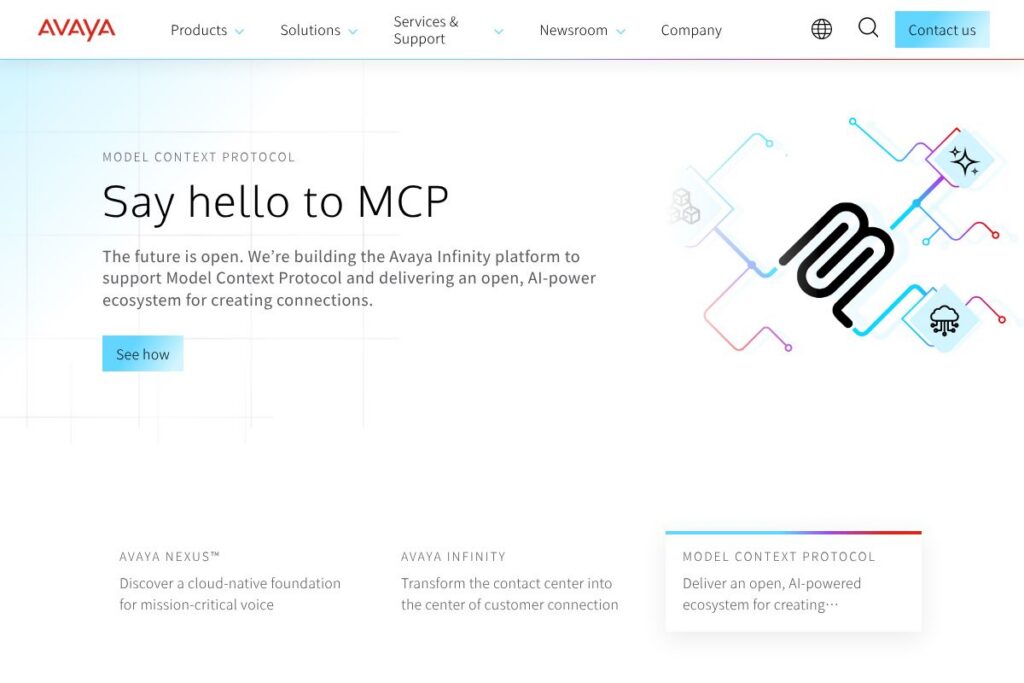
Avaya’s product set spans contact center routing, critical communications, unified communications, AI orchestration, and analytics. Recent emphasis is on the Avaya Infinity platform and Model Context Protocol to enable an open AI ecosystem and higher-level orchestration across channels and systems.
The platform includes several powerful capabilities:
Avaya Nexus
Avaya Nexus provides a secure, resilient voice infrastructure designed for environments where downtime has serious consequences. It is built for zero-downtime operations, redundant voice paths, and regulatory compliance, making it appropriate for public safety, healthcare, and financial services operations.
Avaya Infinity / Experience Platform
Avaya Infinity, often delivered through the Avaya Experience Platform, unifies voice and digital channels into a single orchestration layer. This capability manages session routing, context sharing, and cross-channel handoffs so agents and automation see a consistent customer profile throughout interactions.
Model Context Protocol (MCP) and AI Ecosystem
MCP supports an open approach to AI integrations, enabling third-party models and contextual data to interact with Avaya workflows. This allows AI agent assist, automated summarization, and contextual routing to draw on external models while keeping orchestration centralized.
Omnichannel Contact Center
Avaya’s contact center capabilities bring phone, chat, email, SMS, and social channels into one queue with unified routing rules. The system supports skills-based routing, queue management, and digital self-service so organizations can blend automation and live assistance efficiently.
AI Agent Assist and Automation
Real-time AI features provide suggested responses, information lookup, and next-best-action prompts to agents during live interactions. Automation layers can handle routine requests via chatbots and virtual agents while escalating complex issues to human agents with relevant context.
Analytics and Workforce Optimization
Built-in analytics capture interaction data for quality management, compliance, and performance measurement. Workforce optimization tools include forecasting, scheduling, and quality monitoring to align staffing with demand and improve service outcomes.
Hybrid Cloud and Resilience
Avaya supports mixed deployment models that combine on-premises voice platforms with public cloud digital channels. This hybrid approach lets organizations retain control over voice resiliency while benefiting from cloud-based channel expansion and innovation.
With its mix of resilient voice infrastructure, AI integrations, and omnichannel orchestration, Avaya’s biggest benefit is enabling consistent, regulated, and context-rich customer experiences at scale.
Avaya pricing
Avaya uses an enterprise pricing model with customized plans based on deployment type, number of agents or users, required resilience, and support commitments. Pricing is tailored to hybrid or fully managed deployments, and commercial terms typically require a sales engagement to determine licensing, cloud subscription costs, and professional services.
For details on specific deployment options and to request a tailored quote, contact Avaya through their enterprise solutions pages or reach out via Avaya’s contact page. These pages provide guidance on licensing models and how to initiate proof-of-concept or pilot engagements.
What is Avaya Used For?
Avaya is used to run enterprise contact centers, manage mission-critical voice infrastructures, and deliver unified communications for large organizations. Common uses include customer service centers, emergency communications, telehealth access points, and bank contact centers that need regulated, secure voice systems.
Organizations use Avaya to consolidate disparate systems into a single orchestration layer, integrate CRM and business systems for context-aware routing, and deploy AI-assisted agents to lower handling times while improving consistency. Enterprises that require high availability, regulatory controls, and complex routing logic rely on Avaya for both operational continuity and customer engagement.
Pros and Cons of Avaya
Pros
- Resilient voice infrastructure: Avaya Nexus and on-prem capabilities provide redundant, zero-downtime voice paths suitable for regulated environments and mission-critical operations.
- Omnichannel orchestration: The platform unifies voice, chat, email, and social channels into a single workflow, reducing fragmentation and improving context continuity across interactions.
- AI and open model support: Model Context Protocol enables third-party AI models and contextual data to be integrated into routing and agent assist workflows for greater flexibility.
- Hybrid deployment flexibility: Organizations can mix on-premises voice with cloud digital channels, allowing phased cloud adoption and control over critical systems.
Cons
- Enterprise-focused licensing: Pricing and procurement are tailored to large organizations, which can make initial procurement and proof-of-concept cycles longer for small teams.
- Implementation complexity: The breadth of features and hybrid options can require specialized services and skilled administrators for optimal deployment and maintenance.
- Upgrade and integration effort: Integrating legacy telephony with modern cloud services may need additional engineering and testing to achieve seamless operation.
Does Avaya Offer a Free Trial?
Avaya offers demos and pilot engagements rather than a public free plan. Prospective customers typically arrange product demonstrations, proof-of-concept projects, or pilot deployments through Avaya sales to evaluate functionality and resiliency before committing to enterprise contracts.
Avaya API and Integrations
Avaya provides developer APIs and platform extensions to integrate contact center capabilities, telephony controls, and data orchestration with external systems. The Avaya developer portal hosts API documentation, SDKs, and integration guides for building connectors and custom workflows.
Key integrations include major CRM platforms, workforce management systems, chatbots, and collaboration tools such as Salesforce, Microsoft Teams, and other enterprise applications, enabling data synchronization and contextual routing across systems.
10 Avaya alternatives
Paid alternatives to Avaya
- Genesys — Cloud-native contact center platform with strong routing, AI, and CX orchestration for large enterprises.
- Cisco Contact Center — Enterprise communications and contact center suite integrated with Cisco networking and collaboration technologies.
- NICE — Customer engagement and workforce optimization platform with advanced analytics and compliance features.
- Talkdesk — Cloud contact center focused on fast deployments and extensibility with a broad app ecosystem.
- RingCentral — Unified communications and contact center cloud services for distributed teams.
- Five9 — Cloud contact center with omnichannel routing and pre-built CRM integrations.
Open source alternatives to Avaya
- Asterisk — Open source telephony engine for building PBX, IVR, and custom communications solutions.
- FreeSWITCH — Scalable open source telephony platform for voice, video, and messaging applications.
- Kamailio — Open source SIP server useful for building large-scale, high-performance VoIP routing and registration services.
- OpenSIPS — Carrier-grade open source SIP proxy and routing platform for custom communications stacks.
Frequently asked questions about Avaya
What is Avaya used for?
Avaya is used for enterprise contact centers, critical communications, and unified workplace communications. Organizations deploy it to manage omnichannel customer interactions, maintain resilient voice infrastructure, and orchestrate AI-assisted workflows.
Does Avaya integrate with Salesforce?
Yes, Avaya integrates with Salesforce and other major CRMs. Integrations surface customer context to agents, enable screen pops, and support click-to-dial and automated logging of interactions.
Can Avaya support hybrid cloud deployments?
Yes, Avaya supports hybrid deployments that combine on-premises voice with cloud-based digital channels. This hybrid model preserves voice resiliency while enabling cloud innovation for omnichannel services.
Does Avaya provide APIs for developers?
Yes, Avaya offers APIs and SDKs through its developer portal. The APIs cover telephony control, session management, and data exchange for building custom integrations and automation.
Is Avaya suitable for healthcare and financial services?
Yes, Avaya is commonly used in healthcare and financial services due to its resilience and compliance features. The platform supports secure voice paths, auditability, and integration with systems such as electronic health records and banking platforms.
Final verdict: Avaya
Avaya stands out for combining mission-critical voice resilience with omnichannel contact center orchestration and an open approach to AI integrations. Its strengths lie in hybrid deployment options, regulatory-focused features, and the ability to centralize fragmented customer context across channels.
Compared with Genesys, which also targets enterprise contact centers with cloud-native offerings, Avaya typically emphasizes resilient on-premises voice and hybrid scenarios while Genesys focuses on cloud-first CX orchestration. Both vendors use enterprise pricing models, so choice often comes down to required resiliency, existing telephony investments, and integration preferences.
Overall, Avaya is a strong choice for large organizations that require regulated, always-on communications and want a platform that combines resilient voice architecture with modern AI and omnichannel routing capabilities. For more on deployment options and to request a demo, visit Avaya’s contact page.