Clearbit: An Overview
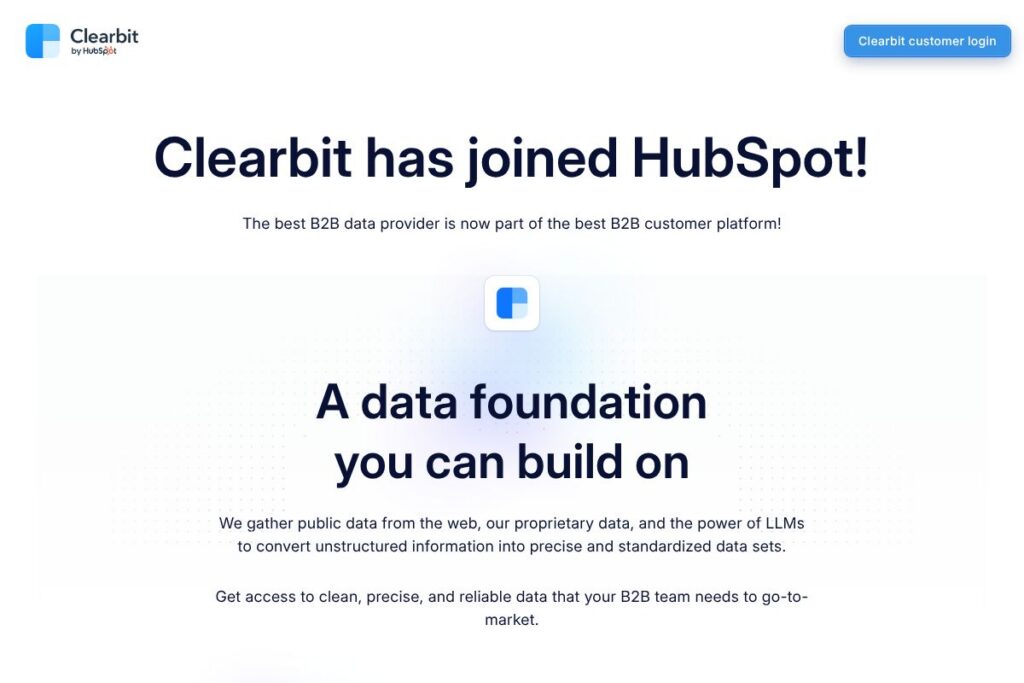
Clearbit supplies B2B company and contact intelligence that helps sales and marketing teams enrich leads, prioritize outreach, and identify buying intent. The platform combines public web data, proprietary sources, and large language model processing to convert unstructured signals into standardized, machine-ready fields for CRM and marketing automation systems.
Since joining HubSpot, Clearbit operates as a native data provider inside the HubSpot ecosystem, which makes real-time enrichment, scoring, and intent signals available without external middleware. Compared with ZoomInfo and Apollo.io, Clearbit emphasizes lightweight, API-first enrichment and deep HubSpot integration rather than large bundled contact databases and heavy outbound tooling.
Clearbit does particularly well at delivering normalized role and seniority fields, granular industry categorization such as 6-digit NAICS, and IP-based intent signals that map directly to HubSpot workflows. This combination makes it a practical choice for mid-market and enterprise teams that need accurate enrichment inside HubSpot and want to act on intent data in real time.
How Clearbit Works
Clearbit ingests public web data and proprietary sources, then applies normalization and LLM-based processing to produce consistent fields such as company name, industry codes, headcount ranges, and standardized role and seniority values. Those fields are written back to CRM records in real time or batched for bulk enrichment.
In HubSpot, Clearbit can enrich new leads as they arrive, update existing contact and company records, and surface intent signals from anonymous website traffic so teams can route high-fit prospects to the right reps. Workflows use Clearbit fields for scoring, dynamic lists, and automated routing rules.
What does Clearbit do?
Clearbit focuses on record enrichment, intent detection, lead scoring, and routing, plus form shortening to reduce friction during lead capture. Recent refinements emphasize AI-driven normalization and HubSpot-native data delivery so teams can run segmentation and automation directly on enriched fields.
Let’s talk Clearbit’s Features
Data Enrichment
Clearbit enriches leads, contacts, and accounts with structured company and person fields that include firmographics, location, employee count, technologies, and standardized job roles. Enrichment occurs in real time for incoming leads and can be applied in bulk to existing databases, which improves segmentation and lead routing in HubSpot.
Intent and IP Intelligence
Clearbit converts anonymous website traffic into intent signals by mapping visitor IPs to organizations and scoring their activity against an ideal customer profile. The visitor dashboard highlights companies showing buying behavior so sales teams can prioritize outreach based on observed interest.
Scoring and Routing
The platform provides the fields and signals needed to create real-time scoring and routing rules inside HubSpot, enabling immediate identification of high-fit leads. Teams can use Clearbit attributes to trigger workflow actions, assign leads to specific reps, or escalate opportunities based on predefined criteria.
Role and Seniority Normalization
Clearbit standardizes free-text job titles into consistent role and seniority categories so systems can map titles to an Ideal Customer Profile without manual cleansing. This makes it easier to build role-based segments, nurture tracks, and routing rules that rely on consistent title taxonomy.
Industry Classification and Company Hierarchy
Clearbit offers granular industry tagging including NAICS, GICS, and SIC classifications and identifies parent-subsidiary relationships to correctly route and account-manage inbound interest. That structure helps account-based programs and enterprise sales teams track opportunities across complex org charts.
Dynamic Form Shortening
Dynamic Form Shortening reduces form friction by populating enrichment fields automatically when an email address or other minimal input is provided. Forms show only missing fields, which increases conversion while preserving complete data coverage for lead records.
AI-Powered Data Normalization
LLM-based processing converts unstructured public signals into precise, standardized attributes that are easier to use in automation and reporting. This helps preserve data quality and reduces the manual effort required to normalize raw inputs into usable CRM fields.
With these capabilities combined, Clearbit delivers a data foundation that supports real-time lead qualification and targeted outbound efforts directly inside HubSpot. For implementation guidance, review Clearbit’s data documentation and HubSpot’s native data provider information.
Clearbit Pricing
Clearbit offers flexible, enterprise-oriented pricing that is typically tailored to business size, usage volume, and integration needs rather than published flat-rate tiers. For specific plan options and quotes, view Clearbit’s current pricing options or contact their sales team to discuss volume-based and HubSpot-native licensing.
What is Clearbit Used For?
Clearbit is used to enrich CRM records, reduce manual data entry, and improve lead qualification through standardized firmographic and person-level fields. Marketing teams use those fields for segmentation, personalization, and dynamic lists while sales teams use them to prioritize outreach and route leads correctly.
It is also commonly applied to identify intent from anonymous web traffic so outbound teams can focus on companies actively researching products or solutions. Clearbit’s form shortening and real-time enrichment are particularly useful for increasing conversion and ensuring new leads arrive in HubSpot with usable data.
Pros and Cons of Clearbit
Pros
- Native HubSpot integration: Clearbit writes enrichment and intent signals directly into HubSpot records and workflows, which simplifies implementation and reduces middleware complexity.
- Granular industry and hierarchy data: Detailed NAICS, GICS, and SIC coding plus parent-subsidiary relationships improve account-based targeting and enterprise routing decisions.
- Role and seniority normalization: Standardized role and seniority fields reduce title parsing work and make segmentation and routing more reliable.
- Dynamic form shortening: Fewer required fields on lead capture forms increase conversions while maintaining data completeness through enrichment.
Cons
- Enterprise pricing model: Pricing is typically custom and volume-based, which can require sales engagement to evaluate total cost and ROI for smaller teams.
- Dependent on enrichment signals: Teams that require zero-latency, 100 percent on-premise data control may need additional validation steps as the platform relies on external and public data sources.
Does Clearbit Offer a Free Trial?
Clearbit offers trial and demo access for evaluation and typically provides product demos or short-term trial arrangements for teams evaluating HubSpot-native data workflows; contact their sales team or visit the Clearbit site to request a demo or trial account.
Clearbit API and Integrations
Clearbit provides developer APIs for enrichment, prospecting, and intent endpoints; the Clearbit API documentation describes endpoints, rate limits, and common usage patterns. Developers can call enrichment APIs to augment lead flows or build custom data pipelines into HubSpot and other systems.
In addition to HubSpot, Clearbit commonly integrates with platforms such as Salesforce, Marketo, Segment, and common analytics and automation tools, enabling teams to route cleaned, normalized attributes across their go-to-market stack. For HubSpot-specific setup, consult HubSpot’s materials on native data providers and marketplace listings.
10 Clearbit alternatives
Paid alternatives to Clearbit
- ZoomInfo — Contact and company database with advanced prospecting, org charts, and intent offerings commonly used by enterprise sales teams. See ZoomInfo’s pricing for subscription tiers and features.
- Apollo.io — Combined prospect database and outreach automation with built-in cadence and CRM enrichment features for outbound teams.
- Lusha — Fast contact enrichment and browser-based enrichment tools focused on direct dials and email addresses for sales reps.
- Lead411 — Intent signals and verified contact data with trigger-based alerts and regional coverage for targeted prospecting.
- InsideView — Market intelligence and data enrichment tailored for enterprise account-based sales and marketing programs.
- Datanyze — Technology stack and firmographic data used to identify potential customers by the tools they use.
Open source alternatives to Clearbit
- OpenCorporates — A public database of company registration data worldwide that can be queried for corporate attributes and basic firmographics.
- Wikidata — Structured, community-maintained knowledge base that contains company and people information useful for enrichment when combined with processing logic.
- DBpedia — Extracted structured data from Wikipedia that can supplement enrichment pipelines with organization and topic metadata.
- GOV open data portals — Country-specific government business registries and open datasets provide authoritative company information for certain regions.
Frequently asked questions about Clearbit
What does Clearbit enrich in my CRM?
Clearbit enriches companies, contacts, and leads with firmographics, standardized roles, industry codes, and intent signals. Enrichment includes company size, industry classifications such as NAICS, and normalized title fields for routing and segmentation.
Does Clearbit work inside HubSpot?
Yes, Clearbit operates as a HubSpot Native Data Provider. That allows Clearbit to write enrichment fields and intent signals directly into HubSpot records and to participate in HubSpot workflows and lists.
Can Clearbit reveal anonymous website visitors?
Yes, Clearbit includes IP-based intent and visitor intelligence to map anonymous traffic to organizations. This capability produces a visitor dashboard and signals that help prioritize outbound outreach to companies showing interest.
Is there a Clearbit API for developers?
Yes, Clearbit provides public APIs for enrichment and intent data. Developers can consult the Clearbit API documentation to integrate enrichment calls into lead capture flows and custom automations.
How does Clearbit handle form shortening?
Clearbit’s Dynamic Form Shortening auto-populates enrichment fields when minimal information such as an email address is provided. Forms display only missing fields so teams capture fewer required inputs while maintaining complete lead records after enrichment.
Final verdict: Clearbit
Clearbit excels at delivering clean, normalized B2B company and contact data directly inside HubSpot, combined with IP-based intent signals and role normalization that improve routing and lead qualification. Its HubSpot-native approach reduces integration overhead and makes it straightforward to act on enriched data in workflows, lists, and routing rules.
Compared with ZoomInfo, Clearbit typically offers a lighter, API-first enrichment experience that is tightly integrated with HubSpot, while ZoomInfo focuses on a large proprietary contact database and bundled prospecting tools. Pricing for Clearbit tends to be custom and usage-based, so teams that need clear public pricing and bundled prospecting may prefer ZoomInfo, whereas teams prioritizing native HubSpot enrichment and streamlined data normalization will find Clearbit better aligned with those needs.
For onboarding details and to evaluate licensing for HubSpot-native delivery, review Clearbit’s product documentation and contact options and HubSpot’s resources on native data providers at the HubSpot site.