Emma: An Overview
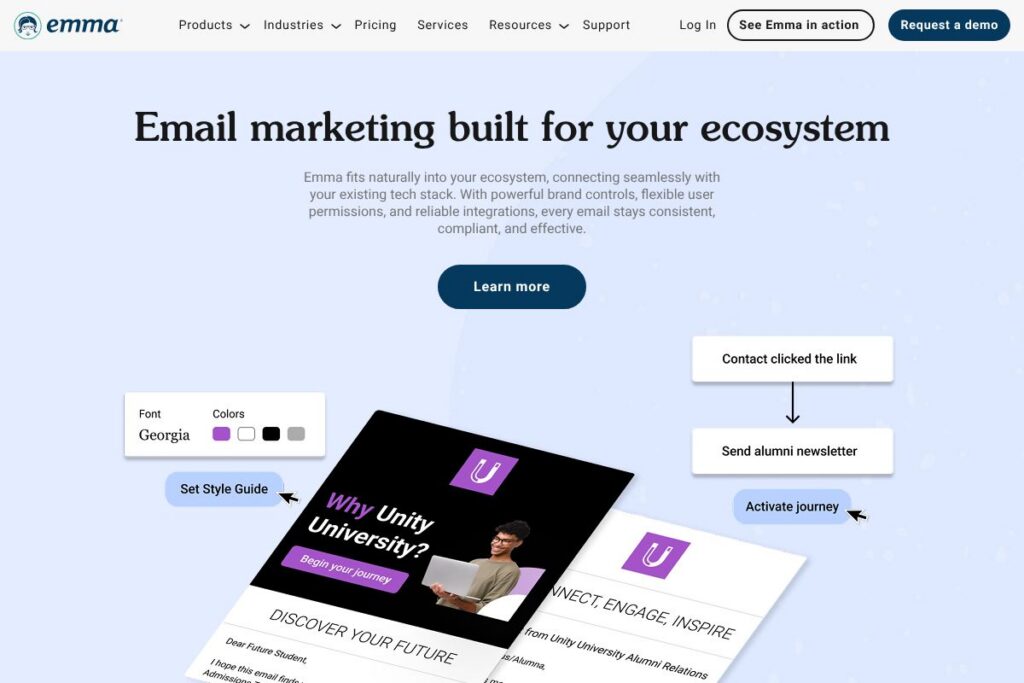
Emma is an email and SMS marketing platform focused on brand control, permissions, and integrations that fit into existing tech stacks. It positions itself for marketing teams at midmarket and enterprise organizations that require centralized brand guidelines, approval workflows, and the ability to send consistent, compliant messages across email and SMS.
Compared with Mailchimp and Constant Contact, Emma emphasizes granular permissions and brand governance rather than a purely self-serve small-business experience. Against Klaviyo, Emma leans toward managed integrations, professional services, and privacy-first AI features that help teams draft messaging that adheres to brand standards. All of this makes Emma well suited to organizations that need collaboration, approval controls, and a multi-channel approach that includes SMS.
Emma performs especially well where brand guidelines, legal approvals, and consistent customer experience matter. It is a practical choice for marketing teams at sports franchises, universities, hospitality groups, and retail brands that need central control over templates, audience segmentation, and message timing.
How Emma Helps Marketing Teams
Emma connects to existing tools and data sources so teams can orchestrate email and SMS campaigns without rebuilding lists or workflows. You can map audiences, apply segmentation rules, and enforce approval gates so content is consistent with brand voice and regulatory requirements.
Campaigns typically follow a collaborative flow: content is drafted with Emma’s AI Assistant or uploaded from templates, routed through permissioned approvers, and scheduled for email and SMS delivery with audience-level targeting and throttling. Integrations and an open API let you trigger campaigns from CRM events, e-commerce purchases, or ticketing systems, creating timely, relevant outreach.
What does Emma do?
Emma centers on campaign creation, audience segmentation, template management, analytics, and multi-channel messaging, with recent emphasis on a privacy-first AI assistant and SMS capabilities. The platform offers integration paths that range from self-service connectors to professional services and an open API for deeper custom work.
Let’s talk Emma’s Features
AI Assistant
Emma’s AI Assistant helps teams draft copy that aligns with brand standards and voice guidelines while keeping data usage private and on-policy. It speeds up content creation for welcome flows, promotional emails, and transactional templates while preserving approval workflows so compliance and legal reviews remain intact.
Template and Brand Controls
Centralized template libraries, locked style elements, and permissioned editing let brand teams maintain consistency across campaigns. Designers can publish approved components so marketers reuse compliant layouts without re-creating assets.
Audience Segmentation and Personalization
Segmentation tools let you build cohorts from CRM attributes, purchase history, and engagement metrics for targeted messaging. Personalization tokens and conditional content enable dynamic messages that improve relevance across email and SMS channels.
SMS Messaging
Emma SMS complements email campaigns by enabling timely, short-form messages for confirmations, reminders, and promotions. Combined email and SMS workflows support coordinated multi-channel journeys and unified reporting on engagement.
Integrations and Open API
Multiple integration paths support plug-and-play connections, premium integrations, and bespoke implementations via an open API. That flexibility helps teams connect Emma to ticketing platforms, CRMs, e-commerce systems, and analytics tools to automate triggers and sync audience data.
Reporting and Deliverability Tools
Analytics dashboards show engagement metrics, deliverability signals, and A/B test results to help optimize campaigns over time. Deliverability tooling and best-practice guidance aim to maintain inbox placement and reduce bounce and complaint rates.
With these capabilities, the biggest benefit is a platform that balances creative speed with governance: teams get automation and AI where it helps, plus controls and review paths where brand and compliance matter.
Emma Pricing
Emma uses a custom pricing approach tailored to organization size, channel mix, and integration needs rather than a single public price sheet. Pricing typically varies based on email volume, SMS usage, number of seats, and optional professional services or premium integrations.
For current rates and plan details, check Emma’s current pricing options or contact their sales team for a quote that matches your deployment and support needs.
What is Emma Used For?
Emma is used to run brand-governed email and SMS campaigns across customer lifecycle stages: acquisition, onboarding, retention, and re-engagement. Teams leverage its segmentation and template controls to ensure that every message aligns with company style and legal requirements.
Organizations also use Emma to centralize campaign approvals and reporting, reducing inconsistencies that arise when multiple teams publish messages from separate tools. The combination of campaign orchestration, SMS, and API connectivity makes it useful for event-driven outreach from CRMs, ticketing systems, and e-commerce platforms.
Pros and Cons of Emma
Pros
- Brand governance and permissions: Emma enforces centralized template and approval workflows so marketing, legal, and design teams maintain consistent, compliant messaging.
- Privacy-first AI: The AI Assistant drafts on-brand copy while respecting privacy controls, speeding content creation without removing oversight.
- Multi-channel coordination: Email and SMS can be orchestrated together, enabling timely, personal customer journeys across channels.
- Flexible integration options: Self-service integrations, premium connectors, professional services, and an open API make it feasible for complex stacks.
Cons
- Custom pricing model: Organizations seeking transparent, line-item pricing may find Emma’s tailored pricing slower to evaluate without a formal quote.
- Less focused on DIY small businesses: Smaller teams that want quick self-serve onboarding and low-cost entry plans may prefer more mass-market solutions.
- Learning curve for enterprise features: Managing permissions, templates, and advanced integrations can require setup time and stakeholder coordination.
Does Emma Offer a Free Trial?
Emma offers custom, quote-based pricing and typically provides demos or trial access on request. Prospective customers can request a demo or trial through the Emma contact channels to evaluate the platform with sample datasets and a guided setup. For arrangements and trial limitations, contact the team via Emma’s contact and demo request options.
Emma API and Integrations
The platform provides an open API and multiple integration paths for common marketing workflows. The API documentation outlines endpoints for audience management, campaign triggering, and report retrieval to integrate Emma with CRMs, ticketing systems, and custom applications.
Common integrations include connectors to major CRMs and e-commerce platforms, as well as ecosystem partners and professional services for custom data syncs and automation. That flexibility supports event-triggered sends, audience enrichment, and consolidated reporting across systems.
10 Emma alternatives
Paid alternatives to Emma
- Mailchimp: A widely used email marketing and automation platform with self-serve plans and a large template library, suited to small and midmarket teams.
- Klaviyo: A data-driven marketing platform focused on e-commerce segmentation and revenue attribution; strong for stores that need deep customer analytics and automated flows.
- Constant Contact: Email marketing with event and contact management features that appeal to nonprofits, small businesses, and local organizations.
- Campaign Monitor: Template-driven campaign management with a focus on design and simplicity, and straightforward reporting for marketers.
- ActiveCampaign: Combines email marketing with CRM and automation tools for customer lifecycle management and sales-marketing workflows.
- Sendinblue (Brevo): Offers email, SMS, and chat capabilities with an emphasis on transactional messaging and developer-friendly APIs.
- HubSpot Marketing Hub: A broader marketing automation suite that includes email, CRM, landing pages, and reporting aimed at inbound marketing teams.
Open source alternatives to Emma
- Mautic: An open source marketing automation platform that supports email campaigns, segmentation, and workflows with self-hosting options.
- Listmonk: A high-performance, self-hosted newsletter and mailing list manager designed for large lists and administrators who prefer full control.
- OpenEMM: A self-hosted email marketing system built for on-premise deployments and enterprise control over deliverability and data.
Frequently asked questions about Emma
What is Emma used for?
Emma is used for email and SMS marketing with brand controls and integrations. Teams use it to create, approve, and send campaigns while maintaining template consistency and audience permissions.
Does Emma integrate with CRMs and ticketing systems?
Yes, Emma integrates with common CRMs and ticketing platforms via connectors and its open API. These integrations enable event-driven campaigns and audience synchronization.
Can Emma send SMS messages as part of a campaign?
Yes, Emma supports SMS messaging alongside email. Marketers can coordinate email and SMS to reach customers with timely, short-form messages for confirmations, reminders, and promotions.
Does Emma provide AI-assisted content tools?
Yes, Emma includes a privacy-first AI Assistant for drafting on-brand copy. The assistant helps teams generate messaging that follows brand guidelines while preserving approval workflows.
Is Emma suitable for enterprise teams?
Emma is designed to support midmarket and enterprise marketing teams that require governance and integrations. Its permissioning, template controls, and professional services make it a fit where compliance and brand consistency are priorities.
Final Verdict: Emma
Emma is a strong option for organizations that need centralized brand governance, permissioned workflows, and multi-channel reach combining email and SMS. The platform is especially useful where legal review, design consistency, and integration with CRMs or ticketing systems are required to maintain a unified customer experience.
Compared with Klaviyo, which focuses on e-commerce segmentation and usage-based pricing, Emma targets teams that prefer a managed approach with professional services and custom pricing. That makes Emma a better fit for brands prioritizing control and compliance, while Klaviyo often appeals to direct-to-consumer merchants seeking fine-grained revenue attribution and automated flows.
If your team needs structured approval paths, a privacy-conscious AI helper, and multiple integration options, Emma is worth evaluating through a demo or trial to see how it maps to your existing stack. For sales or tailored pricing, visit Emma’s official site to request a demo or speak with their team.