Just Eat: An Overview
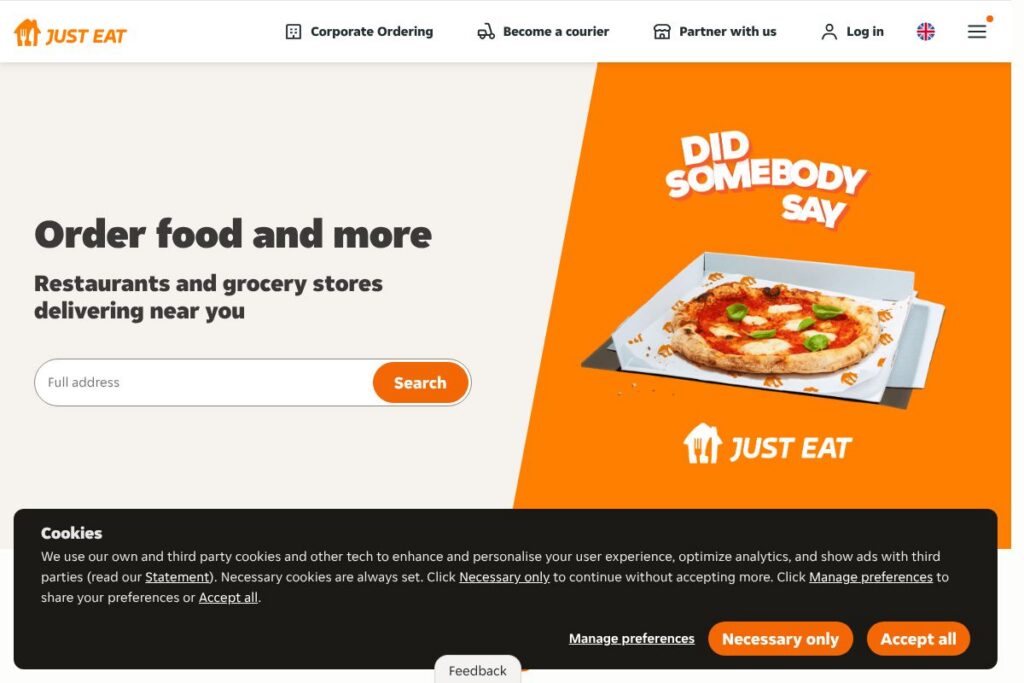
Just Eat is a consumer-facing marketplace that connects people with local restaurants, takeaways, supermarkets, and pharmacies for delivery or collection. The platform aggregates menu listings, delivery options, and local merchants so users can search by postcode, browse by category, place orders, and pay in a single checkout. It is primarily built for on-demand convenience and covers a wide range of food and non-food items in many markets.
Compared with Uber Eats, Just Eat emphasizes broad local coverage and partnerships with small independent takeaways as well as larger chains; Uber Eats often focuses on tightly integrated logistics and restaurant partnerships. Against Deliveroo, Just Eat generally offers a wider restaurant mix in suburban and smaller-town areas while Deliveroo focuses on curated, premium restaurant choices in denser urban zones. Compared to DoorDash, which has expanded aggressively in North America, Just Eat’s footprint is more established in the UK and parts of Europe through localized merchant relationships.
All of this makes Just Eat well suited to consumers who want a single place to order meals, groceries, and essentials from nearby merchants. It works well for people who value choice across many categories and those who prefer either delivery or collection from local shops and restaurants.
How to Use Just Eat
Search and ordering begins with your delivery address or postcode so the platform can surface nearby restaurants and stores that deliver or allow collection. Browse categories like takeaway meals, pizza, Chinese, groceries, or pharmacy items, open a merchant’s menu, then add items to your cart.
At checkout choose delivery or collection, select payment method, and confirm the order. Real-time order status and tracking updates are shown in the app until the merchant or courier completes delivery. For mobile ordering use the Just Eat mobile apps available from the app download page to get push notifications and live tracking.
What does Just Eat do?
Just Eat organizes local on-demand ordering across food, groceries, and household essentials. Core capabilities include merchant discovery, menu and item-level ordering, multiple payment methods, order tracking, and options for delivery or collection. The platform also surfaces promotions and merchant ratings to help customers choose.
Let’s talk Just Eat’s Features
Local merchant listings
Just Eat aggregates restaurants, takeaways, supermarkets, and pharmacies by location so you can see what delivers to your address. This simplifies discovery when you need a meal or essentials quickly and lets smaller vendors reach local customers.
Menu browsing and customization
Menus are presented with categories, item options, and modifiers so customers can customize orders, choose sizes, extras, or special requests. That level of detail helps restaurants capture specific preferences and reduces order errors.
Checkout and payments
The platform supports in-app payment methods and sometimes cash-on-delivery depending on the market and merchant. Multiple payment options make checkout seamless and let customers use cards, digital wallets, or saved payment details.
Delivery tracking and status updates
After ordering you receive real-time status updates and, in many markets, live tracking of couriers. Status indicators show when the merchant accepts the order, when it is prepared, and when it is out for delivery.
Collection (click and collect)
If you prefer to pick up your order, many merchants offer collection slots so you can place an order and arrive when it is ready. Collection reduces delivery wait times and can avoid delivery fees.
Promotions and discounts
Just Eat displays merchant-specific deals and platform promotions at checkout to help reduce order costs. These can include percentage discounts, fixed-value vouchers, or free delivery offers where available.
Ratings and reviews
Customer ratings and reviews are available on merchant pages to help you evaluate food quality and reliability. Ratings influence visibility and help other users choose merchants with strong track records.
Categories beyond food
In addition to prepared meals, the platform lists groceries, convenience goods, and pharmacy items from local stores to cover immediate household needs. This makes Just Eat useful for quick errands when you prefer delivery.
With these capabilities Just Eat helps users find and order from a broad range of local merchants, manage payments, and track orders until delivery or pickup.
Just Eat pricing
Just Eat operates a consumer marketplace model where costs to the user vary by merchant and market, with delivery fees, service charges, and occasional minimum order requirements applied per order. For the latest details on delivery fees, service charges, subscription options, and any merchant-specific costs, check the current delivery fees and service charges listed on Just Eat’s site.
What is Just Eat Used For?
Ordering meals for home delivery is the most common use case, whether you want a takeaway dinner, a family meal, or a treat from a local restaurant. The platform is also used to order groceries, convenience items, and pharmacy essentials when you need them delivered quickly.
Just Eat is suitable for individuals and households who want flexible delivery or collection options across many categories, and for people who prefer browsing multiple nearby merchants in one place rather than ordering from a single restaurant’s site.
Pros and cons of Just Eat
Pros
- Wide local coverage: The platform lists many independent takeaways and local stores as well as national chains, increasing choice in suburban and smaller markets. This helps users find options that are close by and often faster to deliver.
- Multiple order types: Support for both delivery and collection gives flexibility for different needs and budgets. Collection can reduce wait times and delivery fees when available.
- Category breadth: Beyond prepared meals, you can order groceries, household essentials, and pharmacy items from participating local merchants. This reduces the need to switch apps for different types of orders.
- In-app tracking: Real-time status updates and live tracking in many markets improve the ordering experience and reduce uncertainty about delivery times.
Cons
- Variable fees by merchant: Delivery fees and service charges vary widely by merchant and location, which can make final order cost unpredictable. Comparing merchants requires checking each listing and the final checkout summary.
- Quality variance: Because the platform aggregates many independent vendors, food quality and delivery reliability can vary from one merchant to another. Reviews help but do not eliminate variability.
- Dependency on local couriers: Delivery speed and reliability depend on local courier availability, which can fluctuate at peak times and affect estimated arrival times.
Does Just Eat Offer a Free Trial?
Just Eat offers a free-to-download app and browsing the platform is free. Placing orders incurs delivery and service fees set by merchants and by market; some offers and promotions may reduce costs. For details on delivery fees and any subscription benefits, see Just Eat’s ordering pages on the official site.
Just Eat API and Integrations
Just Eat provides merchant and partner integration options so restaurants and stores can receive and manage orders, connect point-of-sale systems, and work with delivery providers. Information for partners and merchants is available on the Just Eat merchant platform.
If you need developer-level access for integrations, check the partner documentation or merchant pages for API details and supported POS integrations. Integration availability and capabilities vary by country and merchant agreements.
10 Just Eat alternatives
Paid alternatives to Just Eat
- Uber Eats — A global food delivery service known for integrated logistics and a wide restaurant selection. Explore Uber Eats at the official site.
- Deliveroo — Focuses on urban, curated restaurant options and fast delivery in dense markets; see Deliveroo for more details at the Deliveroo site.
- DoorDash — Major North American player with marketplace, subscription, and merchant services; visit DoorDash at the DoorDash site.
- Grubhub — A long-standing U.S. marketplace that connects diners with local restaurants; learn more about Grubhub at the Grubhub site.
- Postmates — Now integrated with other delivery networks but still referenced for convenience delivery and diversified merchant types; check Postmates via the Postmates information page.
Open source alternatives to Just Eat
- WooCommerce — An open-source e-commerce platform that restaurants can use to run direct online ordering from their own website, with extensions for delivery. Learn about WooCommerce at the WooCommerce site.
- Magento Open Source — A flexible open-source commerce platform that can be configured for food ordering and delivery workflows; see Magento Open Source at the Magento page.
- Foodsoft — An open-source system used by food co-ops and local distribution groups that can be adapted for community-focused ordering; explore Foodsoft on the project page.
Frequently asked questions about Just Eat
What is Just Eat used for?
Just Eat is used for ordering food, groceries, and essential items from local merchants for delivery or collection. Customers browse nearby merchants, place orders, and choose delivery or pickup based on merchant options.
How does Just Eat charge for delivery?
Just Eat charges delivery fees and service charges that vary by merchant and location. Final fees appear at checkout and may include additional service charges or minimum order requirements depending on the merchant.
Does Just Eat provide contactless delivery options?
Yes, Just Eat supports contactless delivery where merchants and couriers offer it. Contactless options are typically selectable at checkout if available for the merchant and location.
Can restaurants join Just Eat to receive orders?
Yes, restaurants and local merchants can join Just Eat through its merchant platform. The merchant pages explain onboarding, fees, and technical integration options for accepting orders.
Does Just Eat have an API for developers?
Just Eat offers partner and merchant integration options that include APIs for order management and POS connections. Developers and partners should consult the merchant platform documentation for integration details.
Final Verdict: Just Eat
Just Eat excels at providing broad, local coverage for ordering meals, groceries, and essentials through a single consumer marketplace. Its strengths are merchant diversity, multiple order types, and user-facing convenience features like tracking and in-app payments. The platform is particularly useful for suburban and smaller-town users who need access to a wide range of local vendors.
Compared with Deliveroo, Just Eat generally offers a wider merchant mix and stronger presence in non-urban areas, while Deliveroo focuses on curated partnerships and premium, urban delivery experiences. Pricing on both platforms is market- and merchant-dependent with delivery and service fees applied at checkout, so buyers should compare final order costs and delivery times when choosing between them.