Nextiva: An Overview
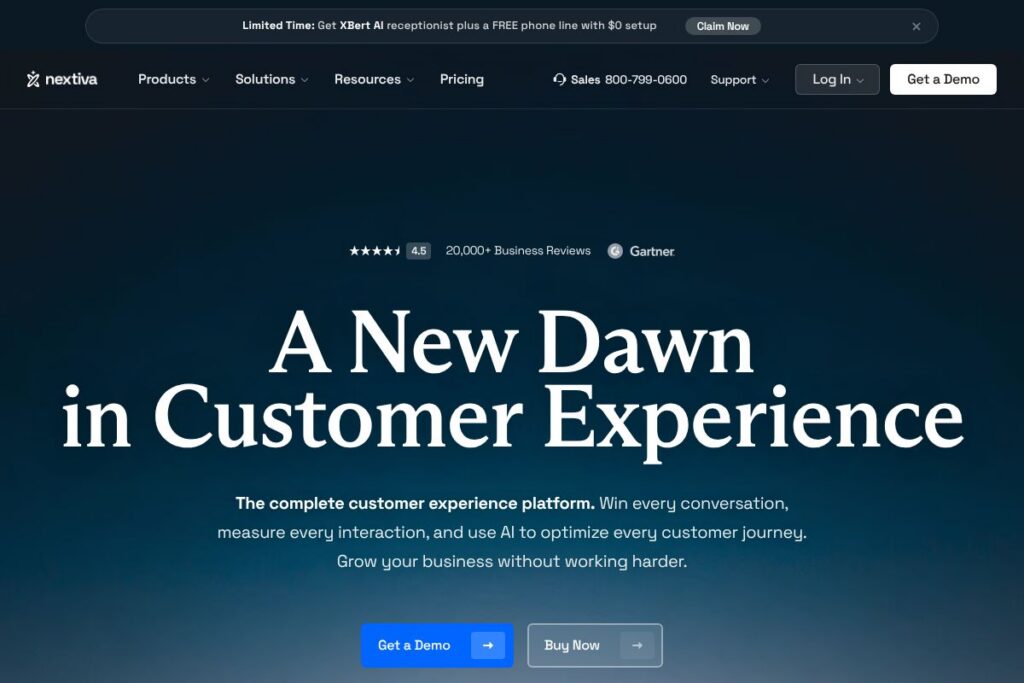
Nextiva is a unified customer experience platform built to centralize voice, video, messaging, contact center operations, and AI automation into a single system. It focuses on delivering consistent visibility across customer interactions and uses AI capabilities to automate routine tasks like appointment booking, routing, and FAQ responses.
Compared with RingCentral, Nextiva places a heavier emphasis on embedded AI receptionist and journey orchestration tied directly to contact center flows. Compared with Zendesk, Nextiva bundles telephony and SMS into the same platform rather than relying primarily on ticketing as the central object. Compared with Twilio Flex, Nextiva offers a more packaged, turnkey solution with prebuilt CX workflows rather than a developer-first toolkit.
All of this makes Nextiva particularly well suited for teams that need an integrated communications stack with built-in AI automation and unified reporting. It fits businesses from small local operations up to enterprise contact centers that require real-time visibility and automated handling of routine interactions.
How Nextiva Works
Nextiva combines a cloud telephony core with a contact center layer and an AI agent called XBert that can take actions across channels. Calls, chats, emails, and SMS flow into a unified workspace where context, transcripts, and customer history are available to agents in real time.
XBert handles automated touches such as scheduling, simple question answering, record updates, and routing; when a conversation needs human attention, the platform performs an intelligent handoff so agents have the full context. Administrators configure routing, skills-based queues, and journey orchestration rules to match business processes and compliance requirements.
On the technical side, Nextiva connects to CRMs, helpdesk systems, EHRs, and productivity tools so data flows between systems, and administrators use dashboards and voice analytics to monitor performance and tune AI behavior. The vendor provides an integration marketplace to connect common business systems and REST APIs for custom workflows.
What does Nextiva do?
Nextiva centers on four capability areas: multichannel customer interactions, AI-driven automation, contact center operations, and integrations that link communications to business systems. Recent product emphasis is on agentic AI for routine conversations and expanded analytics that track satisfaction and journey metrics.
Let’s talk Nextiva’s Features
Customer Interactions
Nextiva consolidates voice, video, chat, email, and social messaging into a single workspace so teams can manage all customer communication without context switching. Unified interaction history and transcriptions ensure agents see prior contacts and can pick up conversations quickly, which reduces handle time and repeat contacts.
XBert AI
XBert is an AI agent that conducts conversations across voice, chat, SMS, and email to answer FAQs, book appointments, and update records autonomously. The AI can be configured with business policies and guardrails, and it hands off to humans when complexity exceeds configured thresholds, reducing agent workload on routine tasks.
AI Receptionist and Appointment Booking
The AI receptionist automates inbound routing, availability checks, and appointment scheduling so callers reach the right resource without manual intervention. This capability lowers missed connections and supports higher conversion rates for sales and service teams.
Contact Center Functionality
Nextiva offers blended inbound and outbound contact center features including skills-based routing, queue management, and campaign dialing. Supervisors use real-time dashboards and voice analytics to manage staffing and measure service levels across channels.
Unified Phone System
The business phone service supports unlimited calling, voicemail transcription, video meetings, and team messaging across devices with quick setup for new numbers and users. Mobile and desktop apps provide consistent feature parity for remote and hybrid teams.
Integrations and Open APIs
Nextiva connects to major CRMs like Salesforce and HubSpot, helpdesk systems such as Zendesk, productivity suites like Microsoft Teams and Google Workspace, and industry systems including Epic for healthcare workflows. REST APIs enable custom integrations and data exchange with internal systems.
Analytics and Reporting
Built-in dashboards surface CSAT, NPS, response times, transcription summaries, and custom reports to measure customer experience across touchpoints. Real-time alerts and historical reporting help teams identify friction points and track improvements after AI or process changes.
With these capabilities, Nextiva aims to reduce busywork with automated interactions while giving teams the tools to focus on high-value conversations. The biggest practical benefit is unified visibility across channels combined with automation that reduces routine agent tasks.
Nextiva pricing
Nextiva uses a subscription-based pricing model with tiered plans and optional add-ons for AI receptionist and advanced contact center features; enterprise contracts are available for large deployments. Pricing typically depends on seat counts, required channels, and add-on modules for contact center and XBert capabilities.
For current plan details, customized quotes, and information about trial or demo options, see Nextiva’s official website or explore their integration marketplace for an overview of capabilities that may affect pricing. Contact sales to get a tailored proposal based on your user count and required integrations.
What is Nextiva Used For?
Nextiva is commonly used to centralize communications for customer service, sales teams, and small IT helpdesks that need voice, digital channels, and reporting in one place. Organizations use it to reduce missed connections, automate scheduling, and maintain consistent customer histories across touchpoints.
It is also used by enterprise contact centers that require blended inbound and outbound campaigns, skills-based routing, and real-time analytics. Industry use cases include healthcare patient outreach, financial services client support, retail customer care, and high-volume messaging on platforms such as WhatsApp.
Pros and Cons of Nextiva
Pros
- Unified multichannel platform: Consolidates voice, chat, email, SMS, and video into a single interface so teams have full customer context and fewer handoffs. This reduces repeat contacts and speeds up resolution times.
- Agentic AI with guardrails: XBert automates routine conversations including appointment booking and common FAQs, which lowers agent workload while allowing administrators to control escalation rules. Automation improves response rates and consistency on repetitive tasks.
- Broad integrations: Native connectors to CRMs, helpdesk systems, productivity suites, and EHR platforms reduce data silos and allow workflows to span systems. Built-in integrations accelerate onboarding and maintain data fidelity.
Cons
- Complexity for very small teams: The platform offers enterprise-grade features that can be more than small businesses need, which may require additional setup and configuration effort. Smaller teams may prefer a simpler, phone-only provider for immediate needs.
- Custom pricing for large deployments: Enterprise contracts and add-ons mean pricing varies by use case and often requires engagement with sales for a detailed quote, which can slow procurement for fast-moving teams.
Does Nextiva Offer a Free Trial?
Nextiva offers free trial and demo options that let prospective customers test core telephony, messaging, and contact center capabilities; many organizations start with a demo that includes a walkthrough of XBert automation. To request a trial or demo and confirm trial feature availability, use Nextiva’s contact and demo request page.
Nextiva API and Integrations
Nextiva provides REST APIs and an Integration Marketplace to connect telephony, contact center events, and transcripts with CRMs, helpdesk tools, and industry systems. The integration marketplace lists connectors for platforms such as Salesforce, HubSpot, Zendesk, Microsoft Teams, and sector-specific systems like Epic.
Developers can use API endpoints to pull call records, push contact data, and trigger workflows; for integration details and developer resources, consult Nextiva’s integration listings and developer resources to plan custom workflows.
10 Nextiva alternatives
Paid alternatives to Nextiva
- RingCentral — Cloud communications platform that combines phone, video, messaging, and contact center services with a strong focus on global PSTN coverage. Good fit for distributed teams requiring global telephony.
- Zendesk — Customer service platform centered on ticketing and digital channels, with add-on voice options; best for teams that prioritize ticket workflows and self-service support.
- Five9 — Focused cloud contact center solution with advanced routing, workforce optimization, and campaign management for high-volume service teams.
- Twilio Flex — A programmable contact center platform for teams that want a developer-first, highly customizable CX stack and pay-as-you-go flexibility.
- Genesys Cloud — Enterprise-grade contact center with advanced routing, AI orchestration, and omnichannel analytics for large contact centers.
- 8×8 — Broad unified communications platform with integrated contact center features, competitive global calling plans, and analytics.
Open source alternatives to Nextiva
- Asterisk — Open source telephony engine for building PBX and contact center solutions, requiring self-hosting and engineering resources to assemble a full CX stack.
- FreeSWITCH — Telephony platform that supports voice, video, and signaling for custom communications projects, suited to teams with in-house VoIP expertise.
- Zammad — Open source helpdesk and ticketing system that covers multichannel inbox management and can be paired with open telephony components for a custom CX setup.
Frequently asked questions about Nextiva
What is Nextiva used for?
Nextiva is used to unify business communications and customer experience across voice, chat, email, and SMS. Organizations use it to centralize interaction history, automate routine tasks with AI, and run contact center operations.
Does Nextiva integrate with Salesforce and HubSpot?
Yes, Nextiva offers native integrations with CRMs such as Salesforce and HubSpot. These integrations sync contact and interaction data so sales and service teams see customer context during calls and messages.
Can Nextiva automate appointment scheduling?
Yes, Nextiva’s AI capabilities include appointment booking and confirmation. XBert can check availability, create calendar invites, and send confirmations across channels.
Is Nextiva suitable for enterprise contact centers?
Yes, Nextiva supports enterprise contact center features such as skills-based routing, blended queues, and real-time analytics. The platform scales with add-ons and custom enterprise contracts for larger deployments.
Does Nextiva provide APIs for custom integrations?
Yes, Nextiva provides REST APIs and an integration marketplace for custom workflows. Developers can use these APIs to extract call data, push customer updates, and connect telephony events to backend systems.
Final Verdict: Nextiva
Nextiva stands out as a comprehensive CX platform that bundles business phone, contact center operations, and agentic AI into a single product. Its emphasis on XBert automation and unified interaction histories reduces routine agent work and gives teams consistent visibility across channels.
Compared with RingCentral, Nextiva tilts more toward integrated AI receptionist and journey orchestration while both vendors use subscription pricing and offer enterprise tiers; Nextiva’s packaged approach can mean faster time to value for teams that want built-in CX workflows, whereas RingCentral may appeal to organizations prioritizing global telephony scale or broader PBX feature sets. Overall, Nextiva is a strong choice for teams that want unified communications with embedded AI to handle the busywork and surface real-time customer insights.