What is Oracle Simphony
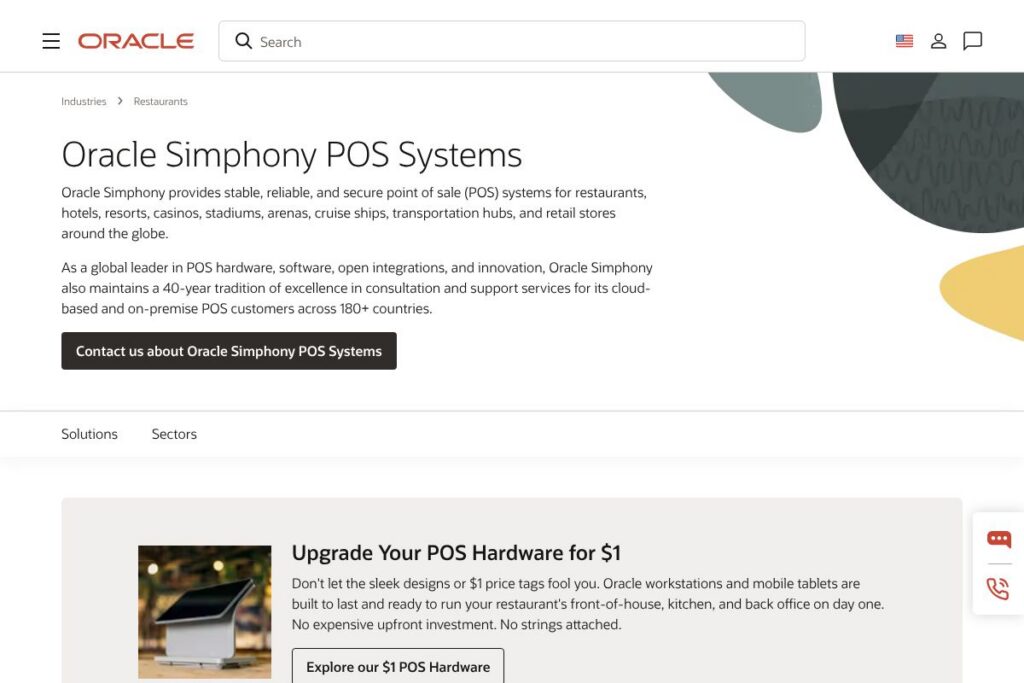
Oracle Simphony is a point-of-sale and operations platform that combines POS terminals, mobile ordering, kitchen display systems, reporting, and integrations for restaurants, hotels, stadiums, transportation hubs, casinos, and retail stores. It supports both cloud and on-premise deployments and is designed for organizations that need centralized control across multiple locations and varying regulatory environments.
Compared with Toast, which focuses primarily on the North American restaurant market with SMB-friendly pricing and an ecosystem of restaurant-specific apps, Oracle Simphony targets larger and international operations with deeper property management and enterprise integration options. Against Lightspeed, which emphasizes retail and hospitality with out-of-the-box e-commerce and inventory tools, Simphony places more emphasis on large-venue scale, multi-site fiscal compliance, and integration with property management systems. Compared with Clover, which is hardware and SMB focused with easy setup, Simphony offers a more comprehensive suite for complex venue workflows and global support.
All of this makes Oracle Simphony a strong choice for enterprise and multi-location hospitality operations that require global localization, advanced kitchen orchestration, and a single platform to manage front-of-house, back office, and integrations. It is particularly well suited to hotels, large restaurant groups, stadiums, and retail chains that need robust reporting, compliance, and consultative support.
How Oracle Simphony Works
Simphony runs as a modular platform combining POS workstations, handheld devices, kiosks, and kitchen displays with a centralized management layer that can be hosted in the cloud or deployed on-premise. Transactions, menus, and inventory sync to a central configuration so changes propagate to terminals, kiosks, and kitchen displays in real time or via scheduled updates depending on connectivity and site needs.
In a typical restaurant workflow, servers or handheld tablets capture orders that flow to Oracle Simphony KDS for kitchen routing, with timers and priority levels to manage multi-station prep. The system ties into inventory and purchasing modules so ingredient usage from each prep station adjusts stock levels automatically, and reporting collects sales, labor, and guest data for analytics.
For hospitality and retail, Simphony integrates with property management systems and retail order management to link room charges, retail transactions, or event sales to guest profiles and centralized loyalty programs. Third-party payment processors, delivery platforms, and ERP systems connect via open APIs and vetted marketplace partners to extend capabilities without replacing core infrastructure.
What does Oracle Simphony do?
Simphony is organized around core POS workflows, kitchen orchestration, inventory and labor control, loyalty and payments, and extensible integrations for third-party apps. Recent platform priorities emphasize cloud management, global fiscal compliance, improved kitchen display ergonomics, and an expanding partner ecosystem on the Oracle Cloud Marketplace.
Let’s talk Oracle Simphony’s Features
Core POS and Transactions
The POS layer handles order entry, modifiers, item-level pricing, table management, and payments across stationary terminals, mobile tablets, and handheld devices. It supports split checks, seat-level ordering, reservation integration, and synchronized menus so operators can manage promotions and price changes centrally and push them to all devices.
Kitchen Display System (KDS)
KDS replaces paper tickets with touch-enabled displays, bump bar support, and remote station views to prioritize items and manage timing across prep stations. The system accepts orders from multiple channels including servers, kiosks, mobile apps, and third-party delivery platforms which reduces errors and shortens ticket-to-plate times.
Mobile POS and Self-Service Kiosks
Simphony supports mobile tablets for tableside ordering and staff handhelds for line-bust operations, plus self-service kiosks that update menus and pricing centrally. Kiosk integration allows for upsell logic and synchronized menu changes across in-house and digital channels to maintain consistency and reduce management overhead.
Inventory and Cost Control
Inventory management tracks ingredients, SKUs, and recipe usage tied to sales so food cost and shrinkage can be monitored in near real time. The system supports vendor catalogs, purchase orders, and stock alerts to help operations plan replenishment and forecast needs based on historical sales and seasonality.
Reporting and Analytics
Built-in dashboards surface sales, labor, profitability, and menu performance across single sites and multi-location portfolios. Custom reports and KPI exports enable finance and operations teams to analyze trends, measure campaign impact, and reconcile point-of-sale data with back-office systems.
Loyalty, Gift, and Payments
Simphony includes tools for running gift card programs, loyalty tracking, and promotions while integrating with major payment processors and mobile wallets. Centralized guest profiles let teams apply personalized offers and link spend across outlets and stays for hospitality properties.
Integrations and Extensibility
An open API and a curated partner ecosystem on the Oracle Cloud Marketplace make it straightforward to connect delivery aggregators, payment gateways, property management systems, and analytics platforms. This modular approach helps operations tailor the stack to venue-specific requirements without custom rework of core POS logic.
The biggest advantage of Simphony is its ability to operate at enterprise scale while supporting the specific needs of kitchens, properties, and venues across global markets. Centralized control, robust kitchen orchestration, and a broad integration ecosystem are the capabilities that most teams will value most.
Oracle Simphony pricing
Oracle Simphony uses enterprise licensing and custom pricing tailored to deployment model, number of terminals, hardware packages, and integration requirements. Pricing is generally quoted per-site or per-portfolio with options for cloud subscription or on-premise licensing and implementation services.
For detailed pricing, deployment options, and hardware promotions consult the Oracle Simphony product page or contact Oracle sales for a tailored quote and to discuss hardware upgrade programs and support plans.
What is Oracle Simphony Used For?
Oracle Simphony is used to run point-of-sale operations, kitchen workflows, inventory, and guest transactions for restaurants, hotels, casinos, stadiums, transportation hubs, and retail outlets. It centralizes menu and pricing control and provides the reporting and compliance features needed by multi-site and international operations.
Teams use Simphony to support a mix of sales channels including in-house servers, drive-thru, kiosks, mobile ordering, and third-party delivery integrations while maintaining consistent inventory and loyalty programs. Hospitality properties use it to integrate room charges, event sales, and dining spend into single guest profiles for reporting and promotions.
Pros and Cons of Oracle Simphony
Pros
- Enterprise-grade global support: Oracle provides localized fiscal, tax, and language support across 180+ countries which helps multinational chains comply with local regulations and reporting requirements.
- Comprehensive venue coverage: The platform supports restaurants, hotels, stadiums, and retail with modules for POS, KDS, inventory, and PMS integration, enabling unified operations across diverse site types.
- Open integrations and partner ecosystem: The presence on the Oracle Cloud Marketplace and an open API make it easier to connect payment processors, delivery platforms, and analytics tools to extend functionality.
- Hardware programs and lifecycle management: Oracle offers bundled POS workstations, handhelds, and kiosk hardware with upgrade programs intended to reduce upfront capital expenditure for customers.
Cons
- Enterprise focus can mean higher TCO for small sites: Smaller independent restaurants may find the platform and implementation scope more complex and costly compared with SMB-first POS providers.
- Implementation complexity: Deploying a multi-site Simphony installation with custom integrations and localized compliance requires planning, professional services, and time which can extend go-live schedules.
- Fewer off-the-shelf SMB features: For quick, out-of-the-box setups aimed at single-site operators, competitors with plug-and-play retail or restaurant packages may be faster to adopt.
Does Oracle Simphony Offer a Free Trial?
Oracle Simphony is offered under custom licensing with demos and pilot programs available rather than a public free tier. Prospective customers can request a product demonstration or pilot deployment through Oracle to evaluate workflows, hardware, and integrations prior to committing to a full implementation.
Oracle Simphony API and Integrations
Oracle Simphony provides developer-facing APIs and a partner ecosystem to connect payments, delivery platforms, property management systems, and analytics applications. The Oracle Cloud Marketplace lists vetted integrations and third-party applications that extend Simphony for specific venue needs.
For technical teams, Oracle publishes integration guides and partner documentation that outline endpoints for orders, inventory, and guest data used to build connectors or to integrate middleware and ERP systems.
10 Oracle Simphony alternatives
Paid alternatives to Oracle Simphony
- Toast — A restaurant-focused POS and operations platform popular with single-site and multi-location operators in North America; includes online ordering, delivery integrations, and labor tools.
- Lightspeed — A cloud POS for retail and hospitality with inventory, e-commerce, and omnichannel features geared toward high-growth retailers and restaurateurs.
- Clover — A hardware-and-software POS ecosystem that provides simple setup and integrated payments for SMB retailers and restaurants.
- Square for Restaurants — An easy-to-deploy POS and payments solution designed for small to mid-sized restaurants with integrated payments and online ordering.
- NCR Aloha — A long-standing restaurant POS system with robust concession, QSR, and full-service capabilities and deep integrations for large-scale venue operations.
- Revel Systems — A cloud-native POS focused on enterprise-grade restaurant and retail customers with APIs for custom integrations.
- POSitouch — A restaurant-specific POS with strong kitchen routing, inventory, and multi-site management features aimed at multi-unit operators.
Open source alternatives to Oracle Simphony
- Odoo POS — Part of the Odoo ERP suite, the POS module is open source and integrates with inventory, e-commerce, and accounting in a single platform.
- uniCenta — An open source POS system compatible with multiple OS platforms that supports retail and hospitality workflows with plugin extensibility.
- Chromis POS — A Java-based open source POS that supports kitchens, printers, and multiple payment flows for small and mid-sized venues.
- Floreant POS — An open source restaurant POS with features for table management, kitchen printing, and basic inventory functions suitable for independent restaurants.
Frequently asked questions about Oracle Simphony
What is Oracle Simphony used for?
Oracle Simphony is used to run POS transactions, kitchen operations, inventory, and guest services for restaurants, hospitality and retail venues. It centralizes menu control, reporting, and integrations across single and multi-site deployments.
Does Oracle Simphony integrate with property management systems?
Yes, Oracle Simphony integrates with property management systems and hospitality platforms. That integration lets hotels and resorts post charges to rooms, consolidate guest profiles, and coordinate loyalty programs across stays and dining spend.
Can Oracle Simphony handle offline transactions?
Yes, Simphony supports offline or local transaction processing for sites with intermittent connectivity. Deployed terminals can continue to process orders and sync back to the central server when network connectivity is restored.
Is Oracle Simphony suitable for stadiums and large venues?
Yes, Oracle Simphony is designed for high-volume environments such as stadiums, arenas, and entertainment venues. The platform supports compact concession hardware, mobile vending, self-service kiosks, and high-throughput payment processing.
Does Oracle Simphony offer integrations with third-party delivery platforms?
Yes, Oracle Simphony connects to third-party delivery and online ordering platforms via APIs and marketplace partners. The open integration approach allows orders from multiple channels to flow into the POS and kitchen systems.
Final verdict: Oracle Simphony
Oracle Simphony excels at serving enterprise-scale hospitality, multi-site restaurant groups, stadiums, casinos, and retail chains that need centralized control, international compliance, and strong kitchen orchestration. Its combination of cloud and on-premise deployment options, dedicated hardware programs, and a broad partner ecosystem make it a fit for organizations that require reliability across complex operations.
Compared with Toast, which is more SMB-focused with transparent pricing and fast time-to-value, Oracle Simphony targets larger and international deployments with custom pricing and deeper property management and venue integration capabilities. Organizations that need a platform tailored to complex, multi-venue workflows and global support will find Oracle Simphony’s consultative approach and enterprise features especially valuable.