RingCentral: An Overview
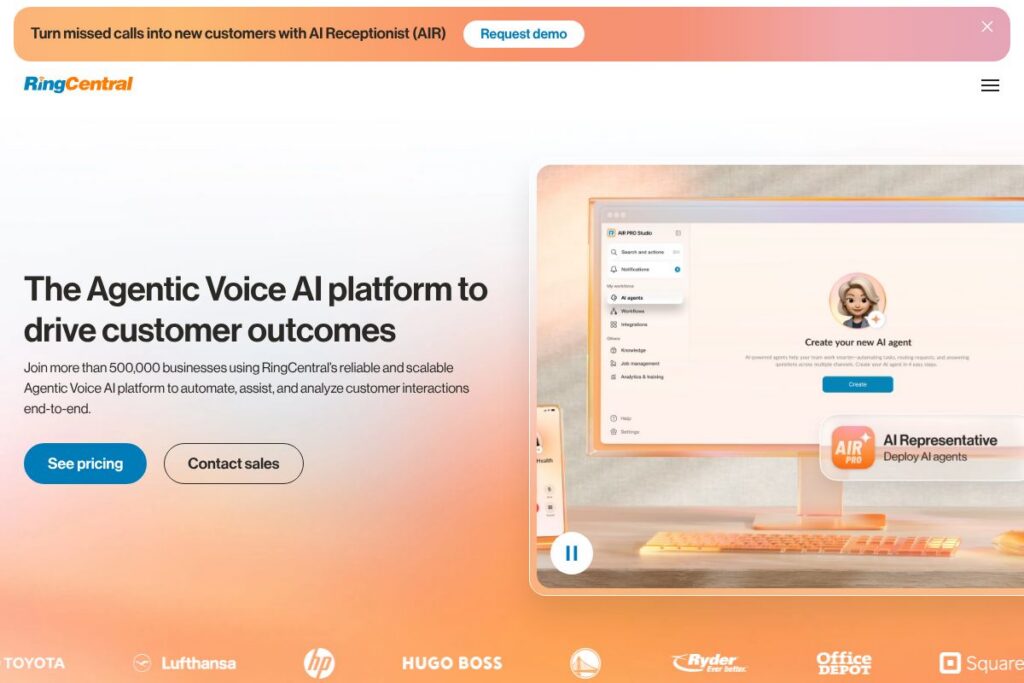
RingCentral is a unified communications platform that combines cloud telephony, messaging, video meetings, and contact-center capabilities with a suite of Agentic Voice AI products. Its AI portfolio includes AI Receptionist (AIR), AI Virtual Assistant (AVA), AI Conversation Expert (ACE), and the AIR Pro builder for custom conversational agents that operate across voice, SMS, chat, and social channels.
Compared with competitors, RingCentral focuses more heavily on telephony and contact-center automation than Zoom, which centers on meetings and conferencing, and more on AI-driven voice outcomes than Microsoft Teams, which ties communications into broader Microsoft 365 productivity bundles. Compared with developer-first communications platforms like Twilio, RingCentral ships more packaged, enterprise-ready voice and contact-center features out of the box, alongside an open platform for integrations and custom development.
All of this makes RingCentral well suited for organizations that need reliable global voice infrastructure, contact-center automation, and prebuilt AI agents. It is particularly useful for customer-facing teams in healthcare, finance, retail, and services that require 24/7 voice coverage, transcription, and integrated analytics.
How RingCentral Works
RingCentral runs as a cloud-hosted communications platform that connects users across SIP, mobile apps, web clients, and desk phones. Incoming calls and messages flow through configurable routing rules and can be handled by human agents, prebuilt AI agents, or a hybrid combination where AI assists live agents with real-time suggestions and note capture.
AI agents are deployed using the Agentic Voice AI framework: out-of-the-box agents provide intent recognition and common workflows, while AIR Pro provides a drag, drop, and describe interface to create custom agents without coding. Administrators manage agents, callflows, integrations, and reporting from a centralized admin console while leveraging the platform’s open APIs to connect CRM, workforce management, and analytics systems.
What does RingCentral do?
RingCentral combines cloud PBX, meeting and webinar services, messaging, and a contact-center suite with AI capabilities to automate common customer outcomes. The platform emphasizes voice-first automation, including 24/7 call answering, call routing, booking, and seamless escalation to live agents, plus capture of call notes and transcripts for analytics.
Let’s talk RingCentral’s Features
Agentic Voice AI
Agentic Voice AI is RingCentral’s umbrella for voice-first AI agents that handle intent recognition, task automation, and conversation orchestration across voice, chat, and SMS. The system creates a self-learning flywheel by capturing interaction data that improves agent performance and helps teams refine workflows over time.
AI Receptionist (AIR)
AIR provides automated call answering, routing, and FAQ handling so organizations can answer calls 24/7 and reduce missed leads. It can transfer complex queries to human agents and escalate urgent interactions while logging call metadata for follow-up.
AI Virtual Assistant (AVA)
AVA assists live agents in real time with suggested responses, call summaries, and relevant customer context from integrated systems. This reduces average handle time and helps agents maintain consistent, accurate interactions across channels.
AI Conversation Expert (ACE)
ACE provides post-call analysis, sentiment detection, and automated summarization to capture perfect notes and reveal trends. Teams can use these insights to spot coaching opportunities, compliance issues, and service gaps.
AIR Pro (Custom Agent Builder)
AIR Pro lets non-developers build and iterate on conversational agents using natural language prompts, drag-and-drop flows, and industry accelerators such as healthcare templates. Custom agents can be deployed across voice, SMS, chat, and social channels without writing code.
Video, Events, and Hybrid Meetings
RingCentral’s video offering supports meetings, webinars, and virtual events with integrated calling and AI-enabled features for engagement and accessibility. These tools are designed to connect distributed teams and external audiences with recording, transcription, and moderation controls.
Analytics and Conversation Intelligence
Built-in analytics aggregate conversation details, call outcomes, and agent performance into dashboards and reports that reveal trends and help close operational gaps. Organizations can move from transactional metrics to richer customer and deal insights using conversation-level data.
Integrations and Open APIs
RingCentral supports an open platform with over 500 prebuilt integrations and public developer APIs for custom workflows and CRM connections. The RingCentral developer documentation provides endpoints for telephony, messaging, and contact-center automation so teams can extend functionality into existing systems.
Global Scale and Reliability
RingCentral operates a globally distributed cloud architecture that supports enterprise telephony, compliance, and high-availability voice services. The platform is suitable for multi-site deployments, regulated industries, and organizations that require consistent uptime and carrier-grade call handling.
RingCentral’s biggest feature is its combination of production-ready voice infrastructure and an AI agent framework that moves organizations from manual call handling to automated, measurable outcomes. That combination makes it practical to automate routine tasks while retaining tight control and integration with business systems.
RingCentral pricing
RingCentral uses a subscription and enterprise pricing model with tiers for small teams and add-on pricing for contact-center and advanced AI capabilities. Pricing is commonly tailored to deployment size, required features, and contact-center scale rather than a single public list for every configuration.
RingCentral offers flexible licensing and enterprise plans; for exact rates and configuration guidance, check RingCentral’s current pricing options or contact their sales team through the RingCentral homepage to discuss needs and obtain a custom quote.
What is RingCentral Used For?
RingCentral is used for cloud telephony and contact-center operations that require reliable voice routing, automated call handling, and integrated messaging and meetings. Teams deploy it to answer calls 24/7, route customers to the right specialist, book appointments without human handoffs, and capture conversation data for downstream systems.
It is also used by IT and DevOps teams to integrate communications into business applications via APIs, and by customer experience leaders seeking to apply AI for real-time assistance and post-call analytics. Industries with high call volumes such as healthcare, finance, retail, and professional services benefit from the platform’s AI accelerators and compliance features.
Pros and Cons of RingCentral
Pros
- Comprehensive voice and contact-center platform: RingCentral combines PBX, contact center, meetings, and messaging in a single platform, reducing vendor sprawl and simplifying administration.
- Agentic Voice AI suite: The set of AI products such as AIR, AVA, and ACE automate call handling, real-time assist, and conversation analysis, which helps reduce response times and capture accurate notes.
- Custom agent builder: AIR Pro enables non-developers to create custom conversational agents using natural language prompts and drag-and-drop flows, accelerating deployment of industry-specific workflows.
- Extensive integrations and APIs: With hundreds of prebuilt integrations and a public developer portal, RingCentral connects to CRM, ticketing, and workforce tools to build end-to-end automation.
- Global scale and reliability: The platform supports enterprise-grade telephony, high availability, and regulatory compliance across multiple regions.
Cons
- Complexity for small teams: The breadth of features and configuration options can be more than smaller teams need, making setup and administration heavier for simple use cases.
- Enterprise-oriented pricing model: Pricing is typically tailored and can involve add-ons for advanced contact-center features, which may increase total cost for high-volume deployments.
- Learning curve for AI tuning: While AIR Pro reduces coding needs, refining AI agents for edge cases and regulatory constraints requires planning and iterative tuning.
Does RingCentral Offer a Free Trial?
RingCentral offers trial and demo options for prospective customers, and trial availability varies by product and region; organizations are advised to request a demo or trial directly through RingCentral sales or product experts to evaluate Agentic Voice AI capabilities before purchasing.
RingCentral API and Integrations
RingCentral provides public developer APIs and SDKs for telephony, messaging, meetings, and contact-center workflows; the developer documentation includes guides, sample code, and API reference for building custom integrations. Key prebuilt connectors include integrations for Salesforce, Microsoft 365, Google Workspace, Slack, and major CRM and ticketing platforms.
For organizations that need deeper automation, RingCentral’s open platform supports webhooks, event-driven integrations, and outbound connectors to ETL and analytics systems, enabling conversion of conversation data into operational insights.
10 RingCentral alternatives
Paid alternatives to RingCentral
- Zoom — Strong meeting and webinar capabilities with optional Zoom Phone for cloud telephony and call handling.
- Microsoft Teams — Integrated with Microsoft 365, combining chat, meetings, and calling, often bundled with existing Microsoft subscriptions.
- Twilio — Developer-focused communications platform ideal for custom programmable voice, SMS, and contact-center experiences.
- 8×8 — Cloud contact-center and unified communications provider with global telephony and analytics features.
- Vonage — Cloud communications platform offering voice, messaging, and contact-center services with developer APIs.
- Dialpad — AI-enhanced calling and contact-center platform focused on voice intelligence and agent assistance.
- Cisco Webex — Enterprise conferencing and calling platform with contact-center integrations and global infrastructure.
Open source alternatives to RingCentral
- Asterisk — Widely used open-source PBX engine for building custom telephony platforms and IVR systems.
- FreeSWITCH — Scalable telephony engine for voice, video, and messaging that supports custom call routing and media handling.
- Jitsi — Open-source video conferencing with components that can be integrated into broader communication stacks.
- BigBlueButton — Open-source web conferencing system oriented at education and webinars with integrated recording and chat.
Frequently asked questions about RingCentral
What is RingCentral used for?
RingCentral is used for cloud telephony, contact-center operations, and unified communications. Organizations use it to manage voice, messaging, and meetings while automating customer interactions with Agentic Voice AI.
Does RingCentral provide APIs for developers?
Yes, RingCentral offers public APIs and SDKs. The developer documentation includes API references, SDKs, and examples for telephony, messaging, and contact-center automation.
Can RingCentral handle healthcare call workflows?
Yes, RingCentral includes healthcare-ready accelerators and compliance features. The platform supports templates and integrations designed to launch AI agents quickly for patient intake, appointment booking, and secure communications.
Is RingCentral suitable for global deployments?
RingCentral is designed for global scale and high availability. It provides carrier-grade telephony, regional compliance features, and redundancy to support multi-site and multinational organizations.
How does RingCentral support analytics and quality coaching?
RingCentral captures conversation-level data and provides analytics and conversation intelligence. Teams can review transcripts, sentiment, and performance metrics to identify trends, coach agents, and improve customer outcomes.
Final Verdict: RingCentral
RingCentral stands out as a comprehensive communications and contact-center platform with a clear emphasis on voice-first AI that automates outcomes and captures conversation intelligence. Its Agentic Voice AI suite combined with a global cloud telephony backbone makes it a strong choice for organizations that need reliable voice services and automated customer workflows rather than only conferencing or messaging.
Compared with Microsoft Teams, which is often bundled within Microsoft 365 and can reduce marginal costs for organizations already invested in Microsoft, RingCentral offers deeper telephony, contact-center, and AI-agent functionality out of the box. For teams that prioritize telephony, call automation, and conversation analytics, RingCentral provides a more focused feature set and enterprise tooling; for teams primarily seeking integrated collaboration inside Microsoft 365, Microsoft Teams may present a lower-cost entry point.
Overall, RingCentral is best suited for mid-market and enterprise customers who need mission-critical voice, sophisticated contact-center capabilities, and a platform approach to deploying and managing AI-driven conversational agents. For details on plans, trials, and enterprise options, contact RingCentral through the RingCentral homepage.