What is Sinch
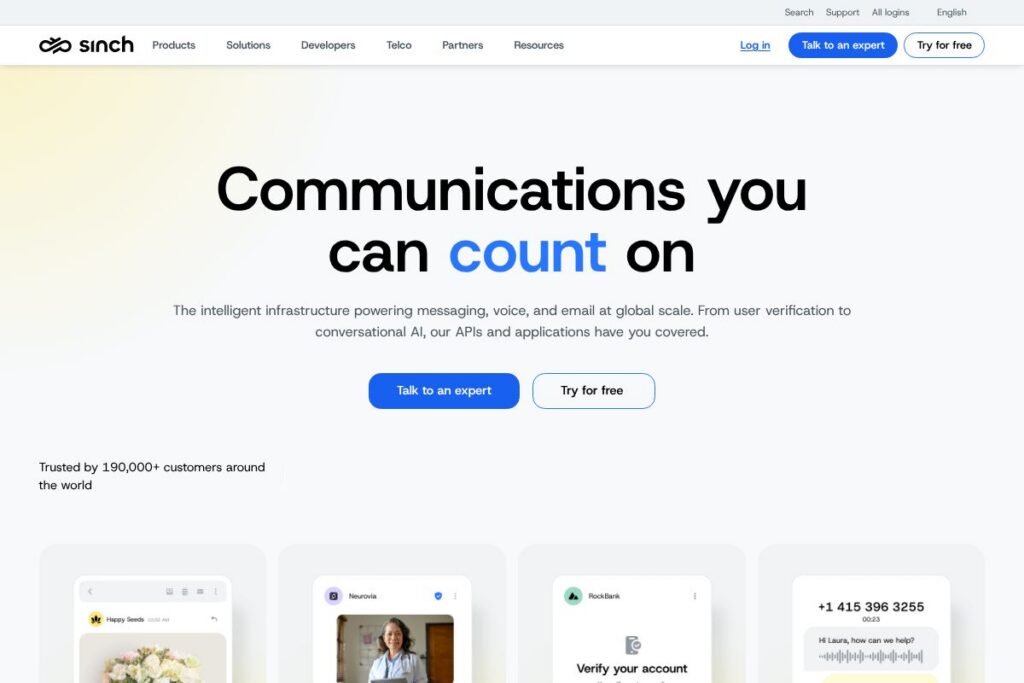
Sinch is a communications platform that offers programmable SMS, voice, email, video, and verification APIs alongside prebuilt applications for marketers and developers. It combines developer-facing SDKs and APIs with operator-grade network connectivity so businesses can reach users at scale across channels and countries.
Sinch is often compared with Twilio, Vonage (Nexmo), and MessageBird. Compared with Twilio, Sinch emphasizes direct operator connections and carrier relationships to improve deliverability and compliance for large-volume messaging. Compared with Vonage, Sinch bundles broader network services and number provisioning, and compared with MessageBird, Sinch highlights enterprise routing and global operator coverage as differentiators.
All of this makes Sinch particularly well suited for enterprises and platforms that need high-volume omnichannel communications, verified branded messaging such as RCS, and close carrier-level controls. It is a strong fit for telecoms, large ecommerce platforms, fintechs, and global customer engagement teams.
How Sinch Works
Developers integrate Sinch by using its REST APIs and SDKs to send messages, place calls, manage numbers, and run verification workflows. API requests are routed through Sinch’s infrastructure which handles carrier selection, delivery optimization, and compliance checks before reaching the handset.
For marketing and support teams, Sinch provides web applications to build campaigns, create chatbots, and view delivery analytics. A typical workflow is to invoke the Messaging API from a backend system for transactional alerts, while marketers use the campaign UI for promotional RCS or email sends, and verification flows use a dedicated Verification API to validate user phone numbers.
What does Sinch do?
Sinch unifies several communications channels under a single platform: SMS and RCS messaging, voice via SIP and PSTN, email delivery, video calling, and phone-number verification. The platform also exposes network services for number provisioning, routing, and fraud prevention, and it integrates AI capabilities to improve safety and automation.
Key functionality includes:
Messaging API
The Messaging API supports SMS, MMS, and RCS messaging with global routing and delivery optimization. It is designed for both transactional and promotional sends, including support for longer messages, concatenation, and message status callbacks.
Voice API and Elastic SIP Trunking
Voice capabilities include programmable voice calls, IVR routing, and Elastic SIP Trunking for connecting applications to the public telephone network. This enables call flows, call recording, and legacy PBX integration for customer support or notification systems.
Verification APIs
Verification APIs provide OTP delivery, phone number lookup, and fraud-reduction tooling to confirm user identity during signup and high-risk transactions. These APIs help reduce account takeover and improve onboarding conversion through automated checks.
Email API
Sinch’s email offering delivers transactional and marketing email with deliverability tools and analytics. It is intended to sit alongside messaging and voice for unified customer contact strategies and reporting.
Video and Real-time Communications
Video APIs and SDKs enable in-app video calling and real-time communications with stream management and scaling support. These capabilities are useful for telehealth, customer support, and remote collaboration features within apps.
RCS for Business
RCS for Business enables branded, interactive messages that display like mini-app experiences within the user’s messaging inbox. RCS supports rich media, verified sender identity, and suggested actions to increase engagement compared with plain SMS.
Sinch Super Network
The Sinch Super Network provides direct operator connects and routing that reduce intermediaries and improve reach and latency. The network supports large-scale messaging and voice volumes while offering number provisioning and regional compliance controls.
Sinch AI
Sinch applies AI across verification, fraud detection, and conversational tooling to reduce manual moderation and improve message relevance. AI features help automate responses, flag suspicious activity, and improve routing decisions.
With these capabilities, Sinch helps organizations centralize communications across channels while focusing on reach, deliverability, and operational controls.
Sinch pricing
Sinch uses a volume-based, enterprise pricing approach tailored to channel mix, geographic coverage, and usage patterns rather than fixed public tiers. Pricing is generally structured around per-message and per-call fees, number provisioning charges, and add-ons such as RCS or verification throughput.
For specific rate cards, enterprise discounts, and channel-specific fees, consult Sinch pricing and plans or request a tailored quote through the Sinch sales team. Developers can also review usage-based details and rate limits in the Sinch developer documentation before engaging sales.
What is Sinch Used For?
Sinch is used for transactional notifications, marketing campaigns, user verification, and voice/video customer interactions. Typical implementations include OTP verification during account creation, appointment reminders via SMS or RCS, order and payment notifications, and voice IVR for customer service.
Product and growth teams use Sinch to combine channels into omnichannel campaigns, while platform operators use the network services for number provisioning, compliance, and carrier-level routing. Industries that frequently use Sinch include retail, telecommunications, finance, mobility, and customer support platforms.
Pros and Cons of Sinch
Pros
- Global operator reach: Sinch offers extensive direct operator connections which improves message deliverability and regulatory compliance across many regions.
- Multi-channel stack: Messaging, voice, email, video, and verification are available from one vendor which simplifies integration and unified reporting.
- Enterprise-grade network controls: Number provisioning, routing customization, and carrier-grade infrastructure make it suited for high-volume and regulated environments.
- Developer tools and apps: SDKs, APIs, and user-facing campaign apps allow both engineers and marketers to run campaigns and automate workflows.
Cons
- Enterprise focus and pricing: Sinch’s pricing model is oriented toward higher-volume customers, which can be less transparent for small teams or startups compared with public pay-as-you-go providers.
- Complexity for small projects: The breadth of network and compliance features can add configuration complexity for simple use cases that only need basic SMS or email.
- Vendor lock considerations: Using carrier-level routing and provisioning can make switching providers more involved due to number and contract migration requirements.
Does Sinch Offer a Free Trial?
Sinch offers a free developer account with sandbox access and trial credits for testing APIs and basic integration scenarios; the developer account lets teams prototype messaging, voice, and verification flows before moving to production. To sign up for a developer sandbox and sample credentials, see the Sinch developer documentation.
Sinch API and Integrations
Sinch provides a comprehensive developer API suite and SDKs for multiple languages and platforms, with endpoints for messaging, voice, verification, email, and video. The API documentation contains endpoints, sample code, and SDK downloads to get started quickly.
Sinch also integrates with common enterprise systems and contact center platforms; many customers connect Sinch to CRMs and ticketing systems such as Salesforce and Zendesk to synchronize communications and customer records. For workflow automation and third-party connectors, review the developer docs and available SDKs.
10 Sinch alternatives
Paid alternatives to Sinch
- Twilio — A widely used communications platform with transparent pay-as-you-go pricing and a broad set of APIs for messaging, voice, video, and verification.
- Vonage (Nexmo) — Offers messaging and voice APIs with developer-friendly tooling and global reach for transactional communications.
- MessageBird — Focuses on omnichannel messaging with conversational commerce tools and regional routing.
- Infobip — Enterprise messaging and contact center solutions with strong global coverage and campaign tooling.
- Bandwidth — Provides communications APIs with in-house carrier infrastructure and number provisioning in key markets.
- Plivo — A programmable voice and SMS provider with competitive pricing and a focus on developer simplicity.
- Telnyx — Offers SIP trunking, voice, and messaging with a strong emphasis on network control and self-service provisioning.
Open source alternatives to Sinch
- Asterisk — An open source telephony engine for building voice and IVR systems that can be self-hosted for full control.
- FreeSWITCH — A scalable open source telephony platform suitable for PBX, IVR, and conferencing solutions.
- Kamailio — An open source SIP server for routing and processing SIP traffic at scale, commonly used for custom voice infrastructures.
- OpenSIPS — A SIP proxy server project for building carrier-grade SIP services and routing logic.
- Kannel — An open source WAP and SMS gateway commonly used for basic SMS sending and gateway integration.
Frequently asked questions about Sinch
What channels does Sinch support?
Sinch supports SMS, MMS, RCS, voice, email, video, and verification APIs. These channels can be combined in omnichannel campaigns and integrated via the Sinch API and SDKs.
Does Sinch provide developer APIs and SDKs?
Yes, Sinch offers REST APIs and SDKs for common languages and platforms. The Sinch developer documentation includes guides, code samples, and SDK downloads.
Can Sinch handle global message delivery and compliance?
Sinch supports global delivery via direct operator connects and regional routing controls. Its network services include number provisioning and compliance tooling to help meet local regulations.
Does Sinch offer solutions for verification and fraud prevention?
Yes, Sinch provides Verification APIs, phone number lookup, and fraud mitigation features. These tools help reduce account takeover and automate identity validation during onboarding.
Is Sinch suitable for high-volume enterprise workloads?
Sinch is designed for large-scale enterprise usage with carrier-grade infrastructure. The Sinch Super Network and managed routing services are intended to support high message and call volumes reliably.
Final verdict: Sinch
Sinch stands out for its combination of programmable communications and operator-grade network services, making it a strong choice for enterprises that need high deliverability, regulatory controls, and multi-channel reach. The Sinch Super Network and number provisioning services differentiate it from purely API-focused competitors by offering deeper carrier relationships and routing options.
Compared with Twilio, which provides transparent pay-as-you-go pricing and broad developer tooling, Sinch focuses more on carrier connectivity and enterprise routing, which can deliver better deliverability for some regions but typically involves custom pricing and longer engagement. Organizations that need straightforward, low-volume usage may prefer Twilio, while those operating at scale or requiring advanced carrier-level features will find Sinch better aligned with their needs.