Talkdesk: An Overview
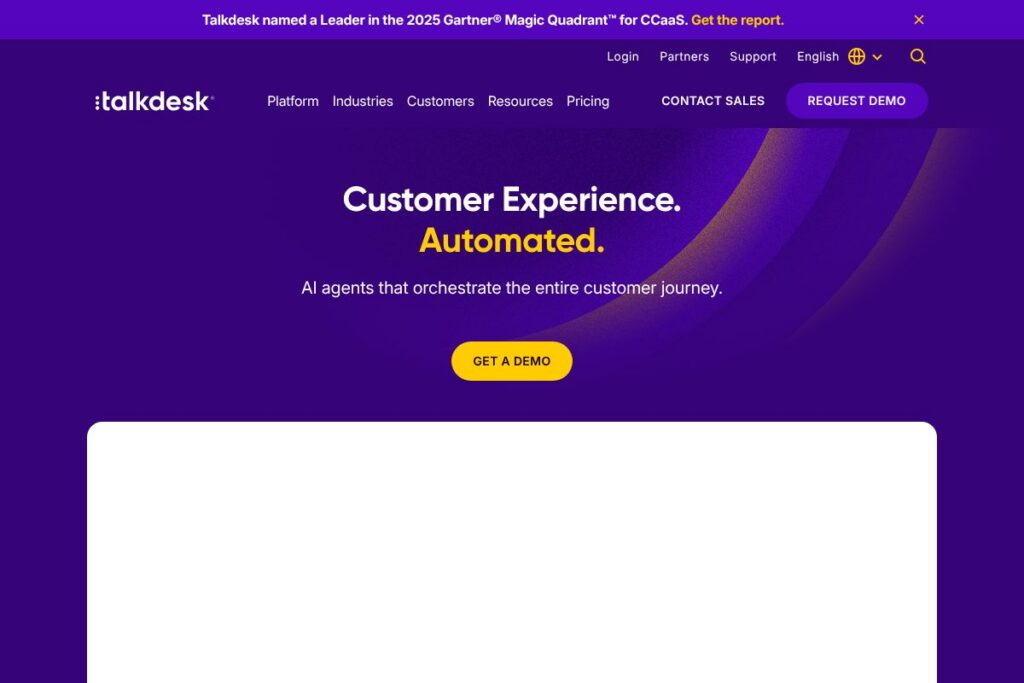
Talkdesk is a contact center platform centered on Customer Experience Automation, using AI agents and real-time context to automate customer journeys across voice and digital channels. The platform emphasizes hybrid workforces where humans handle judgment and empathy while AI agents execute repeatable CX tasks end to end, from appointment confirmations to payment authorizations.
Compared with competitors, Talkdesk emphasizes AI-first orchestration rather than only routing and analytics. Genesys focuses on large-scale omnichannel routing and workforce optimization with deep telephony features, Five9 is optimized for cloud-native telephony and agent efficiency, and Amazon Connect offers a flexible, pay-as-you-go cloud contact center with strong AWS integration. Talkdesk stands out by packaging autonomous, task-focused AI agents with prebuilt CX workflows to reduce manual handoffs and accelerate production deployments.
All of this makes Talkdesk particularly well suited for mid-market and enterprise contact centers that need to automate common CX tasks while retaining control over policies, compliance, and human escalation. Its combination of industry-specific agents, continuous learning, and validation controls aims to lower operational costs and improve outcome accuracy.
How Talkdesk Works
Talkdesk composes AI agents that each handle a focused piece of CX work, such as confirming appointments or resolving order status issues. These agents run alongside human agents in a coordinated workflow, passing context, validating decisions, and escalating to people when judgment or empathy is required.
Implementation typically starts with defining goals, policies, and constraints for the AI agents, then mapping customer journeys into orchestrated flows. During live traffic, agents leverage enterprise data and real-time context to make decisions and generate outcomes, while telemetry and quality controls monitor behavior and trigger retraining or policy adjustments.
What does Talkdesk do?
Talkdesk organizes around automated customer journeys, AI agent orchestration, and real-time CX controls. Core capabilities include autonomous AI agents, intent-driven execution, dynamic knowledge creation, and built-in validation to ensure decisions meet regulatory and business constraints. The platform also supports voice and digital channels with features for monitoring and continuous improvement.
Let’s talk Talkdesk’s Features
AI agent orchestration
Talkdesk enables composing, deploying, and coordinating multiple specialized AI agents that work together across a customer journey. This orchestration lets teams reuse skills and scale agent counts without rebuilding workflows, which accelerates rollouts and reduces engineering overhead.
Autonomous agents
Agents can execute end-to-end tasks such as appointment management or order resolution without constant human intervention, while still escalating when policy or empathy is required. This reduces routine workload for human agents and improves throughput for high-volume interactions.
Intent-driven execution
Teams define goals, rules, and constraints and agents carry out work in alignment with those definitions using intent recognition and policy enforcement. That approach focuses automation on measurable outcomes rather than just scripted replies.
Industry-specific agents
Pre-trained agents reflect domain knowledge, regulatory requirements, and common workflows for industries like finance, healthcare, and travel. Industry templates reduce time to value and limit risky behavior in regulated environments.
Dynamic knowledge creation and learning
The platform continuously refines agent knowledge using live interactions and enterprise data, which improves decision accuracy over time. This feedback loop helps maintain relevance as products, policies, and customer language evolve.
Real-time voice and conversational CX
Natural-language voice interactions let customers speak naturally while agents reason through requests, access context, and deliver actionable outcomes rather than only providing information. That supports higher containment rates and smoother self-service.
Quality controls and compliance
Built-in validation and monitoring enforce accuracy and policy adherence in real time, allowing teams to validate decisions before they execute. These controls help maintain reliability at scale and support audit and compliance requirements.
The platform’s biggest benefit is its focus on outcome-driven automation: by combining specialized AI agents, continuous learning, and quality controls, Talkdesk aims to move contact centers from manual ticket handling to automated resolution at scale. For more on the platform and capabilities, see the Talkdesk CXA platform overview.
Talkdesk Pricing
Talkdesk uses an enterprise-focused pricing model with tailored plans and custom quotes rather than a single public price list. Pricing typically reflects factors such as the number of seats, required AI agent capacity, channel mix, integrations, and support levels, so organizations should contact sales for a quote.
For detailed pricing information or to request a custom estimate, review Talkdesk’s pricing and plans or contact their sales team through the official site.
What is Talkdesk Used For?
Talkdesk is used to automate customer interactions across voice, SMS, chat, and email, handling tasks like appointment confirmations, order tracking, proactive notifications, and payment validations. It is commonly deployed where repeatable CX tasks consume agent time and where measurable containment and SLA improvements are priorities.
Organizations use Talkdesk to run pilots that scale to production, integrate automation with CRMs and back-end systems, and apply industry-specific policies to ensure decisions meet regulatory standards. The platform is also used to improve agent satisfaction by shifting routine work to AI agents and leaving complex conversations to humans.
Pros and Cons of Talkdesk
Pros
- Specialized AI agent orchestration: The platform allows teams to compose and coordinate multiple agents focused on specific CX tasks, which reduces workflow rebuilding and improves reuse.
- Industry-aware automation: Pre-trained agents and templates help enforce regulatory constraints and speed deployments in sectors like finance and healthcare.
- Built-in quality controls: Real-time validation and monitoring reduce risky behavior and maintain execution accuracy as automation scales.
- Hybrid workforce support: Human agents remain central for judgment and empathy while AI handles high-volume, repeatable tasks, improving agent experience and throughput.
Cons
- Enterprise-focused pricing and procurement: Pricing is customized and typically aimed at mid-size to large organizations, which can slow evaluation for smaller teams.
- Implementation complexity: Deploying multi-agent orchestration with third-party systems and legacy telephony can require professional services and integration effort.
- Dependence on data quality: The platform’s effectiveness depends on access to up-to-date enterprise data and knowledge sources for accurate agent decisions.
Does Talkdesk Offer a Free Trial?
Talkdesk offers pilot programs, demos, and trials for qualifying customers. Organizations can request a demo or pilot to validate automation use cases and evaluate AI agents in live or sandboxed environments before committing to production deployments.
Talkdesk API and Integrations
Talkdesk provides developer APIs and SDKs for integration with CRMs, ticketing systems, and enterprise data sources; the Talkdesk developer documentation describes available endpoints, webhooks, and integration patterns. Key integrations commonly include Salesforce, Zendesk, Microsoft Teams, Slack, and Google Workspace, which enable data sharing and streamlined agent workflows.
For orchestration across third-party telephony or on-premises systems, Talkdesk supports connectors and professional services to map existing infrastructure into automated journeys.
10 Talkdesk alternatives
Paid alternatives to Talkdesk
- Genesys — Enterprise contact center platform focused on omnichannel routing, workforce optimization, and AI-driven engagement.
- Five9 — Cloud contact center solution with strong telephony features and AI-assisted agent tools for large-scale customer support.
- NICE inContact — Comprehensive CX platform with routing, analytics, workforce management, and automation capabilities.
- RingCentral Contact Center — Integrated UCaaS and contact center offering with omnichannel support and analytics.
- Amazon Connect — Cloud-native contact center with pay-as-you-go pricing and deep AWS integration for developers and ops teams.
- Cisco Contact Center — Robust enterprise telephony and contact center suite with deep networking and security features.
- Vonage Contact Center — Flexible cloud contact center with developer APIs and omnichannel routing.
Open source alternatives to Talkdesk
- Asterisk — Open source telephony engine that can serve as a foundation for custom contact center solutions and IVR systems.
- FreeSWITCH — Scalable telephony platform used to build voice and messaging applications, often embedded in bespoke contact center stacks.
- Vicidial — Open source contact center suite offering predictive dialer, agent interface, and reporting for inbound and outbound campaigns.
- GoAutoDial — Web-based open source contact center distribution built on Asterisk, useful for organizations that want full control over deployment.
Frequently asked questions about Talkdesk
What is Talkdesk used for?
Talkdesk is used to automate customer journeys and run contact center operations across voice and digital channels. It focuses on AI agents, orchestration, and quality controls to reduce manual work and improve customer outcomes.
Does Talkdesk integrate with Salesforce?
Yes, Talkdesk offers a native Salesforce integration. Integration lets agents access CRM context, log interactions automatically, and use CRM data to inform AI agent decisions.
How much does Talkdesk cost?
Talkdesk uses custom enterprise pricing tailored to each deployment. Costs depend on seat counts, AI agent capacity, channels, integrations, and support levels; contact sales via the Talkdesk homepage for a quote.
Can Talkdesk handle both voice and digital channels?
Yes, Talkdesk supports voice, chat, SMS, and email channels in a unified platform. Agents and AI agents can operate across channels with shared context and routing rules.
Does Talkdesk provide an API for developers?
Yes, Talkdesk provides developer APIs and SDKs. Review the Talkdesk developer documentation for endpoints, webhooks, and integration examples.
Final Verdict: Talkdesk
Talkdesk is strongest where organizations need outcome-driven automation across contact center channels, combining specialized AI agents, continuous learning, and real-time validation. Its emphasis on industry-specific agents and quality controls makes it suitable for regulated industries and large-scale deployments that require predictable, auditable outcomes.
Compared with Genesys, which also targets enterprises with comprehensive routing and workforce tools, Talkdesk differentiates through its agent orchestration and quicker pilot-to-production paths for AI-driven automation. Both vendors rely on custom enterprise pricing, so teams should evaluate feature fit, integration effort, and total cost of ownership when choosing between them.
For product details, implementation guides, and to request a demo, visit the Talkdesk homepage or consult the Talkdesk developer documentation.