What is Telnyx
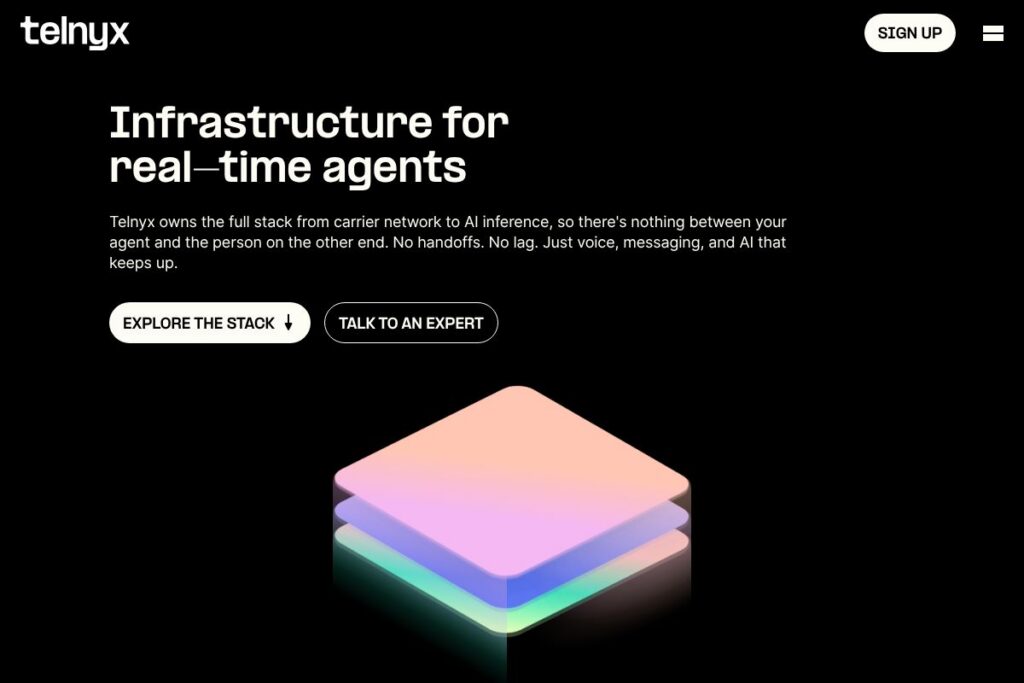
Telnyx is a communications infrastructure provider that combines carrier-grade telephony with Voice AI agent tooling. The platform owns and operates its global network and core telco stack, which lets you deploy real-time conversational agents with lower latency, deterministic routing, and built-in carrier services compared with solutions that sit on top of public internet routing.
Compared with Twilio, Telnyx emphasizes ownership of the telephony fabric rather than reselling third-party carrier services, which can reduce network handoffs and improve call quality. Against Vonage, Telnyx focuses more on integrating inference at the edge with co-located GPUs for Voice AI workloads. Compared with Amazon Connect, Telnyx is more telecom-native with direct control over number provisioning and carrier compliance rather than being primarily a contact-center SaaS layer.
All of this makes Telnyx especially well suited for teams that need predictable, carrier-grade voice quality for automated conversations. It is a practical choice for enterprises building live Voice AI agents that require low latency, regional carrier compliance, and fine-grained control over telephony primitives.
How Telnyx Works
The platform routes voice and messaging over an owned private IP backbone and bare-metal peering points, reducing the number of network hops and sources of jitter between the caller and your agent. Telnyx co-locates processing resources such as GPUs at edge points of presence to keep inference close to the audio path and reduce round-trip time.
Developers interact with Telnyx through APIs and an agent runtime that controls models, voices, and call logic. Agents can be configured to handle speech-to-text, inference, text-to-speech, routing, and outbound dialing without manual handoffs, enabling automated call flows that run end to end under programmatic control.
Operational features include carrier-grade number provisioning, automated compliance checks such as 10DLC and KYC, and orchestration tools for agent-to-agent or agent-to-human handoffs. For more on the network design and peering, see Telnyx’s network materials.
What does Telnyx do?
Telnyx provides a stack for building, deploying, and operating real-time Voice AI agents at global scale. Core capabilities include a private telco network, low-latency inference at the edge, speech transcription and synthesis, programmable telephony primitives, compliance controls, and orchestration for autonomous or semi-autonomous agent workflows.
Let’s talk Telnyx’s Features
Private Global Network
Telnyx operates a private backbone with bare-metal fiber and direct peering across regions, which reduces packet loss and latency compared with public internet routing. That network control is the foundation for consistent call quality and deterministic routing for voice AI workloads.
Edge PoPs and Co-located GPUs
The platform places compute for speech inference near telecom edge points of presence to lower round-trip times and speed up voice response. That architecture matters when milliseconds directly affect perceived responsiveness in live calls.
Voice Agent Builder
A runtime and builder environment lets teams compose agent behaviors, select models and voices, and deploy agents that can answer, route, and act on calls programmatically. Agents can be tuned for tasks like booking, verifications, or triage.
Speech-to-Text and Multilingual Transcription
Telnyx includes real-time speech-to-text capabilities supporting more than 40 languages, enabling transcription, intent detection, and downstream processing in multilingual environments. This supports global deployments and language-specific routing.
Text-to-Speech and TTS Library
The platform offers configurable text-to-speech voices and a TTS voice library for producing natural-sounding responses; teams can choose voice styles and languages to match their brand. Explore the TTS voice library for available voices and samples.
Programmatic Compliance and Carrier Services
Built-in compliance includes automated 10DLC registration, KYC checks, and carrier provisioning so compliance is enforced before campaigns run. This reduces manual paperwork and helps maintain deliverability across regulated regions.
Telephony Primitives: SIP, WebRTC, and Global Numbers
Telnyx exposes standard telephony interfaces like SIP trunking and WebRTC, plus global numbers and direct carrier interconnects for inbound and outbound calling. That makes it straightforward to integrate Voice AI agents into existing contact center or telephony setups.
Security and Identity Verification
Because the provider controls the mobile core and network stack, Telnyx can perform identity checks at the network level to mitigate spoofing and improve trust for voice authentication flows. Enterprise security controls are surfaced in the platform and trust materials; see the Trust Center for details.
With these features combined, the biggest practical benefit is deterministic, carrier-grade voice delivery for automated agents, which helps reduce latency, lower failure rates, and maintain compliance for regulated use cases.
Telnyx pricing
Telnyx uses an enterprise-focused pricing approach with flexible options depending on seat counts, phone number plans, voice minutes, and usage of AI inference resources. Pricing is typically customized for deployments that require global numbers, co-located inference, and programmatic carrier services.
For specific rates and a tailored quote for Voice AI deployments, contact Telnyx sales through their contact page for enterprise pricing or consult the platform’s product pages to discuss typical consumption patterns and licensing.
What is Telnyx Used For?
Telnyx is commonly used to deploy real-time Voice AI agents for customer-facing automation such as appointment scheduling, order handling, secure verifications, and 24/7 support. Its strengths are most visible where voice quality, compliance, and low latency are critical to the user experience.
Typical users include contact center teams modernizing voice channels, healthcare providers managing appointment flows under regulatory constraints, financial services teams running voice verifications, and logistics or travel companies that need always-on voice assistants with reliable global reach.
Pros and cons of Telnyx
Pros
- Network ownership and control: Owning the telco stack reduces network handoffs and can improve call quality and latency for live Voice AI interactions.
- Edge inference for low latency: Co-located GPUs and edge PoPs make it practical to run speech models with lower round-trip times compared with cloud-only inference.
- Built-in compliance and carrier services: Programmatic 10DLC, KYC, and number provisioning simplify regulatory and carrier requirements for campaigns and automated calls.
- Standard telephony interfaces: SIP, WebRTC, and global numbers make integration with existing systems and contact center platforms straightforward.
Cons
- Enterprise focus can increase complexity: The carrier-grade, infrastructure-first model may be more complex to set up than plug-and-play SaaS contact-center products for small teams.
- Custom pricing and procurement: Pricing and capacity planning are often handled through custom quotes, which can add lead time for procurement compared with fixed-price SaaS tiers.
Does Telnyx Offer a Free Trial?
Telnyx provides developer accounts and trial options for testing voice and messaging features. The free developer experience typically includes access to API keys and limited credits to experiment with voice calls, SIP trunks, and basic agent flows; for production deployments, Telnyx works with teams to align capacity and billing. For signup and trial details, see the developer signup and account options.
Telnyx API and Integrations
Telnyx offers developer APIs and SDKs for controlling telephony primitives, provisioning numbers, and running voice sessions; the API documentation describes endpoints for calls, messaging, and account management. Developers can script agent behavior, configure WebRTC or SIP endpoints, and consume real-time transcription or TTS outputs via the API.
Integrations include standard telephony and contact center connectors, plus the ability to integrate with CRMs and backend systems via webhooks and API calls. Typical integration points are CRM systems, payment or verification services, and orchestration platforms for routing calls between agents and humans.
10 Telnyx alternatives
Paid alternatives to Telnyx
- Twilio — A broad communications platform with programmable voice, messaging, and contact-center features, backed by extensive developer tooling.
- Vonage — Voice and messaging APIs with contact center and unified communications products aimed at enterprise customers.
- Bandwidth — SIP and voice services with a focus on carrier-level services and number provisioning for enterprise telephony.
- Amazon Connect — A cloud contact center service that integrates with AWS AI and analytics services for contact routing and insights.
- Google Cloud Contact Center AI — Combines Google Cloud speech and agent tooling for conversational AI inside contact centers.
- Genesys Cloud — A contact center platform that embeds AI capabilities and omnichannel routing for large CX deployments.
- Five9 — A cloud contact center provider that pairs agent tools, routing, and AI services for customer service operations.
Open source alternatives to Telnyx
- Asterisk — A mature open source telephony engine for building custom PBX and voice applications at the protocol level.
- FreeSWITCH — A scalable telephony platform used to build voice and conferencing applications with flexible routing.
- Jitsi — An open source video and voice conferencing stack that supports WebRTC and SIP integrations.
- Kamailio — A high-performance SIP server for routing, load distribution, and signaling control in large SIP deployments.
Frequently asked questions about Telnyx
What is Telnyx used for?
Telnyx is used to build and operate real-time voice and messaging services with integrated Voice AI. Organizations deploy it for automated calling, secure verifications, and contact center automation that require carrier-grade quality.
Does Telnyx provide APIs for Voice AI?
Yes, Telnyx provides developer APIs and SDKs for telephony, transcription, and TTS. The API documentation describes endpoints for calls, webhooks, and media streams.
Can Telnyx handle global phone numbers and compliance?
Telnyx supports global numbers and programmatic compliance workflows. Built-in processes for 10DLC, KYC, and carrier provisioning help maintain deliverability across regions.
Is Telnyx suitable for healthcare and regulated industries?
Yes, Telnyx offers enterprise security controls and compliance features suitable for regulated use cases. The platform highlights security and trust information in the Trust Center.
How does Telnyx compare to Twilio on latency and call quality?
Telnyx prioritizes network ownership and edge inference to reduce latency and improve call consistency. That architecture can produce lower end-to-end latency and fewer handoffs compared with providers that rely on third-party carrier routing.
Final verdict: Telnyx
Telnyx stands out for owning the telecom stack and integrating edge inference to support real-time Voice AI with predictable latency and carrier-grade voice quality. The platform is practical for teams that need deterministic routing, programmatic compliance, and a direct path from caller to agent runtime.
Compared with Twilio, which is priced and structured around broad developer services, Telnyx focuses more on infrastructure ownership and carrier integration; that makes Telnyx a stronger fit when call quality and regulatory controls are top priorities, while Twilio may offer faster onboarding for simpler use cases. For enterprise projects that require global reach, low latency, and tight carrier control, Telnyx is a solid infrastructure choice.