What is Toast
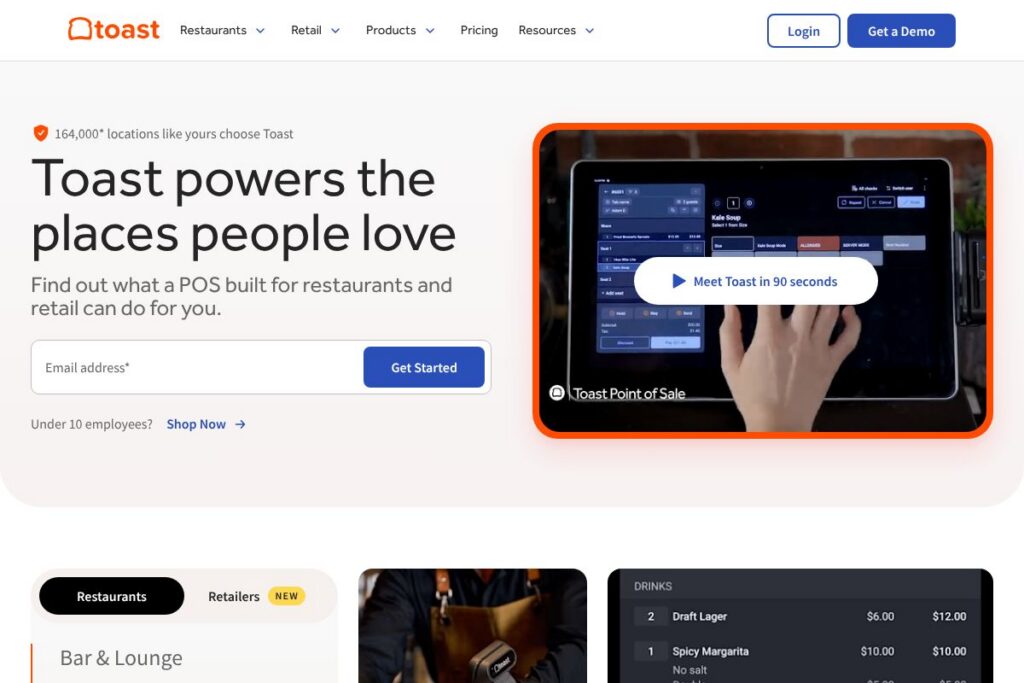
Toast is a point of sale and restaurant management platform built specifically for full-service, fast-casual, and quick-service food businesses. It combines register software, restaurant-grade hardware, payment processing, online ordering, payroll, and reporting into a single platform designed around service flows and kitchen operations.
Compared with general-purpose POS systems like Square and Lightspeed, Toast focuses more heavily on restaurant workflows such as table management, kitchen display routing, and menu engineering. Compared to restaurant-focused competitors such as Clover and TouchBistro, Toast emphasizes an end-to-end platform approach that ties payments, labor, and online ordering together rather than shipping separate third-party solutions.
Toast performs particularly well for multi-location restaurants and operators who want an integrated stack that keeps ordering, payments, and back-office reporting synchronized. That makes it a common choice for restaurants and hospitality groups that plan to scale operations or centralize payroll and inventory management.
How Toast Works
Toast runs as a cloud-connected platform with local failover so restaurants can continue taking orders if internet connectivity drops. On-premise terminals and handheld devices communicate with cloud services for menu sync, reporting, and guest data while local nodes manage transaction capture during offline periods.
Typical deployment includes Toast terminals on the floor, handheld ordering devices for servers or line cooks, a kitchen display system, and optional self-service kiosks. Orders flow from guest-facing devices into kitchen routing, while payments can be processed on the same devices or at a separate terminal, and sales data is pushed to the cloud for reporting and payroll reconciliation.
On the management side, restaurant owners use the cloud console to edit menus, adjust pricing, run labor and sales reports, and configure integrations for delivery, accounting, and marketing. The platform supports role-based access controls so managers and staff see only the tools they need.
What does Toast do?
Toast’s platform centers on transaction capture and restaurant operations with modules for POS, payments, online ordering, delivery, inventory, payroll, and reporting. Recent focus areas include expanding online ordering, deeper payroll and HR features, and a broader partner ecosystem with over 200 integrations to connect third-party services.
Let’s talk Toast’s Features
Point of Sale
The POS supports table service, counter service, and quick pickup workflows with configurable menus, modifiers, and order routing to kitchen display systems. It streamlines common restaurant tasks like seat-level ordering, split checks, and timed courses to reduce server friction and speed up table turns.
Payments and Processing
Toast handles integrated payment processing so transactions are recorded directly in the platform and reconciled with sales reports. Having payments built into the POS simplifies payouts, tip reporting, and refunds while reducing reconciliation work for managers.
Online Ordering and Delivery
Built-in online ordering routes orders directly to kitchen printers or displays without a third-party aggregator in the middle. The system also supports integrated delivery management and the option to connect to third-party delivery partners through the integrations directory.
Hardware and Offline Mode
Toast sells restaurant-grade terminals, handhelds, and kiosks that are ruggedized for kitchens and service floors. Local offline mode keeps ordering and payments working when the internet is unavailable, with automatic syncing once connectivity returns.
Payroll, HR, and Reporting
Payroll and timekeeping tools link labor data with sales to automate wage calculations and tip distribution. The reporting suite provides sales, profit, and labor analytics to help operators measure average check, labor cost, and item-level performance.
Integrations and Partner Ecosystem
Toast connects to accounting, inventory, reservations, loyalty, and marketing apps so restaurants can use best-of-breed tools while keeping sales and guest data synchronized. The integrations help centralize operations across vendors and automate routine tasks like posting sales to accounting systems.
With Toast you get an integrated restaurant platform that covers the front of house, back of house, and back office. The biggest benefit is reducing the number of disconnected systems restaurants must manage while keeping operations optimized for service speed and guest experience.
Toast pricing
Toast uses a subscription-plus-hardware pricing approach with optional modules and payment processing fees, and it offers flexible plans tailored to different restaurant sizes and service models. The company advertises options to “Start for $0” for some entry-level configurations, while advanced features, hardware purchases, and enterprise deployments use custom pricing.
Monthly Billing:
Starter – $0 starter option available for qualifying setups, typically covers core POS software access and online demo onboarding. (Hardware, payment processing, and add-ons are billed separately.)
Core – Custom monthly subscription for single-location restaurants that want integrated POS, payments, and basic reporting. (Contact sales for exact rates and available modules.)
Annual Billing:
Growth – Annual subscriptions are available for restaurants that commit to longer terms and want bundled discounts on software and services. (Contact Toast for annual pricing details and any available discounts.)
Enterprise
Enterprise – Custom pricing for multi-location or franchise operators, typically including centralized reporting, bulk hardware procurement, SSO, and priority support. For tailored quotes and plan comparisons, view Toast’s platform and request a demo through the Toast platform site.
What is Toast Used For?
Restaurants use Toast to run service workflows from order capture to payment and kitchen routing while centralizing back-office functions such as payroll, inventory, and reporting. It is commonly used to manage table turns, process takeout and delivery orders, and coordinate staff scheduling and tips.
The platform is suitable for single-location restaurants that want a robust POS and for multi-unit groups that need centralized controls and reporting. Operators who rely on integrated online ordering, loyalty programs, and connected payment processing will find the platform especially useful.
Pros and Cons of Toast
Pros
- Restaurant-tailored workflows: The POS is built around table service, kitchen routing, and modifiers, which reduces configuration work for restaurants and speeds up order flow.
- Integrated payments and operations: Payments, payroll, and reporting live in the same platform, which simplifies reconciliation and labor cost tracking across shifts and locations.
- Robust partner ecosystem: Toast syncs with over 200 partners for accounting, delivery, reservations, and marketing, allowing operators to extend functionality without building custom integrations.
- Hardware built for restaurants: Terminals and handhelds are tested for restaurant conditions, improving durability and uptime in hot, wet, and busy environments.
Cons
- Custom pricing and add-ons: Pricing can be complex because features, hardware, and processing are often sold separately, which requires conversations with sales to understand total cost.
- Platform lock-in risk: Because many operational functions live inside Toast, moving to another POS can require significant data migration and changes to workflows.
- Learning curve for advanced features: Some back-office modules and enterprise controls require training to get the most value, especially for operators without prior POS experience.
Does Toast Offer a Free Trial?
Toast offers a personalized online demo and a “Start for $0” entry option rather than an open-ended free plan. You can schedule a no-credit-card demo to see feature workflows and request a tailored quote through Toast’s demo request page at the personalized online demo.
Toast API and Integrations
Toast provides developer resources and APIs so partners and larger operators can build custom integrations; see the API documentation for endpoints, authentication, and webhook details. The platform also maintains an integrations directory for pre-built connections to payroll, accounting, delivery, and loyalty vendors.
Key native integrations include payroll and HR tools, online ordering providers, accounting packages, and delivery aggregators, which simplify data sync and reduce manual reconciliation work.
10 Toast alternatives
Paid alternatives to Toast
- Square — A widely used POS with transparent processing fees and a strong small-business feature set that is easier to start with for counter and mobile service restaurants.
- Lightspeed — A cloud POS known for advanced inventory and multi-location support, often chosen by full retail and hybrid restaurant operations.
- Clover — A modular POS hardware and app marketplace that lets merchants mix and match functions but may require third-party apps for advanced restaurant features.
- TouchBistro — A restaurant-focused POS with strong table management and menu customization features, often used by independent eateries and bars.
- Revel Systems — An enterprise-grade iPad POS with offline capabilities and deep reporting aimed at multi-unit operators.
- Upserve — A restaurant management platform with a POS, guest analytics, and labor tools, focused on improving average check and repeat visits.
- ShopKeep — A straightforward POS for small foodservice operators that need basic register functions and simple reporting.
Open source alternatives to Toast
- Odoo (POS module) — An open-source ERP with a POS module that can be adapted for restaurants, plus accounting and inventory management in one stack.
- Unicenta — A Java-based open-source POS that supports multiple terminals, receipt printers, and basic inventory for restaurants and retail.
- Chromis POS — A fork of UniCenta focused on lightweight, cross-platform POS use, suitable for small cafes and food stalls.
- Floreant POS — An open-source restaurant POS designed for quick-service and table-service restaurants, offering kitchen printing and menu management.
Frequently asked questions about Toast
What hardware does Toast require for a restaurant?
Toast supports a range of restaurant-grade terminals, handhelds, and kiosks. Operators can purchase hardware bundles from Toast or bring compatible devices for certain deployments; check Toast’s hardware options on the Toast platform site.
Does Toast integrate with accounting and payroll systems?
Yes, Toast integrates with payroll and accounting partners and offers native payroll and timekeeping modules. These integrations help automate wage calculations, tip reporting, and posting sales data to accounting ledgers.
Can Toast process online orders and deliveries?
Yes, Toast includes built-in online ordering and supports delivery workflows. Orders from Toast’s online ordering or connected delivery partners route directly to the kitchen display system for fulfillment.
Is Toast reliable when the internet goes down?
Toast includes a reliable offline mode that keeps transactions and orders running during connectivity outages. The system queues transactions locally and reconciles them automatically when connectivity is restored.
Does Toast provide developer APIs for custom integrations?
Yes, Toast provides developer APIs and webhook support. Developers can review the available endpoints and authentication details in the API documentation.
Final verdict: Toast
Toast is a comprehensive restaurant-focused POS and operations platform that is strongest when operators want a single vendor to handle POS, payments, online ordering, payroll, and reporting. It reduces integration overhead for restaurants by keeping multiple operational systems within one platform and offering restaurant-grade hardware built for busy service environments.
Compared to Square, which favors transparent, flat-rate processing and quick setup for small merchants, Toast is better suited to multi-location restaurants or businesses that need deeper back-office controls and kitchen routing. Pricing with Toast tends to be customized and bundled with hardware and add-ons, while Square emphasizes straightforward per-transaction fees and easy entry for single-location shops.
For restaurants planning to scale, centralize operations, or use an integrated payments and payroll stack, Toast offers a robust set of tools that align with real-world restaurant workflows. For very small or mobile-only operations, a simpler POS with clearer pricing like Square may be a better fit.