What is Twilio?
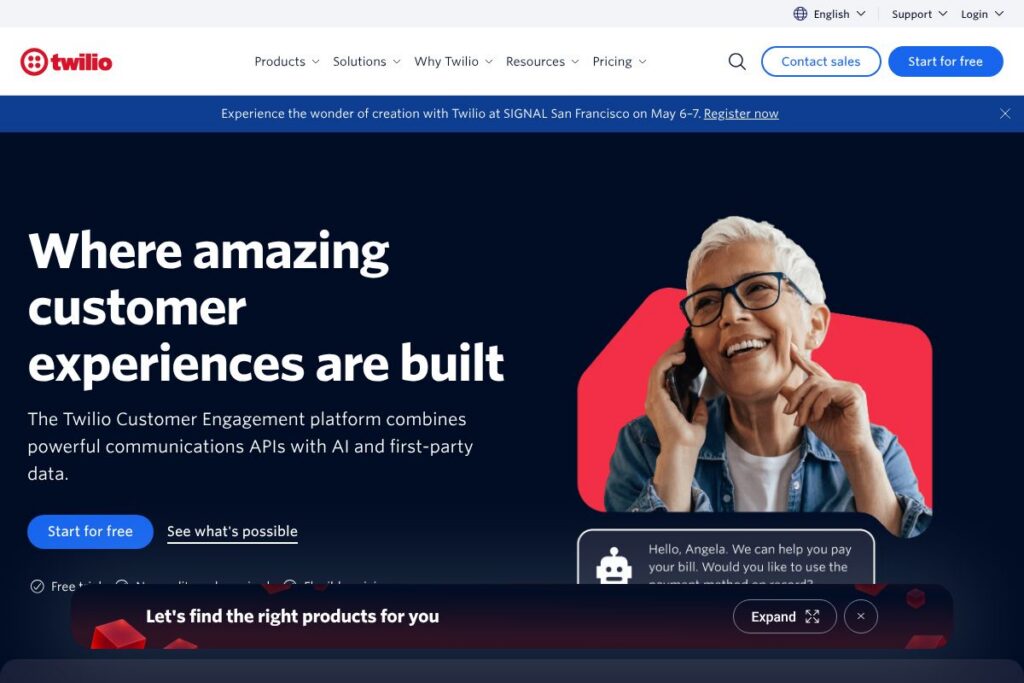
Twilio is a cloud communications platform that exposes APIs for SMS, voice, email, and other messaging channels while combining customer data and AI to personalize interactions. It targets developers and product teams who need programmable communications and the ability to route, analyze, and act on customer signals across channels.
Twilio sits in the Communications Platform as a Service category alongside companies that provide programmable voice and messaging. Compared with Vonage (Nexmo) and MessageBird, Twilio offers a broader set of developer SDKs, a larger global footprint, and deeper tooling for programmable voice and programmable messaging. Against SendGrid, which focuses primarily on email delivery, Twilio brings email into a unified platform with SMS, voice, and customer data capabilities.
All of this makes Twilio particularly well suited for teams that require granular developer control, global reach, and integrated customer context. It is a strong choice for businesses building notification systems, conversational interfaces, verification workflows, and data-driven customer engagement at scale.
How Twilio Works
Twilio exposes RESTful APIs and language-specific SDKs so you can send messages, make calls, and trigger workflows from your backend. Typical implementations use the Console to provision numbers and credentials, then call Twilio APIs from server-side code or use official SDKs to handle media, messaging, and telephony logic.
Webhooks and event callbacks deliver real-time status updates back to your application so you can record delivery, process replies, and update CRM records. For server-side quickstarts and helper libraries, follow the Python helper library installation guide and manage secrets using the Twilio Console.
What does Twilio do?
The Twilio Customer Engagement platform is organized around programmable communications, customer data, and AI tooling. Core capabilities include multichannel messaging, a trusted Email API, programmable voice, fraud-resistant verification, and a Customer Data Platform for unified profiles. Recent additions emphasize AI and first-party data to power individualized, automated interactions.
Let’s talk Twilio’s Features
Messaging
Twilio Messaging supports SMS, MMS, and popular chat channels like WhatsApp and RCS across global carriers. Developers can send, receive, and track message delivery with status callbacks, and use templates and media attachments to enrich customer messages.
The Email API provides transactional and programmatic email sending with deliverability tools, templates, and analytics. It is designed for high-volume delivery and integrates with suppression lists and engagement tracking used by marketing and transactional systems.
Voice
Programmable Voice enables inbound and outbound calls, interactive voice response (IVR), call recording, and real-time media processing. Voice features can be combined with AI to transcribe calls, detect intent, or route calls based on customer data.
Authentication and identity
Twilio offers verification and identity lookup tools for two-factor authentication, phone number validation, and fraud mitigation. These capabilities help reduce fake accounts and secure user sign-ins while providing device and carrier insights.
Customer Data Platform
The Customer Data Platform aggregates consented, real-time customer signals into unified profiles accessible to messaging and AI workflows. That single profile lets teams personalize messages and route communications based on historical context.
AI and conversational tools
Twilio includes conversational APIs and integrations that let you add conversational AI, automated assistants, and NLP-based routing to SMS, voice, and chat flows. AI features can generate responses, summarize interactions, and assist agents during live conversations.
With these capabilities combined, Twilio’s biggest benefit is the ability to unify communications, data, and automation so teams can build personalized, reliable experiences across channels.
Twilio pricing
Twilio uses a flexible, usage-based pricing model that is tailored to channel and volume, with a free trial option to get started. Pricing is typically presented per message, per call, or per resource consumed, and enterprise contracts are available for larger customers.
Pricing model and pay-as-you-go
Twilio primarily bills on a pay-as-you-go basis where charges depend on channel, destination, and optional add-ons such as phone numbers, short codes, or advanced routing. For business contracts and volume discounts you can review Twilio’s current pricing options on their main site and contact sales for custom terms.
Enterprise and custom agreements
Larger organizations often negotiate enterprise agreements that bundle usage, support, and service-level terms. For enterprise details and to discuss volume pricing, reach out through Twilio’s contact channels and enterprise pages available from the Twilio homepage.
What is Twilio Used For?
Twilio is commonly used to build notification systems for order updates, delivery alerts, and operational alerts that require high deliverability and delivery reporting. Teams use Twilio to send appointment reminders, password resets, and marketing messages across SMS, WhatsApp, and email channels.
Twilio is also used to add voice workflows for contact centers, IVR systems, and callback orchestration, as well as to implement identity verification and fraud prevention flows. Its Customer Data Platform and AI features make it useful for personalizing messages at scale and for powering conversational assistants across channels.
Pros and Cons of Twilio
Pros
- Extensive API coverage: A wide range of APIs for messaging, voice, email, and more, with SDKs for common languages and sample apps that accelerate development.
- Global reach and reliability: Carrier and telephony infrastructure across many countries, which helps with scale and deliverability for international programs.
- Integrated data and AI tooling: Built-in customer data capabilities and conversational AI features that help personalize interactions and automate responses.
Cons
- Complexity for simple use cases: The breadth of features can be overwhelming for teams that only need a single channel or a minimal notification service.
- Usage-based billing can be difficult to forecast: Pay-as-you-go pricing requires careful monitoring to predict monthly costs as volumes grow.
- Enterprise setup and compliance overhead: Large-scale deployments often require additional configuration, compliance checks, and contract negotiation.
Does Twilio Offer a Free Trial?
Twilio offers a free trial account without a credit card. The trial lets developers create an account, experiment with APIs, and send test messages and calls with trial credits; upgrading to a pay-as-you-go account removes trial restrictions and enables production usage.
Twilio API and Integrations
Twilio provides a comprehensive set of REST APIs and SDKs with examples in JavaScript, Python, Java, C#, and other languages. The API documentation details endpoints for messaging, voice, email, and real-time events, plus guides for authentication and webhooks.
Twilio integrates with many third-party systems for CRM, helpdesk, and analytics, and it also owns SendGrid for email infrastructure. Common integrations include CRMs like Salesforce, support platforms like Zendesk, and automation platforms via connectors and partner integrations.
10 Twilio alternatives
Paid alternatives to Twilio
- Vonage (Nexmo): Offers programmable SMS and voice APIs with global coverage and competitive local routing options.
- MessageBird: Multichannel communications platform focused on omnichannel messaging and a visual flow builder for customer journeys.
- Infobip: Enterprise-focused CPaaS with omnichannel messaging, voice, and customer engagement orchestration across many regions.
- Sinch: Strong in messaging and verification services with tools for large-scale SMS and voice campaigns.
- Bandwidth: API-driven voice and messaging services with direct carrier relationships and number management.
- AWS Pinpoint: Messaging and analytics tightly integrated with the AWS ecosystem, useful for teams already using AWS services.
Open source alternatives to Twilio
- Asterisk: A mature open source telephony toolkit for building PBX, IVR, and call center systems that you self-host.
- FreeSWITCH: Telephony engine for voice and video that supports building programmable voice applications on self-managed infrastructure.
- Matrix: An open standard for decentralized real-time communication suited to building chat and messaging systems that you control.
- Kamailio: High-performance SIP server for scalable voice routing and call control in self-hosted architectures.
Frequently asked questions about Twilio
What is Twilio used for?
Twilio is used to send messages, make calls, and build programmable communication experiences across SMS, voice, email, and chat. Developers use it for notifications, verification, conversational agents, and contact center integrations.
Does Twilio have a free trial?
Yes, Twilio offers a free trial account without a credit card. The trial includes test credits and access to core APIs so you can prototype flows before upgrading to production billing.
How does Twilio charge for usage?
Twilio primarily uses a pay-as-you-go, usage-based pricing model. Charges depend on channel, destination, phone number rental, and optional features, and larger customers can negotiate enterprise agreements.
Does Twilio provide APIs for email?
Yes, Twilio includes a trusted Email API for transactional and programmatic email delivery. That service integrates with Twilio’s messaging and data tools for unified engagement workflows.
Can Twilio scale to large messaging volumes?
Yes, Twilio is designed to handle high-volume messaging and voice traffic across global carriers. It provides delivery reporting, rate limiting controls, and enterprise support to manage scale and compliance.
Final Verdict: Twilio
Twilio excels at giving engineering teams granular, programmable access to communications channels combined with customer data and AI features. It performs particularly well when you need multichannel reach, fine-grained developer control, and the ability to unify messaging, voice, and email workflows under one platform.
Compared with AWS Pinpoint, Twilio provides a broader set of developer APIs and integrated telephony features, plus a Customer Data Platform and conversational AI tooling that simplify building rich engagement flows. Pricing for both platforms is usage-driven, so decisions often hinge on required channels, integrations, and existing cloud vendor relationships rather than flat plan differences.