What is Twilio Segment
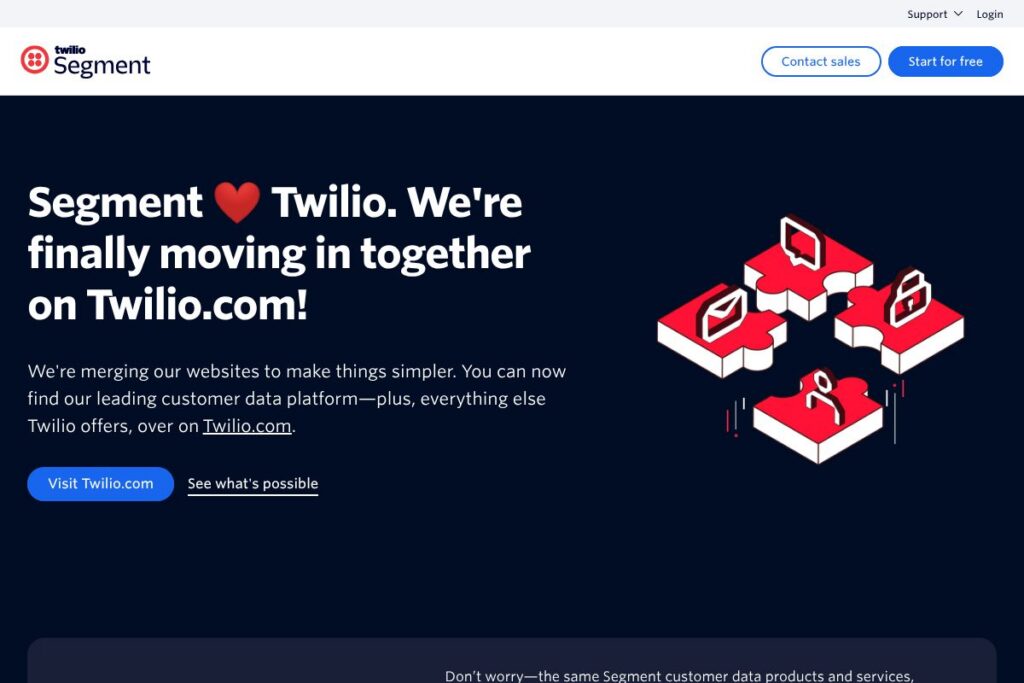
Twilio Segment is a customer data platform that centralizes event and customer data from web, mobile, server, and cloud sources into a single pipeline for analysis and activation. It standardizes incoming data, builds unified customer profiles, and sends that data to analytics tools, marketing platforms, and data warehouses for reporting, personalization, and automation. You can explore the Twilio Segment product page for an overview of capabilities and supported sources.
Compared with mParticle and Tealium, Twilio Segment emphasizes a large library of prebuilt connections and a straightforward developer experience for tracking events. mParticle focuses on strong mobile and privacy features for regulated industries, while Tealium often targets tag management and enterprise governance. Compared with Adobe Experience Platform, Segment is generally simpler to deploy for product and analytics teams, with a lighter integration footprint and more turnkey connectors to warehouses and SaaS tools.
Twilio Segment works well for teams that need reliable first-party data collection and fast activation to many destinations, and for organizations that already use Twilio communications or want to combine customer data with messaging and AI. Its combination of real-time pipelines, unified profiles, and broad integrations makes it a practical choice for product-led analytics and personalized customer journeys.
How Twilio Segment Helps teams
Data collection begins by adding Segment libraries or server-side sources to apps and services, which send events into a central pipeline where data is validated, normalized, and enriched. From there events can be routed in real time to analytics, marketing tools, and data warehouses or stored for batch processing.
Teams typically use Segment to unify siloed touchpoints into a single customer view, then build audiences and trigger actions in downstream systems. For example, product teams instrument events to measure feature adoption, marketing builds audiences from event data for ad targeting, and analytics engineers feed a warehouse for cohort analysis and machine learning. Integration with Twilio communications lets teams use that same customer data to personalize SMS, email, and in-app messaging.
What does Twilio Segment do?
The platform centers on collecting first-party event data, constructing unified customer profiles, and activating data to many destinations for analytics, personalization, and messaging. Recent additions from Twilio integration make it easier to combine Segment data with Twilio messaging and AI services for orchestrated, data-driven customer interactions.
Top functionality includes pipeline reliability, profile building, audience creation, and a large catalog of destinations and sources that reduce custom engineering work. The platform also provides developer libraries, transformation tools, and documentation to speed implementation; see the Segment documentation for developer guides and SDK references.
Connections
Connections provide prebuilt source and destination integrations so teams can send data from apps, servers, and cloud services into the Segment pipeline and then out to analytics, marketing, or warehouse endpoints. This reduces the need to write and maintain many vendor-specific tracking integrations.
Customer data pipeline
The pipeline validates incoming events, applies transforms, and routes them in real time to configured destinations while retaining a canonical event stream. That ensures consistent data across tools and supports both streaming and batch destinations.
Unified profiles
Unified profiles aggregate event history and trait data into a single view of each customer, enabling cross-channel personalization and audience membership logic based on combined behavioral and attribute signals. Profiles can be used to power personalization in downstream systems or to drive segmentation.
Advanced audiences
Audience building lets teams define dynamic segments using event history and profile attributes and then activate those audiences in marketing, advertising, and messaging destinations. Audiences update in near real time so activations reflect recent behavior.
Real-time journeys and orchestration
Real-time journeys allow teams to orchestrate multi-step workflows and trigger messages or actions based on events and audience membership. This supports use cases such as onboarding flows, cart abandonment sequences, and lifecycle campaigns.
Data warehouse sync
Segment offers built-in connectors to send raw event streams and transformed tables to data warehouses like Snowflake, BigQuery, and Redshift, simplifying analytics workflows and machine learning model training. Warehouse sync preserves a single source of truth for long-term storage and ad-hoc analysis.
Integrations and destinations
The integrations catalog spans hundreds of destinations including analytics, advertising, CRM, and customer support tools so teams can activate data without instrumenting each vendor separately. You can browse the Segment integrations directory to find supported destinations and setup instructions.
Developer tools and transformations
Client SDKs, server libraries, and cloud functions let engineering teams collect and enrich events with low latency, while transformation tools enable data cleaning and schema enforcement before activation. The platform also provides tools for testing and monitoring event quality.
Privacy, security, and governance
Built-in controls for data filtering, consent management, and destination-level suppression help teams meet privacy requirements and regulatory needs. Enterprise features include access controls, audit logs, and options for routing to private warehouses for tighter governance.
With Twilio Segment you get reliable event collection, broad destination coverage, and unified customer profiles that make downstream analytics and personalization easier. The biggest benefit is the reduction in integration overhead when you need to move the same data into many tools quickly.
Twilio Segment pricing
Twilio Segment uses a tiered, usage-based commercial model with plans that scale from developer-level usage to enterprise deployments; enterprise customers typically receive custom pricing based on event volume, required features, and support needs. For specific plan options and licensing details, review Twilio Segment product and sales resources.
For an overview of service tiers and to request pricing tailored to your usage, visit the Twilio Segment product page and contact sales via the Twilio sales and pricing channels. You can also review the Twilio Segment product page for guidance on plan selection and enterprise offerings.
What is Twilio Segment used for?
Product analytics and customer experience teams use Twilio Segment to centralize event data so measurement and experimentation work from the same dataset. It is commonly used to track feature usage, build behavioral audiences, and feed analytics models in warehouses.
Marketing and growth teams use Segment to create audiences from behavioral signals and to power targeted campaigns across advertising, email, and messaging providers. Customer success and support teams rely on unified profiles to surface relevant history during support interactions.
Pros and cons of Twilio Segment
Pros
- Large integrations catalog: The platform supports hundreds of prebuilt sources and destinations, which reduces engineering effort when activating data across many tools. This makes integrations faster to configure and maintain.
- Real-time pipelines and profiles: Event streaming and unified profiles enable near real-time personalization and audience updates, which helps teams run timely campaigns and data-driven journeys. This is useful for use cases that require immediate responses to user behavior.
- Strong developer experience: Comprehensive SDKs, transformation utilities, and documentation make it straightforward for engineering teams to instrument events and maintain data quality. Developer tooling speeds up troubleshooting and testing.
Cons
- Usage-based cost can scale quickly: For organizations with very high event volumes, costs may increase substantially as usage grows, requiring careful planning of what events to collect. Cost management often involves sampling and event governance.
- Enterprise features may require custom setup: Advanced governance, SSO, and SLAs are handled via enterprise contracts and implementation work, which can add complexity for organizations that need those capabilities quickly.
- Overlap with other Twilio services: Teams that already use multiple Twilio products should plan integration architecture carefully to avoid duplicate data flows and to align ownership between product and communications teams.
Does Twilio Segment Offer a Free Trial?
Twilio Segment offers developer-level free access and trial options for evaluation, plus enterprise onboarding for production workloads. The free tier typically covers basic event ingestion and testing so teams can validate instrumentation, while enterprise features and higher-volume usage are available through paid plans; see the Twilio Segment product page for signup and trial details.
Twilio Segment API and Integrations
Segment provides developer APIs and SDKs for collecting events, managing sources, and programmatically configuring destinations; consult the Segment API documentation for endpoint details and examples. The documentation covers tracking APIs, management APIs, and best practices for schema design and event validation.
Key integrations include data warehouses such as Snowflake, BigQuery, and Amazon Redshift, plus downstream tools like Salesforce, Shopify, analytics platforms, and advertising networks; search the Segment integrations directory to find exact connectors and setup instructions.
10 Twilio Segment alternatives
Paid alternatives to Twilio Segment
- mParticle — A CDP focused on mobile and cross-channel data with strong privacy and consent controls for regulated industries.
- Tealium — Provides tag management and a CDP with data governance and enterprise integrations for marketing operations.
- Adobe Experience Platform — Enterprise-grade data management and activation tightly integrated with Adobe marketing and analytics products.
- Salesforce Customer Data Platform — CDP built into the Salesforce ecosystem with deep CRM integration and marketing activation tools.
- RudderStack — A developer-focused CDP with streaming-first architecture and paid managed tiers for enterprise needs.
- Heap — Automatic event capture and analysis that reduces manual instrumentation for product analytics and activation.
- Amplitude — Primarily analytics and behavioral data platform with audience and experimentation integrations for product teams.
Open source alternatives to Twilio Segment
- RudderStack (Open Source) — An open core CDP that provides source and destination connectors with an option to self-host the event pipeline for greater control.
- Snowplow — Open-source event collection and modeling pipeline designed for teams that want full control over data quality and schema enforcement.
- Apache Unomi — An open-source customer data platform project focused on profile management, personalization, and GDPR-compliant data handling.
Frequently asked questions about Twilio Segment
What is Twilio Segment used for?
Twilio Segment is used to collect and unify first-party event and customer data for analytics, personalization, and downstream activation. Teams use it to build unified profiles, define audiences, and route data to analytics and marketing tools.
Does Twilio Segment integrate with data warehouses?
Yes, Twilio Segment offers native connectors to warehouses like Snowflake, BigQuery, and Redshift. Those connectors sync event streams and transformed tables for analytics and machine learning workloads.
Can Twilio Segment handle real-time personalization?
Yes, Twilio Segment supports real-time pipelines and audience updates that enable near real-time personalization and campaign triggers. That capability is used to power journeys and messaging activations across channels.
Is Twilio Segment suitable for enterprise compliance and governance?
Yes, Twilio Segment includes privacy and governance features such as data filtering, consent controls, and enterprise access controls. Larger organizations can also combine Segment with private warehouse routing to meet stricter data residency requirements.
How do I get started with Twilio Segment?
Start by reviewing the Segment documentation and installing a client SDK or server source to begin sending events. The documentation and setup guides explain best practices for schema design, testing, and configuring destinations.
Final verdict: Twilio Segment
Twilio Segment stands out for broad source and destination coverage, a strong developer experience, and the ability to build unified customer profiles that feed analytics, personalization, and messaging systems. Its integration with Twilio communications services offers a clear path for teams that want to connect customer data directly to SMS, email, and programmable messaging.
Compared with mParticle, Twilio Segment tends to be easier to deploy for product and analytics teams and offers a larger public catalog of connectors, while mParticle often targets mobile-first and privacy-centric enterprise customers with comparable enterprise pricing. For most teams that need fast instrumenting, warehouse sync, and wide activation options, Twilio Segment provides a practical combination of features and integration breadth.