twinme: An Overview
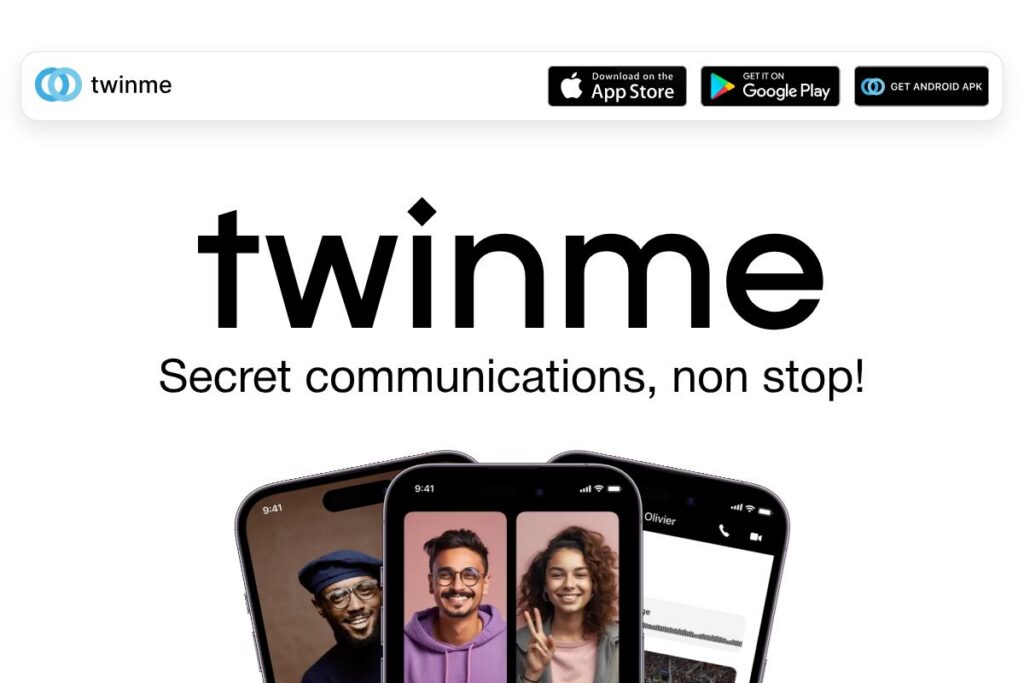
twinme is a privacy-first instant messaging app that connects devices directly, without requiring phone numbers, email addresses, or user accounts. It emphasizes device-to-device, end-to-end encrypted communication so conversations leave no centralized trace and can be controlled or revoked by each participant.
Compared with apps like Signal, Telegram, and Threema, twinme focuses on anonymous relations and peer-to-peer real-time exchanges rather than contact lists tied to phone numbers or cloud-based message storage. Signal relies on a phone number for registration and stores limited metadata, Telegram uses cloud-based routing for some chats, and Threema requires a paid ID model; twinme differentiates itself by enabling invitation-code based relations and in-the-moment interactions without persistent identifiers.
All of this makes twinme well suited for people who need conversation-level anonymity and local control over content, such as privacy-conscious users, short-lived guest interactions at events, or small groups that prefer direct device connections without intermediary servers.
How twinme Works
twinme establishes direct peer-to-peer connections for messaging and voice/video calls using end-to-end encryption. Users create relations by exchanging short invitation codes or QR codes; each relation generates a private profile that only the two ends control and that can be revoked at any time.
In practice you add someone by sharing a relation code, start a high-definition voice or video call directly with that relation, and share media during the session. Features like call transfer and click-to-call use short-lived transfer codes or web URLs so a mobile call can be moved to a browser or guests can call without creating accounts.
What does twinme do?
twinme combines anonymous contact management, encrypted real-time messaging, and HD voice/video calling in a single mobile-first application. Recent additions include a live call transfer feature that moves an ongoing mobile call into a browser session, group calls with improved energy efficiency, and integrated media streaming during calls.
Let’s talk twinme’s Features
Contacts & Conversations
Conversations are tied to relations created by invitation codes, not global IDs or phone numbers. Each relation stores its own private profile and message history, and twinme provides local tools to delete or expire messages by date, conversation, or space with changes applied only on the device initiating them.
Media Sharing
You can share photos, files, and live media streams during calls with the same privacy model as the rest of the app. Participants can control playback locally, interact on the stream in real time, and avoid cloud-based copies because media flows directly between devices when the connection permits.
Call Transfer
Call Transfer moves an ongoing mobile call to a web browser using a short transfer code and a bookmarkable web URL. Create a transfer code on your phone, forward it to a browser session, and continue the call from the browser without creating a new account or leaving a server-based trace.
Group Calls
Group calls support HD audio and video quality while minimizing cloud persistence and device battery impact. You can invite multiple relations into a single voice or video session; the app avoids storing group call content in cloud servers by default.
Click-to-call
Click-to-call lets you publish a URL or QR code that allows a guest to initiate an anonymous call from a browser. This is useful for temporary or public interactions where you want people to reach you without exchanging contact details or leaving any central audit trail.
Share Music During a Call
Participants can stream and control shared music during a call, with synchronized playback options and per-participant controls. This feature replicates the social experience of listening together while keeping media transmission private between participants.
With twinme you get a suite of private, relation-focused communication tools that avoid phone numbers and persistent identifiers. The biggest benefit is fine-grained control over each relationship and conversation, including the ability to revoke access and delete content so it disappears from both ends.
twinme Pricing
twinme uses a free model and does not require subscriptions or per-user fees. The application is presented as free to download and use, with no carrier, SIM card, or subscription requirements noted on the product pages.
For the most current details about availability and any optional paid services, visit the twinme homepage to review their distribution and feature announcements.
What is twinme Used For?
twinme is commonly used for private, ephemeral conversations where parties prefer anonymity or minimal digital footprint. Typical uses include one-on-one secure chats, ad hoc guest calls at events, and private group calls among friends or family without sharing phone numbers.
Organizations and individuals also use twinme for sensitive exchanges that require the ability to revoke relations or remove content permanently from both ends, such as investigative interviews, confidential consultations, or short-term project coordination where persistent contact details are not desirable.
Pros and Cons of twinme
Pros
- Anonymous relations: You can interact without a phone number, email, or global user ID, which reduces linkability across services and preserves real-life-style anonymity.
- Peer-to-peer encrypted: Direct device-to-device connections minimize server-side traces and provide end-to-end encryption for messages, calls, and media streams.
- Relation-level control: Each relation has a private profile you can revoke or delete, and deleting conversation content removes it from both ends when the other device is reachable.
- Call transfer and click-to-call: Unique features allow transferring mobile calls to a browser and letting guests call via URL/QR without creating accounts, useful for temporary or public interactions.
Cons
- Limited integration ecosystem: Because twinme focuses on peer-to-peer privacy, it does not offer the broad app integrations that cloud-based platforms provide, which can limit workflow automation.
- Discovery friction: The invitation-code model adds a step to onboarding contacts compared with apps that use phonebook discovery, which may be awkward for some users.
- Potential connectivity constraints: P2P real-time calls can be affected by NAT or network restrictions more than cloud-relayed services, leading to occasional fallback or quality variance.
Does twinme Offer a Free Trial?
twinme offers a free plan. The app is distributed as a free secure messaging and calling solution with no subscription required, allowing users to create anonymous relations, start encrypted calls, and use features like call transfer and click-to-call without a paid tier.
twinme API and Integrations
twinme does not position itself as a large third-party integration platform; its core capabilities focus on direct device connections and browser-based call transfer via a short-lived URL. Developers interested in extending functionality should consult the twinme homepage for any developer resources or documentation on web call integration.
If you need broader automation or enterprise integrations, consider platforms that offer open APIs or server-side connectors, since twinme emphasizes privacy and minimal external dependencies rather than integrated workflows.
10 twinme alternatives
Paid alternatives to twinme
- Wickr: An enterprise-grade secure messaging platform with paid plans for organizations, offering secure messaging, file transfer, and compliance features.
- Wire: A secure collaboration tool with business plans, end-to-end encryption, and team management features suitable for companies.
- Threema: A paid, privacy-focused messenger that uses anonymous IDs and offers one-time purchase or enterprise licensing for private use.
- Silent Phone (Silent Circle): A paid secure calling and messaging service targeted at enterprise users with advanced security controls.
- Mattermost: An open core team messaging system that offers paid enterprise hosting and support for organizations requiring on-premises control.
Open source alternatives to twinme
- Element (Matrix): A client for the Matrix protocol that supports end-to-end encryption, self-hosting, and rich integrations for teams and communities.
- Signal: An open-source messaging app with end-to-end encryption and secure voice/video calls, although it generally requires a phone number for registration.
- Jami: A decentralized, peer-to-peer communication tool that supports voice, video, and messaging without central servers.
- Briar: An open-source Android app designed for peer-to-peer encrypted messaging that can work over direct connections without central infrastructure.
Frequently asked questions about twinme
What is twinme used for?
twinme is used for anonymous, peer-to-peer messaging and HD voice/video calls. It is designed for people who want private, relation-based conversations without phone numbers or accounts.
Does twinme require a phone number or email to sign up?
No, twinme does not require a phone number or email address. Users create relations via invitation codes or QR codes rather than registering with personal contact details.
Can twinme calls be transferred to a browser?
Yes, twinme supports live call transfer to a browser via a transfer code and URL. You generate the transfer code on your device, open the corresponding URL in a browser, and continue the call without creating an account.
Does twinme keep message history on its servers?
No, twinme emphasizes device-to-device exchanges with no intermediate persistent storage. Conversations and media are designed to remain on the devices involved, and deletion operations remove content from both ends when possible.
Is twinme free to use?
Yes, twinme is offered as a free app with no subscription required. The app provides core messaging, calling, and media sharing features at no cost.
Final Verdict: twinme
twinme delivers a focused set of privacy-first communication tools that remove the need for phone numbers, emails, or persistent accounts. Its peer-to-peer, relation-based model, combined with features like call transfer and click-to-call, makes it a practical choice for users who need ephemeral, controlled interactions and minimal central traces.
Compared with Signal, which is also free and end-to-end encrypted, twinme stands out for allowing truly anonymous relations without phone number registration and for its browser call transfer capability. Signal provides a broader ecosystem and third-party integrations, while twinme prioritizes relation-level anonymity and device-only control, which some users will prefer despite fewer integrations.