What is Verint CX Automation
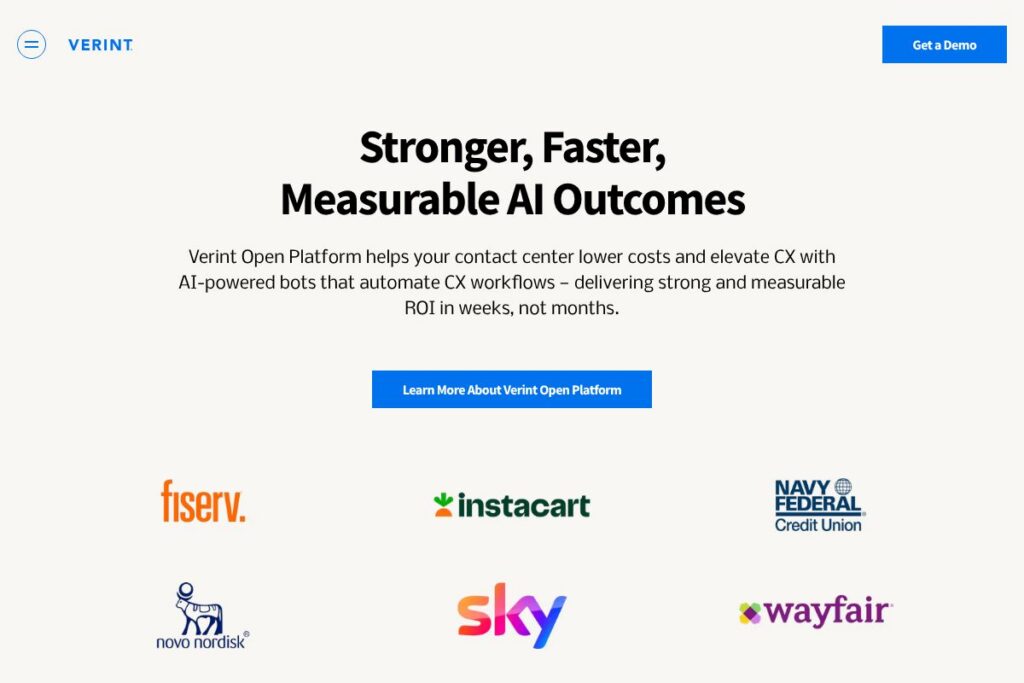
Verint CX Automation is a customer experience automation platform built for enterprise contact centers. It combines an open CCaaS architecture with a catalog of AI-driven bots, intelligent virtual assistants, speech and conversation analytics, and automated quality management to reduce manual work and improve outcomes across service, sales, and collections teams.
Compared with platforms such as Genesys Cloud and NICE CXone, Verint places more emphasis on packaged AI bots for common contact center workflows and deep speech analytics integration. Genesys Cloud emphasizes per-seat cloud contact center features and an extensive marketplace, while NICE CXone focuses on workforce optimization and omnichannel routing; Verint competes by offering prebuilt automation use cases and a strong voice analytics stack. All of this makes Verint CX Automation particularly well suited to large enterprises that need AI-driven containment, transcription accuracy, and scalable quality monitoring.
How Verint CX Automation Works
Verint deploys as a cloud-native CCaaS platform that ties into existing telephony, CRM, and workforce systems to orchestrate customer interactions. Intelligent Virtual Assistants (IVA) handle self-service flows while agent copilot bots offer real-time suggestions, automated wrap-up, and coaching prompts directly in the agent desktop.
Conversation data from IVAs and calls feeds speech analytics and transcription services to generate insights, alerts, and quality evaluations. Those insights in turn train bots and drive continuous improvement loops for routing, scripting, and agent coaching, enabling measurable outcomes like higher containment and shorter average call handling time.
What does Verint CX Automation do?
The platform bundles conversational AI, analytics, and automation into a single contact center stack so teams can deploy use-case specific bots quickly and measure business outcomes. Recent additions emphasize agent copilot bots for coaching, higher-accuracy transcription, and broader automation for quality monitoring and after-call wrap-up.
The platform includes several powerful capabilities:
Intelligent Virtual Assistant (IVA)
IVA handles common customer intents through conversational self-service across voice and digital channels, handing off to agents when necessary. Enterprises use IVA to increase containment rates, reduce calls to live agents, and provide 24/7 support while preserving conversational context across channels.
Agent Copilot and Coaching Bot
Agent copilot bots provide real-time guidance, recommended next steps, and compliance prompts on live interactions to improve first-contact resolution and sales conversion. Organizations use these bots to coach agents during calls, decrease average handle time, and raise service quality without extensive supervisor intervention.
Speech Analytics and Conversation Intelligence
Speech analytics mines unstructured audio to detect sentiment, root causes, and compliance risk, while conversation intelligence surfaces patterns across interactions. Teams use these insights to spot process gaps, refine IVAs, and prioritize training where it will move the needle on NPS and revenue.
Exact Transcription and Voice-to-Text
High-accuracy transcription converts spoken audio into structured text for analytics, search, and downstream automation. Accurate transcriptions enable automated scoring, faster summarization, and searchable records that improve QA coverage and downstream analytics.
Quality Bot and Automated Evaluations
Quality Bot automates call evaluations at scale, increasing coverage without adding headcount by scoring interactions and flagging exceptions. This automation allows quality teams to focus on high-impact coaching rather than sampling low volumes of calls manually.
Wrap Up Bot and After-Call Automation
Wrap Up Bot generates call summaries, populates CRM fields, and captures action items immediately after a call and before disposition. Automating wrap-up reduces manual entry, accelerates agent readiness for the next contact, and improves CRM data consistency.
Open CCaaS Platform and Integrations
Verint is designed as an open CCaaS platform with connectors to CRMs, telephony, and orchestration layers so automation can be embedded into existing contact center ecosystems. This approach enables enterprises to combine Verint’s bots with third-party routing, workforce optimization, and reporting tools.
With these capabilities, the biggest benefit is end-to-end automation that turns raw conversation data into operational improvements, allowing contact centers to increase containment, boost agent capacity, and surface revenue opportunities from routine interactions.
Verint CX Automation pricing
Verint CX Automation follows an enterprise pricing model with custom plans that align features, deployment needs, and support levels to each customer. Public, per-seat or per-feature pricing is not published on a dedicated pricing page; pricing is typically quoted based on scope, channel volume, and required SLAs.
For tailored pricing and licensing options contact the Verint sales team via Verint’s contact page or review available licensing information through Verint’s resource center.
What is Verint CX Automation used for
Verint CX Automation is used to automate contact center workflows, including self-service IVAs, live-agent coaching, automated quality assurance, and post-call processing. Teams deploy it to reduce call volumes routed to agents, shorten average handle times, and improve revenue capture through real-time sales guidance.
Industries that commonly use Verint include telecommunications, banking, healthcare, insurance, and financial services where high call volumes, regulatory requirements, and revenue opportunities justify advanced speech analytics and automation. It is most appropriate for enterprise contact centers that need production-grade accuracy and integration with core systems.
Pros and Cons of Verint CX Automation
Pros
- High containment and cost reductions: Verint’s IVA and self-service bots can substantially reduce live-agent volume and lower operating costs through automated handling and containment. Many customers report multi-million dollar savings by increasing automation.
- Scalable quality coverage: Automated quality and transcription increase monitoring from tiny samples to near-complete coverage without proportional headcount growth, improving compliance and coaching impact.
- Broad bot catalog and industry use cases: Prebuilt bots for wrap-up, coaching, transcription, and quality reduce time-to-value for common contact center workflows across regulated industries.
- Open platform and integration focus: The platform integrates with CRM and telephony ecosystems so organizations can reuse existing investments and orchestrate end-to-end automation.
Cons
- Enterprise deployment complexity: Implementing and customizing advanced analytics and bot-driven automation often requires professional services and significant integration work for large contact centers.
- Custom pricing and procurement: Pricing and licensing are typically negotiated, which can slow procurement cycles for organizations expecting transparent, per-seat pricing.
- Data and model dependency: Outcomes depend on historical interaction data quality and ongoing tuning of models and automations to match evolving customer language and business rules.
Does Verint CX Automation Offer a Free Trial?
Verint CX Automation offers tailored demos and proof-of-concept engagements rather than a standard free plan. Prospective customers typically work with Verint to run a pilot or proof-of-concept, which demonstrates containment, transcription accuracy, and coaching benefits using real interaction data; contact Verint via their contact page to request a demo or pilot.
Verint CX Automation API and Integrations
Verint provides APIs and connectors to integrate with CRM, telephony, workforce, and analytics systems so bots and analytics fit into existing workflows. For developer and integration details, review Verint’s partner and integration resources on the Verint partners page.
Key integrations include common CRM and telephony platforms, analytics pipelines, and workforce management tools, enabling transcription and analytics outputs to populate downstream systems for reporting and remediation.
10 Verint CX Automation alternatives
Paid alternatives to Verint CX Automation
- Genesys Cloud — A cloud contact center platform with omnichannel routing, workforce optimization, and a marketplace of digital and AI services; pricing uses published per-seat plans, and it emphasizes rapid cloud deployment. See Genesys Cloud pricing at the Genesys site.
- NICE CXone — Focuses on omnichannel routing and workforce optimization with analytics and automation for enterprise contact centers. NICE offers comprehensive WFO and CX analytics suites.
- Five9 — Cloud contact center software with AI-infused routing and reporting aimed at medium to large enterprises; known for rapid deployments and an extensive partner ecosystem.
- Cisco Contact Center — Enterprise-grade contact center solutions with deep telephony integrations and deployment options across on-prem and cloud environments.
- Amazon Connect — AWS’s cloud contact center with pay-as-you-go usage and integrations to AWS analytics and AI services; appeals to teams comfortable with AWS tooling and pricing models.
- Talkdesk — Cloud-native contact center platform with AI features and rapid integration to CRMs; positioned for both mid-market and enterprise customers.
- Zendesk — A customer service platform that includes messaging and voice add-ons with automation and workflow tools for support teams.
Open source alternatives to Verint CX Automation
- Asterisk — Open source telephony engine used to build custom contact center and IVR systems, suitable for teams that can manage telephony infrastructure.
- FreeSWITCH — A scalable telephony platform for building custom contact center capabilities and call routing solutions.
- Rasa — Open source conversational AI framework for building custom chatbots and voice assistants with developer control over models and data.
- Kaldi — A speech recognition toolkit used for building custom transcription engines and research projects that require fine-grained control.
- Botpress — An open source conversational platform for building chatbots with a visual flow editor and developer extensibility.
Frequently asked questions about Verint CX Automation
What is Verint CX Automation used for?
Verint CX Automation is used to automate contact center workflows, speech analytics, and quality monitoring. Organizations deploy it to reduce live-agent volume, improve transcription accuracy, and scale QA and coaching.
Does Verint CX Automation integrate with CRM systems?
Yes, Verint CX Automation integrates with major CRM and telephony platforms. Integrations allow transcription, summaries, and QA outputs to populate CRM records and inform downstream workflows.
How does Verint CX Automation improve customer satisfaction?
By combining IVA, real-time coaching, and speech analytics to resolve issues faster and more accurately. That combination raises containment, reduces handle times, and surfaces recommendations that improve net promoter scores and first-contact resolution.
Can Verint CX Automation scale for large enterprises?
Yes, Verint CX Automation is designed for enterprise-scale deployments with cloud-native architecture and partner integration capabilities. It supports high-volume voice and digital channels with automated quality coverage and analytics.
Is there a free version of Verint CX Automation?
No public free version exists; Verint provides demos and pilot engagements tailored to enterprise needs. Contact Verint through their contact page to discuss a proof-of-concept or pilot.
Final verdict: Verint CX Automation
Verint CX Automation excels at turning conversation data into operational outcomes by combining IVA, speech analytics, and a suite of task-focused bots for coaching, wrap-up, and quality automation. It is particularly strong for enterprises that need high transcription accuracy, broad QA coverage, and packaged automation use cases that reduce implementation time compared with building automations from scratch.
Compared with Genesys Cloud, Verint leans more toward packaged AI bots and deeper speech analytics, while Genesys Cloud offers published per-seat subscription tiers and a large marketplace of third-party integrations. Pricing for Verint is typically custom and negotiated to match deployment scope, whereas Genesys provides clearer per-seat pricing for faster procurement, so organizations should evaluate total cost of ownership and integration needs when choosing between them.