What is SAP Software Solutions
SAP Software Solutions is a portfolio of enterprise-grade applications and platform services that combine cloud ERP, industry cloud extensions, data management, and embedded AI to support end-to-end business processes. The portfolio centers on SAP Business Suite capabilities such as ERP, analytics, and industry-specific modules, combined with data services and AI that make operational decisions more contextual and automated. Explore the SAP Business Suite for product details and scope.
Compared with Oracle Cloud and Microsoft Dynamics 365, SAP emphasizes deep industry functionality and process orchestration at scale. Oracle Cloud focuses on converged database and application stack, while Microsoft Dynamics 365 targets integration with Microsoft 365 and Azure services and often appeals to midmarket customers. All three vendors support cloud deployment, but SAP is commonly chosen for large enterprises with complex, global process needs.
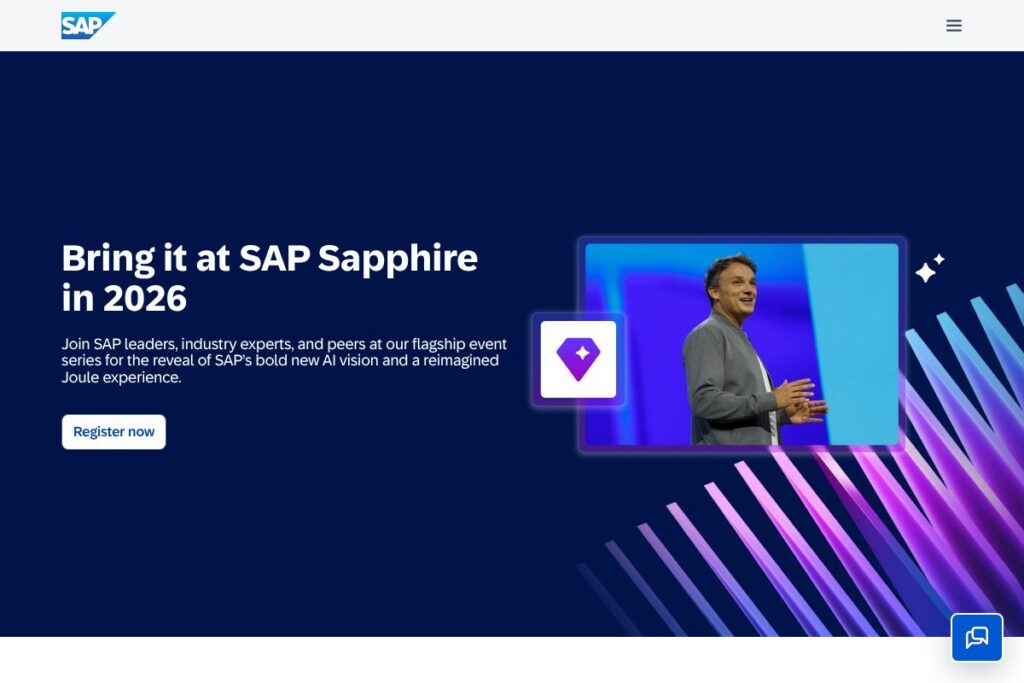
All of this makes SAP Software Solutions well suited for organizations that need integrated ERP and data platforms across multiple lines of business, and for companies that require industry-specific processes and global compliance support. The suite performs especially well where continuous process orchestration, data governance, and embedded intelligence are required, and where organizations work with a broad partner ecosystem to extend core functionality. SAP’s event presence, such as SAP Sapphire, highlights new AI and Joule capabilities aimed at operationalizing AI across processes.
How SAP Software Solutions Works
SAP Software Solutions brings together transactional systems, shared data, and AI services so that operational decisions flow from a single source of truth. Core cloud ERP applications capture transactions, the SAP Business Data Cloud consolidates and contextualizes that data, and embedded AI uses that context to generate recommendations, automate routine work, and trigger downstream processes.
Implementation typically follows a pattern of process mapping, data consolidation, and phased module rollout. Teams start with key processes such as finance or supply chain, connect data sources via the SAP API Business Hub, and configure embedded AI or Joule Agents to automate tasks and surface operational insights. The partner ecosystem supports industry extensions, integrations, and implementation services through the Find a partner marketplace.
SAP Software Solutions features
SAP Software Solutions is organized around three capability areas: intelligent business processes powered by embedded AI, a trusted business data layer for contextual analytics, and cloud ERP applications that orchestrate operations. Recent product focus includes agentic AI via Joule Agents and expanded data-cloud services to accelerate AI-readiness and sustainability reporting.
SAP Business AI
Embedded AI applies models directly inside business processes so recommendations, anomaly detection, and automation appear where users already work, reducing context switching. This lowers response times for operational decisions, helps standardize repetitive tasks, and improves consistency across teams.
SAP Business Data Cloud
The Business Data Cloud consolidates master, transactional, and third-party data into governed views that feed analytics and AI models. Teams benefit from a single, contextualized data layer that reduces data reconciliation, improves model accuracy, and supports regulatory reporting.
SAP Cloud ERP applications
Cloud ERP applications, including SAP S/4HANA Cloud, handle core processes such as finance, procurement, manufacturing, and order management in a unified system. Those applications can activate AI insights to orchestrate workflows, reduce manual handoffs, and improve process efficiency.
Joule Agents and agentic AI
Joule Agents automate cross-application tasks by collaborating across apps, surfacing insights, and executing routine work with minimal human intervention. This feature is designed to reduce manual workload and accelerate time-to-decision for common operational scenarios.
Partner ecosystem and apps
A broad partner marketplace delivers industry extensions, specialized services, and turnkey integrations that complement SAP’s core offerings. Customers can discover and deploy partner solutions to address niche requirements without extensive custom development.
Industry cloud and prebuilt processes
Industry-specific cloud solutions include preconfigured processes and data models tailored to vertical needs such as manufacturing, retail, utilities, and life sciences. These reduce implementation time and align operations to sector best practices.
Security, compliance, and data governance
Security and compliance capabilities include strong identity controls, data residency options, and support for certifications required in regulated industries. Built-in governance tools help teams manage data lineage and audit trails across processes.
With these capabilities combined, the biggest benefit of SAP Software Solutions is end-to-end operational coherence: transactions, analytics, and automation operate from a shared data foundation so decisions become repeatable and measurable. For organizations prioritizing industry depth, global scale, and embedded intelligence, SAP offers a tightly integrated platform and a wide partner ecosystem to extend it.
SAP Software Solutions pricing
SAP Software Solutions follows a custom enterprise pricing model that is tailored to deployment scope, selected modules, number of users, and support requirements. Pricing is typically negotiated with SAP sales or partners and varies by cloud subscription, on-premises licensing, and implementation services.
Because pricing is configured to customer requirements, organizations should contact SAP or an authorized partner to get a precise quote; view SAP’s product portfolio and contact options via the SAP products and solutions pages. For enterprise procurement, factors that commonly affect price include seat counts, transaction volumes, required SLAs, and integration or data migration efforts.
What is SAP Software Solutions Used For?
SAP Software Solutions is used to run and coordinate core business functions such as finance, procurement, manufacturing, supply chain, HR, and customer service at enterprise scale. Organizations use the suite to replace fragmented legacy systems, bring consistent recordkeeping across subsidiaries, and enforce process standardization across global operations.
Teams also deploy SAP to support industry-specific workflows, sustainability reporting, and advanced analytics. The platform supports continuous process improvement by feeding analytics and AI with trusted data, which helps teams reduce cycle times, improve forecasting, and meet regulatory and ESG requirements.
Pros and Cons of SAP Software Solutions
Pros
- Comprehensive process coverage: SAP covers end-to-end business processes from core ERP to industry extensions, allowing large organizations to standardize on a single vendor stack. This reduces integration complexity and preserves transactional integrity across functions.
- Strong industry depth: Modules and prebuilt processes address vertical requirements for manufacturing, retail, utilities, and more, shortening time-to-value for sector-specific deployments. Industry depth reduces the need for heavy customization.
- Embedded AI and data integration: Built-in AI capabilities and a centralized data layer help convert operational data into actionable insights, improving decision speed and consistency across teams.
- Extensive partner ecosystem: A broad marketplace of partners and apps provides implementation expertise, vertical solutions, and third-party integrations that extend core capabilities.
Cons
- Complex implementation: Large-scale deployments can require significant planning, configuration, and change management, which increases project timelines and initial costs. Organizations should plan carefully for data migration and process alignment.
- Cost and procurement complexity: Enterprise-level licensing and services are typically negotiated, which can make budgeting and comparison with other vendors more involved. Smaller companies may find the procurement process less transparent than SaaS alternatives.
- Customization trade-offs: While SAP supports deep customization, extensive tailoring can increase upgrade complexity and maintenance burden; following standardized industry processes is often recommended to reduce long-term operational costs.
Does SAP Software Solutions Offer a Free Trial?
SAP Software Solutions offers limited free trials and developer editions. SAP provides trial versions, sandbox environments, and developer accounts for many cloud products through the SAP Developer Center and product trial pages; enterprise pilots and proof-of-concepts are typically arranged through sales or certified partners.
SAP Software Solutions API and Integrations
SAP provides an extensive API surface and developer tools via the SAP API Business Hub, which includes REST and OData endpoints, sample code, and integration packages. The hub enables automation and integrations with internal systems or third-party services.
Key cloud and platform integrations include major hyperscalers and enterprise platforms such as Microsoft Azure, Amazon Web Services, Google Cloud, and common SaaS systems like Salesforce and ServiceNow through connectors and partner-built adapters. Integration patterns range from real-time APIs to event-driven data replication and ETL-style data pipelines.
10 SAP Software Solutions alternatives
Paid alternatives to SAP Software Solutions
- Oracle Cloud ERP: A suite of cloud applications for finance, procurement, project management, and risk, with emphasis on Oracle Database and integrated cloud infrastructure.
- Microsoft Dynamics 365: Cloud ERP and CRM applications that integrate tightly with Microsoft 365 and Azure, aimed at organizations seeking modular, user-friendly cloud solutions.
- Workday: Cloud-native finance and HR applications that focus on human capital management, financial planning, and analytics for midmarket and enterprise customers.
- Infor CloudSuite: Industry-focused cloud ERP with strong manufacturing and supply chain capabilities and a partner ecosystem for vertical extensions.
- NetSuite (Oracle NetSuite): A cloud ERP platform popular with midmarket companies and subsidiaries for financials, CRM, and e-commerce integration.
Open source alternatives to SAP Software Solutions
- Odoo: A modular open source ERP with apps for accounting, inventory, manufacturing, and CRM that is popular with small and mid-sized businesses. It offers community and enterprise editions.
- ERPNext: A full-featured open source ERP built on the Frappe framework covering accounting, HR, manufacturing, and supply chain, suitable for small and growing organizations.
- Apache OFBiz: A flexible open source ERP and e-commerce framework for developers to build custom business suites and operational systems.
Frequently asked questions about SAP Software Solutions
What is SAP Software Solutions used for?
SAP Software Solutions is used to manage enterprise core processes across finance, supply chain, HR, and operations. Organizations deploy it to consolidate transactional systems, enable standardized processes, and support industry-specific workflows at scale.
Does SAP Software Solutions include AI capabilities?
Yes, SAP Software Solutions includes embedded AI and agent capabilities. Embedded AI and Joule Agents operate inside business processes to surface recommendations, automate routine tasks, and accelerate decision cycles.
Can SAP Software Solutions integrate with other cloud platforms?
Yes, SAP Software Solutions integrates with major cloud platforms and enterprise SaaS. Integration is supported through the SAP API Business Hub, connectors for hyperscalers, and partner-built adapters for systems like Salesforce and ServiceNow.
How does SAP Software Solutions support sustainability initiatives?
SAP Software Solutions supports sustainability through data consolidation and reporting tools. The platform gathers operational data for emissions tracking, sustainability performance metrics, and regulatory reporting to help companies meet ESG targets.
How much does SAP Software Solutions cost?
SAP Software Solutions uses custom enterprise pricing that varies by product, deployment, and scope. For accurate pricing, consult SAP sales or an authorized partner and review product offerings on the SAP products and solutions pages.
Final Verdict: SAP Software Solutions
SAP Software Solutions excels at providing a unified platform for complex, industry-specific enterprise processes, combining cloud ERP, a governed data layer, and embedded AI to turn operational data into actionable workflows. Its strength is the ability to standardize and automate at scale while leveraging a large partner ecosystem for vertical and technical extensions.
Compared with a competitor like Microsoft Dynamics 365, SAP typically targets larger, more process-complex deployments with custom enterprise pricing and deep industry functionality, while Dynamics 365 offers modular, publicly priced plans that can be easier for midmarket organizations to evaluate and adopt. Organizations should choose SAP when they need global process orchestration, industry-specific capabilities, and a partner ecosystem that supports large-scale transformation; for smaller, more modular needs, alternatives may provide faster, lower-cost entry points.