Dacast: An Overview
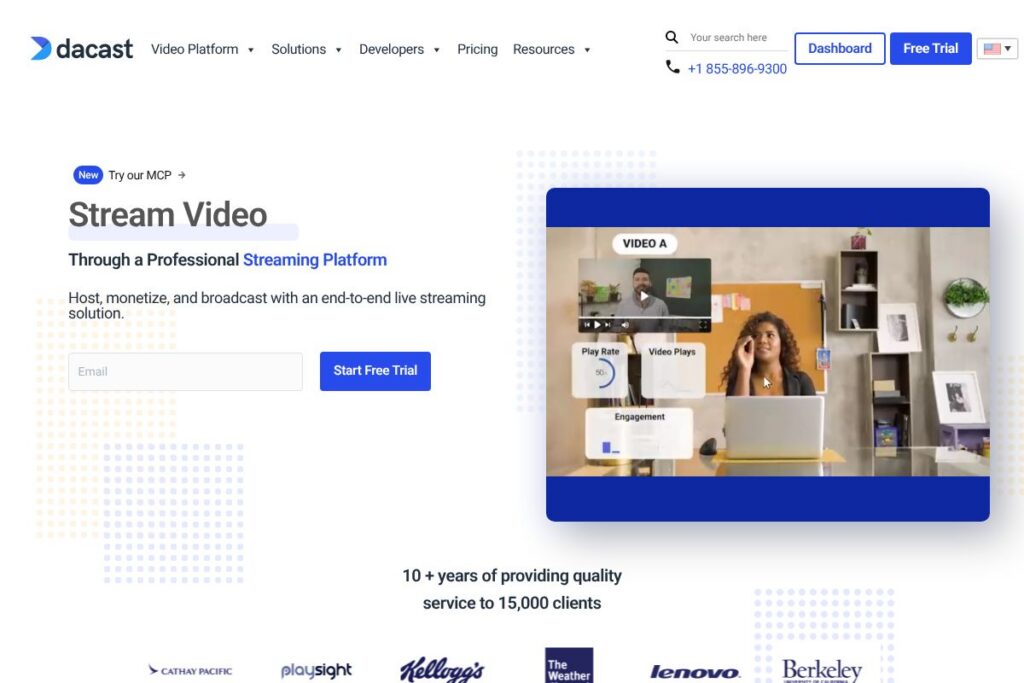
Dacast is a cloud-based online video platform that combines live streaming, VOD hosting, monetization, and developer APIs in a single service targeted at businesses and professional broadcasters. The platform is built for secure delivery and scale, with content protection, multi-device playback, and integrations aimed at teams that need reliable streaming for events, corporate communications, media, houses of worship, and sports.
Compared with Vimeo, Brightcove, and Wowza, Dacast emphasizes a bandwidth- and feature-flexible approach that balances self-service plans with enterprise options. Compared to Vimeo which often targets creators with fixed-tier packages, Dacast focuses on customizable bandwidth, white-label features, and direct monetization tools; compared to Brightcove it competes on enterprise feature parity and pricing flexibility; compared to Wowza it offers a more turnkey hosted service rather than self-managed streaming servers.
All of this makes Dacast a practical choice for organizations that need a secure, developer-friendly streaming platform with built-in monetization and 24/7 support. It is particularly well suited to event producers, enterprises running internal broadcasts, religious organizations, and niche sports broadcasters who need predictable delivery and playback across devices.
How Dacast Works
Dacast accepts live feeds from common encoders over RTMP, SRT, or other ingest protocols, transcodes streams for adaptive bitrate delivery, and distributes content via large-scale CDNs for global playback. Users manage channels, live events, and VOD libraries from the Dacast dashboard, where they can configure players, embed codes, access analytics, and set monetization rules.
For monetization and distribution, workflows typically include creating a live event or VOD asset, choosing a delivery and security profile, enabling paywall or ad settings if needed, and embedding the secure player in a website or app. Developers can automate uploads, manage payloads, and query analytics through the platform API to integrate Dacast into publishing pipelines, mobile apps, and OTT experiences.
What does Dacast do?
Dacast provides hosted, secure video delivery with tools for live streaming, video-on-demand management, monetization, analytics, and OTT distribution. The platform supports configurable players, domain-level security, token authentication, and bandwidth controls so organizations can manage access and scale delivery worldwide.
Let’s talk Dacast’s Features
Secure Video Hosting
The platform offers encrypted storage and playback controls, domain and token-based restrictions, and configurable geo-restrictions to limit who can view content. This benefits businesses and faith-based organizations that need to protect rights-managed footage or restrict internal broadcasts.
Live Streaming
Dacast supports scheduled events, multi-bitrate encoding, and live-to-VOD workflows so streams can be recorded and published after the event. The live workflow helps event producers and sports teams maintain low-latency, high-quality playback across web and mobile players.
Video Monetization
Built-in monetization options include pay-per-view, subscriptions, and voucher codes, plus support for third-party ad insertion if required. Publishers can set pricing rules per event or VOD asset and track revenue alongside viewer metrics.
VOD Management and APIs
Dacast provides VOD libraries with transcoding and metadata management, plus APIs to automate uploads, asset management, and playback integration. This helps media teams and developers build custom portals and automate content workflows.
OTT and Multi-device Playback
The platform delivers video to web browsers, native mobile apps, and connected TV environments using adaptive HLS playback and embeddable players. OTT capabilities allow broadcasters to reach audiences on phones, tablets, and set-top devices without separate hosting solutions.
Analytics and Reporting
Real-time and historical analytics cover viewer counts, bandwidth usage, playback locations, and engagement metrics to inform programming and monetization decisions. Teams use these reports to optimize streaming quality and measure event performance.
Security and DRM
Dacast supports security controls such as token authentication, domain restrictions, SSL delivery, and options for DRM to protect premium content. These features reduce piracy risk and enable monetization of paid content.
Global CDN Delivery and Low Latency
The platform routes content through enterprise CDNs to deliver consistent playback at scale with regional edge caching to reduce buffering. Sports and live-event broadcasters gain the low-latency playback necessary for near real-time viewing.
24/7 Support and Account Assistance
Dacast provides customer support and on-boarding assistance to help set up events, configure security, and troubleshoot delivery issues. Support tiers include around-the-clock options for customers that require continuous operational monitoring.
With these capabilities, Dacast delivers an integrated streaming stack that covers ingestion, delivery, monetization, and analytics while providing developer tools to automate workflows.
Dacast pricing
Dacast uses a subscription pricing model with multiple plan types and enterprise options designed around bandwidth and feature requirements, plus add-on services for enhanced support. The company offers a risk-free trial and provides custom quotes for high-volume or white-label deployments.
Monthly Billing:
- Subscription plans: Monthly plans are available and typically bundle a base amount of bandwidth with hosting and access to platform features; overage and add-ons apply if you exceed included bandwidth.
- Support add-on: $39/month is listed as a starting point for enhanced 24/7 support for customers who need dedicated assistance.
Annual Billing:
- Annual plans are offered that reduce per-month costs when paid upfront and are suitable for recurring events or continuous streaming needs. Annual subscriptions commonly include the same feature set as monthly plans but with cost savings on bandwidth and support.
Enterprise
- Enterprise plans use custom pricing and are quoted based on expected concurrent viewers, total bandwidth consumption, required SLAs, and feature needs such as DRM or white-label players. For tailored pricing and contract terms visit the Dacast homepage to request a quote or speak with sales.
What is Dacast used for
Dacast is used for broadcasting live events, streaming conferences, hosting VOD libraries, and building OTT channels for web and connected devices. Organizations commonly use it to run pay-per-view events, internal all-hands meetings, remote training, church services, and sports broadcasts.
Teams that choose Dacast include event production companies, media outlets, educational institutions, non-profits, and enterprises that need a secure, scalable streaming workflow with monetization options and developer APIs. The platform is also used by sports organizations to stream games with low latency and by churches to extend services to remote congregations.
Pros and cons of Dacast
Pros
- All-in-one streaming stack: Dacast bundles ingest, CDN delivery, VOD, monetization, and analytics into a single platform, reducing the need for separate vendors. This simplifies operations for teams that want a single control plane for video.
- Developer-friendly APIs: The platform provides APIs for uploads, playback configuration, and analytics so engineering teams can automate workflows and integrate video into custom apps. This helps organizations create branded experiences and streamline content pipelines.
- Security and monetization features: Token authentication, domain restrictions, and paywall/subscription options support secure paid delivery of premium content. These controls are useful for rights holders and publishers monetizing live and on-demand content.
Cons
- Bandwidth and overage complexity: Because plans are bandwidth-based, organizations with unpredictable traffic spikes may need careful planning to avoid overage charges. High-volume sports or viral events require proactive scaling discussions with sales.
- Enterprise feature gating: Some advanced features and SLA guarantees are tied to enterprise-level plans, requiring custom procurement for large deployments. Smaller organizations may need to evaluate trade-offs between cost and advanced capabilities.
Is Dacast Free to Try?
Dacast offers a 14-day free trial with 10 GB of bandwidth and no credit card required. The trial allows you to test live streaming and VOD workflows, embed players, and review analytics; it is intended to help you validate the platform before committing to a paid subscription.
Dacast API and Integrations
Dacast exposes developer APIs that allow automated uploads, programmatic creation of live events, playback token management, and analytics retrieval; consult the Dacast developer resources for endpoint details and examples. Key integration points include embeddable players for web and mobile, CDN configuration for delivery, and support for standard encoder protocols such as RTMP and SRT.
The platform also connects with common workflow tools and can be integrated into CMSs, LMSs, and custom OTT apps using the API and player SDKs, enabling publishing automation and centralized analytics collection.
10 Dacast alternatives
Paid alternatives to Dacast
- Vimeo — A creator- and business-focused platform with straightforward hosting, live streaming, and monetization features aimed at small teams and creators.
- Brightcove — Enterprise video platform with advanced enterprise features, audience segmentation, and ad-tech integrations for large publishers.
- Mux — Developer-first streaming and video infrastructure with real-time monitoring and pay-as-you-go pricing for engineering-driven teams.
- JW Player — Known for a fast, customizable player and hosting services with advertising and analytics features geared toward publishers.
- Kaltura — Open-core enterprise video platform that targets education and large organizations with extensive customization and on-premises options.
- IBM Watson Media — Enterprise streaming services with a focus on secure corporate broadcasting and analytics for regulated industries.
- Wowza — Streaming engine and cloud services for customers who prefer more control over the streaming server layer and custom workflows.
Open source alternatives to Dacast
- Nginx RTMP module — A lightweight, self-hosted solution for live streaming using Nginx with the RTMP module to ingest and serve streams; requires self-managed infrastructure.
- Red5 — An open source media server that supports streaming protocols and can be used as the backbone for custom streaming platforms with developer effort.
- Ant Media Server — A scalable, low-latency streaming server that provides community and enterprise editions for live streaming and WebRTC workflows.
- Streama — An open source media streaming platform for self-hosted VOD libraries and simple OTT-style setups.
Frequently asked questions about Dacast
What is Dacast used for?
Dacast is used for live streaming, video hosting, and OTT delivery for businesses and broadcasters. Organizations use it for events, corporate communications, church services, sports broadcasts, and monetized VOD.
Does Dacast offer an API for developers?
Yes, Dacast provides APIs and developer resources. The API supports automated uploads, event management, playback token handling, and analytics retrieval through documented endpoints.
How much does Dacast cost?
Dacast uses subscription and enterprise pricing based on bandwidth and features, with a 14-day free trial available and custom enterprise quotes for high-volume needs; see the Dacast homepage for current options and to request a quote.
Can Dacast handle pay-per-view or subscription monetization?
Yes, Dacast supports pay-per-view, subscription, and voucher-based monetization options. Publishers can configure monetization per event or VOD asset and track revenue through platform analytics.
Is Dacast suitable for low-latency sports streaming?
Yes, Dacast is commonly used for sports streaming and supports low-latency delivery via enterprise CDNs and optimized streaming profiles. For large audiences or peak concurrency, coordinate with sales to ensure adequate bandwidth and CDN configurations.
Final verdict: Dacast
Dacast is a pragmatic, enterprise-capable streaming platform that combines hosted live streaming, VOD, monetization, and developer APIs into a single service. Its strengths are secure delivery, flexible bandwidth-based plans, and support options that suit event producers, enterprises, and broadcasters who require white-label playback and programmatic control.
Compared to Vimeo, which publishes fixed-tier plans and targets creators and small teams, Dacast places more emphasis on customizable bandwidth packages, enterprise support, and granular monetization controls. For organizations that need a developer-friendly platform with strong content protection and scalable delivery, Dacast is a solid choice; for creators seeking simple pricing and an all-in-one creator ecosystem, competitor platforms may be easier to get started with.
Overall, Dacast is best for teams that prioritize security, monetization, and integration capabilities in a hosted streaming solution, and for anyone who expects to scale or customize delivery through APIs and enterprise services.