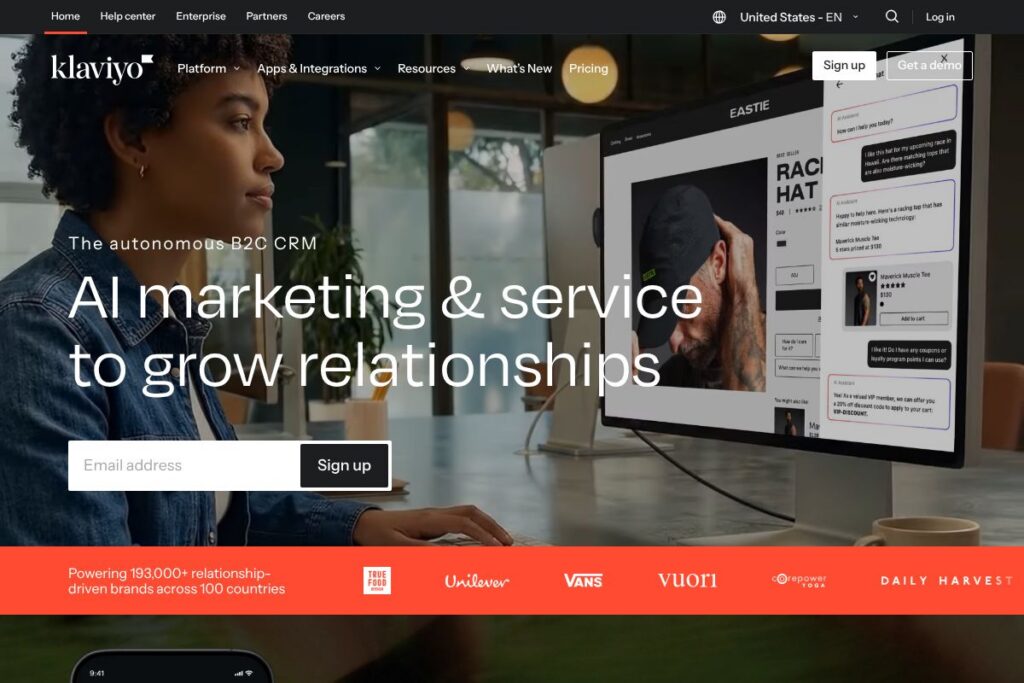
Klaviyo: An Overview
Klaviyo positions itself as an autonomous B2C CRM that unifies customer data, email, SMS, mobile push, RCS, and WhatsApp into a single platform for omnichannel marketing and customer service. It pairs a customer data platform with agentic AI features called K:AI Agents to automate campaign creation, flows, and customer responses while keeping data and execution tightly connected.
Compared with competitors, Klaviyo is more ecommerce-focused than HubSpot, providing deeper native ecommerce integrations and predictive analytics for purchase behavior. Compared with Mailchimp, Klaviyo emphasizes richer segmentation and event-level data for lifecycle marketing. Against enterprise messaging platforms like Braze, Klaviyo is often chosen by merchants who want a balance of ecommerce features and self-serve automation without a heavy engineering lift.
Klaviyo does well at connecting product, order, and behavioral signals into customer profiles and using those signals to trigger revenue-focused automations. This makes it a strong fit for online retailers, DTC brands, and teams that need omnichannel lifecycle programs with minimal developer overhead.
How Klaviyo Works
Klaviyo ingests first-party data from ecommerce platforms, payment providers, analytics systems, and direct site events to build unified customer profiles. Events such as product views, add-to-cart actions, and purchases feed real-time segments and predictive scores that trigger flows and campaigns.
K:AI Marketing Agent can analyze a brand’s website and suggest or build on-brand campaigns, signup forms, and key flows from a URL, while the Customer Agent can handle incoming questions, resolve common inquiries autonomously, and recommend offers or next actions that drive conversions. Teams use Klaviyo to run targeted campaigns, personalize email and SMS content by segment, and measure revenue attribution from each message.
Klaviyo features
Klaviyo bundles real-time customer data, channel orchestration, and AI agents to automate both marketing and customer interactions. Core capabilities include AI-assisted campaign and flow creation, deep ecommerce integrations, advanced segmentation, predictive analytics, and omnichannel execution across email, SMS, push, RCS, and WhatsApp.
Key functionality includes:
K:AI Agents
K:AI Agents automate marketing and support tasks by learning from a brand’s site and customer data to create campaigns, flows, and conversational responses. Marketing Agent can generate initial campaign creatives and forms from a URL, while Customer Agent handles common support queries and recommends conversion actions, reducing manual work for teams.
Segmentation and Predictive Analytics
Klaviyo builds dynamic segments from event-level data and applies predictive metrics such as next-purchase probability and predicted lifetime value. These predictions let teams target high-value customers, create tailored flows for churn risk, and allocate budget to messages that show measurable ROI.
Email and SMS Composer
The platform provides drag-and-drop and code-friendly editors for email templates, plus SMS composition with personalization tokens and channel-specific compliance tools. Templates can be reused in automated flows and A/B tested to optimize open, click, and conversion rates across channels.
Flows and Automation
Klaviyo supports triggered and scheduled flows that chain messages across channels based on customer actions and time delays. Pre-built flow templates for welcome series, cart recovery, and post-purchase follow-ups speed setup while allowing customization for brand tone and cadence.
Integrations and Data Sync
Klaviyo connects to ecommerce platforms, CRMs, analytics tools, and payment systems to sync product, order, and customer data in real time. With an extensive app marketplace and developer tooling, teams can centralize customer signals and keep campaigns up to date without repeated manual exports.
Customer Hub and Support Automation
Customer Hub centralizes conversations and self-service interactions so brands can resolve common questions and escalate complex issues to human agents. Automation within the hub routes queries, surfaces customer context to agents, and logs interaction data back to the customer profile for future personalization.
With these capabilities, Klaviyo helps brands reduce manual setup time, run more relevant campaigns across multiple channels, and measure marketing impact directly against revenue.
Klaviyo pricing
Klaviyo uses a subscription pricing model that scales with the number of contacts and channel usage, while also providing an entry-level free plan. Enterprise options are available for large organizations that need customed SLAs, dedicated support, and advanced security controls.
Monthly Billing:
Monthly Billing: Klaviyo offers month-to-month subscriptions that scale primarily by contact counts and the volume of messages sent across email and SMS, with add-ons for additional channels and activity-based usage.
Annual Billing:
Annual Billing: Klaviyo provides discounted annual contracts for customers who prefer annual commitments and consolidated billing; annual agreements commonly include enterprise negotiation for larger customers.
Enterprise
Enterprise: Custom pricing that includes dedicated CSMs, SLA-backed uptime, audit-ready compliance, and expanded support options. For tailored quotes and enterprise-level requirements, view enterprise pricing details on Klaviyo’s site.
For the most accurate breakdown by contact tier and channel usage, check Klaviyo’s current pricing options.
What is Klaviyo Used For?
Klaviyo is primarily used for ecommerce lifecycle marketing, including welcome series, cart abandonment recovery, win-back campaigns, and VIP segmentation. Brands use its predictive analytics to prioritize retention tactics and personalize messages that influence repeat purchases.
Beyond pure marketing, teams deploy Klaviyo for omnichannel notifications and conversational support that tie into commerce events. Companies that need coordinated email, SMS, push, and messaging channel programs with strong attribution and revenue reporting find Klaviyo especially useful.
Pros and Cons of Klaviyo
Pros
- Deep ecommerce focus: Klaviyo integrates tightly with platforms such as Shopify and BigCommerce, making it straightforward to use product and order events to power personalized campaigns and flows.
- Powerful segmentation and predictions: Advanced segmentation and predictive metrics let marketers target audiences based on behavior, purchase likelihood, and lifetime value for more effective spend allocation.
- AI-driven automation: K:AI Agents can generate campaigns and handle common support interactions, helping teams launch programs quickly and maintain consistent messaging without constant developer work.
- Omnichannel execution: Support for email, SMS, RCS, push, and WhatsApp from one profile enables consistent cross-channel journeys and accurate attribution of revenue to messages.
- Extensive integrations: A broad app marketplace and developer tools make it possible to centralize customer data and connect Klaviyo to analytics, payment, and fulfillment systems.
Cons
- Cost at scale: Pricing is contact- and usage-based, which can grow expensive for large audiences or heavy multi-channel messaging unless lists are carefully managed and pruned.
- Learning curve for advanced features: Implementing complex event schemas, custom metrics, and deeply integrated automations can require planning and some technical setup.
- Reporting for cross-platform attribution: While Klaviyo offers revenue attribution, organizations with highly-customized analytics stacks may need additional data pipelines or warehouse syncs to reconcile metrics across systems.
Does Klaviyo Offer a Free Trial?
Klaviyo offers a free plan that includes core features for small lists and starter campaigns; paid plans scale based on contacts and channel usage, and enterprise contracts are available for larger organizations. The free tier lets teams test list growth, basic flows, and email/SMS functionality before moving to a paid subscription.
Klaviyo API and Integrations
Klaviyo provides developer APIs, webhooks, SDKs, and documentation for building custom integrations and sending event data into customer profiles. The API documentation describes endpoints for profiles, events, lists, and metrics.
Key native integrations include ecommerce platforms like Shopify, major payment providers, analytics tools, and messaging connectors. The app marketplace lists 350+ pre-built integrations used to sync products, orders, and customer behavior in real time.
10 Klaviyo alternatives
Paid alternatives to Klaviyo
- Mailchimp — A broadly used email marketing platform with CRM features and built-in audience management, suited to small businesses and general marketing use.
- HubSpot — A full CRM and marketing suite that combines marketing automation with sales and service hubs, often used by B2B and mixed-model companies with larger budgets.
- ActiveCampaign — Focuses on automation and CRM features with powerful workflows and personalization for SMBs that need advanced email automation and sales automation together.
- Braze — Enterprise-focused customer engagement platform for large-scale cross-channel messaging and real-time decisioning, often used by mobile-first apps and retailers.
- Iterable — A growth marketing platform for cross-channel campaigns with a strong emphasis on orchestration and real-time personalization for mid-market and enterprise brands.
- Brevo (Sendinblue) — Combines email, SMS, and marketing automation with transactional messaging and affordable entry tiers for small businesses.
Open source alternatives to Klaviyo
- Mautic — Open source marketing automation that supports campaigns, segments, and basic personalization, suitable for teams that want self-hosted control and customization.
- Mailtrain — Self-hosted newsletter and list management tool built on Node.js and MySQL, useful for teams focused on cost control and direct email delivery management.
- Postal — An open source mail delivery platform for managing transactional and bulk email infrastructure when you need full control over sending and deliverability.
Frequently asked questions about Klaviyo
What is Klaviyo used for?
Klaviyo is used for ecommerce and B2C lifecycle marketing. Brands use it to run targeted email, SMS, and push campaigns, automate flows like cart recovery and welcome series, and measure revenue impact from messages.
Does Klaviyo have a free plan?
Yes, Klaviyo offers a free plan. The free tier includes core features for small contact lists and lets teams test basic campaigns and flows before scaling to paid subscriptions.
How does Klaviyo integrate with Shopify?
Klaviyo integrates natively with Shopify. The integration syncs products, orders, and customer behavior in real time so you can trigger flows and segmentation based on store events.
Can Klaviyo send WhatsApp messages?
Yes, Klaviyo supports WhatsApp as part of its omnichannel capabilities. WhatsApp can be used alongside email, SMS, and push to create unified customer journeys based on profile and event data.
Is Klaviyo suitable for enterprise brands?
Klaviyo can support enterprise needs with custom contracts. Enterprise offerings include dedicated support, compliance controls, SLAs, and options for larger data volumes and integrations.
Final verdict: Klaviyo
Klaviyo stands out for ecommerce-focused lifecycle marketing and omnichannel execution that is tightly coupled to first-party customer data. Its K:AI Agents and predictive analytics make it easy for merchant teams to launch and maintain targeted flows without heavy developer dependence, which shortens time to value for revenue-driving programs.
Compared with HubSpot, Klaviyo is more specialized for commerce and event-driven personalization, while HubSpot provides a broader CRM and integrated sales stack. Pricing is contact- and usage-based in Klaviyo, which can be more cost-effective for focused ecommerce programs; HubSpot’s marketing tiers tend to include broader CRM and inbound tools but can become more expensive for high-volume messaging and ecommerce-specific workflows.
Overall, Klaviyo is a practical choice for DTC and retail brands that prioritize revenue attribution, omnichannel lifecycle automation, and tight ecommerce integrations. For teams that need a commerce-centric B2C CRM with built-in AI agents and broad integration support, Klaviyo is among the leading options.


