What is Yotpo
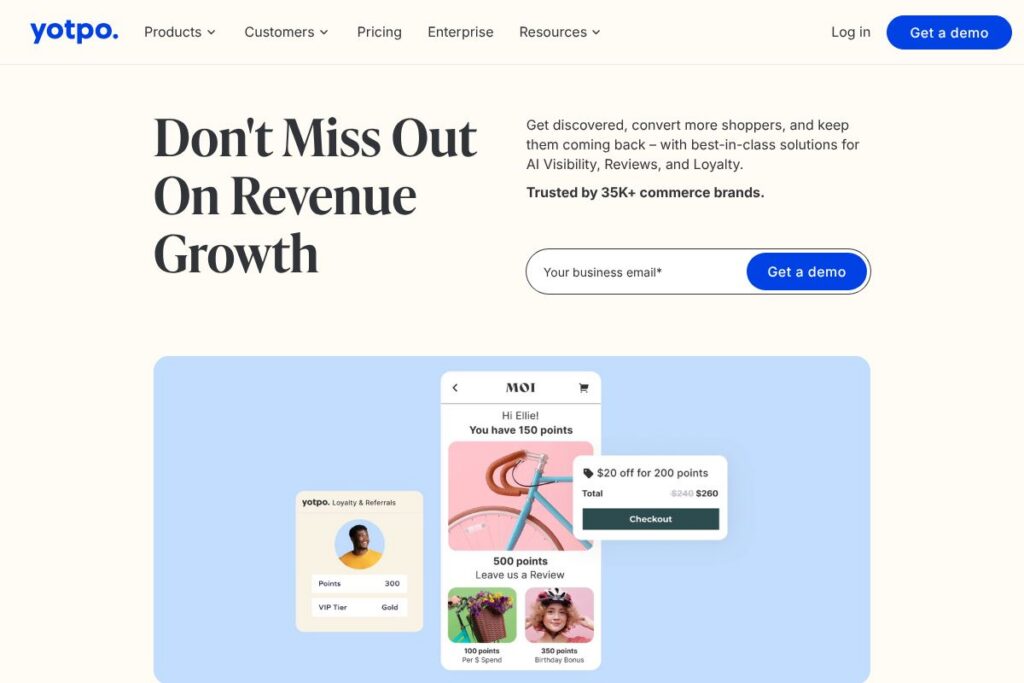
Yotpo is a commerce marketing platform built to help online retailers collect customer reviews and user-generated content, run loyalty and referral programs, and surface AI-driven product and marketing insights. It bundles modules for Reviews & UGC, Loyalty & Referrals, SMS and email remarketing, and analytics so teams can run acquisition and retention programs from a single vendor. You can explore the company and core product set on the Yotpo homepage.
Compared with competitors, Yotpo focuses on an integrated commerce stack rather than a single-channel tool. For reviews and UGC, Bazaarvoice and Trustpilot compete on scale and marketplace reach, while Stamped.io and Okendo are closer direct alternatives for merchant-focused review and loyalty features. For loyalty and lifecycle marketing, LoyaltyLion and Klaviyo overlap on retention capabilities, though Klaviyo centers on email and SMS rather than on-site reviews.
Yotpo works well for mid-market and enterprise eCommerce brands that need a single vendor to manage social proof and retention. Its strengths are centralized management of reviews and loyalty programs, native commerce integrations, and reporting that ties customer content and loyalty activity back to revenue and average order value. All of this makes it a practical choice for merchandisers and lifecycle teams that measure programs by repeat purchase and lifetime value.
How Yotpo Works
Yotpo collects customer content by integrating with your storefront and transactional systems so review requests, visual UGC collection, and loyalty points flows are triggered automatically. On receipt, content is moderated, enriched with metadata, and made available for on-site display, search engine indexing, and syndication to marketplaces and ad platforms.
Marketers use Yotpo to create automated campaigns that surface reviews across product pages, power review-driven ad creative, and enroll buyers into loyalty programs through points, rewards, and referrals. Implementation typically involves connecting your platform via a native app or the Yotpo integrations hub, mapping email and order events, and configuring on-site widgets and loyalty rules.
What does Yotpo do?
Yotpo’s platform centers on three product pillars: Reviews & UGC for collecting and displaying customer content, Loyalty & Referrals for building points and rewards programs, and AI Visibility for surfacing insights and content where it drives conversions. The platform has expanded to include messaging and automation tools, and it emphasizes integrations so data flows between commerce, email, and analytics systems.
Let’s talk Yotpo’s Features
Reviews & UGC
Yotpo automates review requests after purchase, supports photo and video submissions, and offers moderation and response workflows. On-site widgets and curated galleries help convert shoppers by showing authentic customer experiences, and the system can syndicate reviews to paid channels and search engines to improve discovery.
Loyalty & Referrals
The loyalty module lets brands build points, tiers, and rewards programs that integrate with the checkout and customer profiles. It supports referral incentives and rule-based rewards that encourage repeat purchases and higher average order value through targeted campaigns and personalized earning pathways.
AI Visibility and Insights
AI-driven tools analyze reviews and customer signals to surface product trends, sentiment, and merchandising opportunities. These insights help prioritize product improvements, tailor lifecycle messaging, and create review-driven ad creative to increase conversion rates.
On-site Merchandising and Widgets
A library of customizable on-site components places reviews, UGC galleries, and loyalty prompts where they influence shopper behavior. These components are responsive, support A/B testing, and can be adapted for category pages, PDPs, and checkout flow to optimize conversion.
Integrations and Data Sync
Yotpo offers built-in connectors for major platforms and marketing tools so review and loyalty data can trigger emails, update CRMs, or feed advertising platforms. This reduces manual exports and lets teams unify customer signals across the stack for reporting and automation.
With Yotpo you get a tightly integrated commerce marketing suite that turns customer content and loyalty mechanics into measurable revenue. The biggest benefit is tying social proof and retention programs directly to conversion and lifetime value metrics.
Yotpo pricing
Yotpo uses a modular SaaS approach with enterprise-grade packaging, with pricing that is custom and tailored to the product mix, traffic volume, and feature set a merchant requires. Plans are typically structured around which Yotpo modules you adopt, the volume of monthly orders or API calls, and the level of support and SLAs needed.
Enterprise and Custom Plans
Enterprise – Custom pricing (Includes all chosen modules, service-level agreements, dedicated onboarding, and advanced analytics). For enterprise deployments, pricing factors include site traffic, review volume, loyalty program scale, and required integrations; prospective customers should consult Yotpo for a tailored quote and implementation scope. View enterprise pricing details and contact options to request a proposal.
Product-level Packaging
Reviews & UGC: Custom or tiered packaging depending on monthly review volume and widget usage. Check the Reviews and UGC product page for feature breakdowns and package inclusions.
Loyalty & Referrals: Pricing varies by program complexity and active members. See the Loyalty & Referrals overview to evaluate capabilities and request a pricing conversation.
If you need a quick entry point, merchants can request demos or speak with sales to understand estimated costs and implementation timelines via the Yotpo contact page.
What is Yotpo used for?
Yotpo is used to collect and publish customer reviews and visual content that increase shopper trust on product pages and in advertising creative. Brands use these social proof assets to improve SEO, reduce hesitation at checkout, and inform merchandising and product development choices.
It is also used to design and run loyalty and referral programs that reward repeat purchases and advocacy, improving retention metrics such as repeat purchase rate and average order value. Lifecycle marketing teams pair Yotpo with email and on-site personalization to build coordinated retention strategies.
Pros and cons of Yotpo
Pros
- Integrated commerce stack: Yotpo brings reviews, loyalty, referrals, and messaging into a single platform which reduces tooling overhead and keeps customer data centralized.
- Extensive integrations: Yotpo connects with major eCommerce platforms and marketing tools, making it possible to automate review requests, feed loyalty data into CRMs, and sync content with ad platforms.
- Rich UGC support: The platform excels at collecting photo and video content, moderating submissions, and presenting that content in conversion-focused widgets.
- Revenue attribution: Reporting ties reviews and loyalty activity back to sales metrics, helping teams quantify the impact of social proof and retention programs.
Cons
- Custom pricing for enterprise: The tailored pricing approach can make it hard for small merchants to estimate costs without engaging sales, which can slow evaluation cycles.
- Implementation complexity for advanced setups: Brands with complex tech stacks or heavy customizations may require professional services or developer time to fully integrate and customize widgets and loyalty logic.
- Feature scope overlap: Because Yotpo covers many functions, some specialized tools for email, ads, or analytics may still be required for niche needs, leading to additional integration work.
Does Yotpo Offer a Free Trial?
Yotpo offers both free plan options and trial-based access depending on the product. Some Yotpo modules offer entry-level or free tiers for small merchants, while enterprise-grade modules and full-platform bundles are typically available via trial or demo after contacting sales. For current availability, see the product pages and contact options.
Yotpo API and Integrations
Yotpo provides developer APIs and webhooks that allow merchants to submit, retrieve, and moderate reviews, manage loyalty member data, and integrate UGC with other systems. The API documentation details endpoints for reviews, loyalty, subscriptions, and more.
Key native integrations include major commerce platforms and marketing vendors such as Shopify, Magento, BigCommerce, Klaviyo, and ad platforms for syndication. For a full list of supported connections and marketplace apps, visit the Yotpo integrations catalog.
10 Yotpo alternatives
Paid alternatives to Yotpo
- Klaviyo — Email and SMS marketing platform focused on lifecycle messaging and audience segmentation, often used with reviews platforms to help convert repeat buyers.
- Bazaarvoice — Enterprise review syndication and ratings platform with strong retail marketplace distribution and analytics for large brands.
- Trustpilot — Public review marketplace and trust badge solution that emphasizes consumer-facing review discovery and SEO benefits.
- Stamped.io — Reviews and loyalty platform geared toward merchants who want flexible widgets and strong Shopify app support.
- Okendo — Customer content platform with emphasis on reviews, Q&A, and customer insights tailored to eCommerce conversion.
- LoyaltyLion — Loyalty program software that focuses on points, VIP tiers, and ecommerce retention strategies.
- Privy — Conversion and retention toolkit including popups, email capture, and simple loyalty integrations for smaller merchants.
Open source alternatives to Yotpo
- Open Loyalty — An open-source loyalty engine that can be self-hosted and customized to implement points, rewards, and tier logic for merchants.
- Mautic — Open-source marketing automation that can be connected to eCommerce platforms for lifecycle campaigns and can complement review collection through custom integrations.
- Reaction Commerce — Headless commerce platform with extensibility to build custom loyalty and review features into a self-hosted commerce stack.
Frequently asked questions about Yotpo
What is Yotpo used for?
Yotpo is used to collect customer reviews and build loyalty programs to increase conversion and retention. Merchants use its reviews, UGC, and loyalty tools to drive discovery, on-site conversion, and repeat purchases.
Does Yotpo integrate with Shopify and other platforms?
Yes, Yotpo offers native integrations with major eCommerce platforms including Shopify, Magento, and BigCommerce. These integrations automate review collection and sync loyalty activity with the storefront.
How much does Yotpo cost?
Yotpo uses custom pricing for its modular products and enterprise bundles. Costs depend on selected modules, monthly volume, and support level; request a tailored quote via the Yotpo contact page.
Does Yotpo provide an API for developers?
Yes, Yotpo provides developer APIs and webhooks for reviews, loyalty, and UGC. Developers can reference the API documentation for endpoint details and integration patterns.
Can Yotpo replace standalone loyalty or review tools?
Yotpo can replace standalone review and loyalty tools for many merchants because it combines these functions in one platform. However, teams with specialized requirements may still pair Yotpo with niche email, analytics, or personalization tools for specific workflows.
Final verdict: Yotpo
Yotpo is a comprehensive option when you want reviews, UGC, and loyalty programs under a unified commerce marketing platform. It excels at collecting authentic customer content, presenting it in conversion-focused ways, and connecting that content to revenue metrics, which is valuable for eCommerce brands prioritizing retention and average order value.
Compared to Klaviyo, which focuses primarily on email and SMS and charges based on contact volume (with entry-level paid plans often beginning around $20/month for small lists), Yotpo emphasizes on-site social proof and loyalty mechanics with custom, module-based pricing. For teams that need a combined solution for reviews and loyalty and want tighter on-site merchandising of customer content, Yotpo is a strong fit; teams that need only email automation may prefer a specialist like Klaviyo.
Overall, Yotpo makes it straightforward to convert customer content into measurable lift in conversion and repeat purchases, and it is best suited to merchants ready to invest in an integrated, commerce-centered marketing stack.