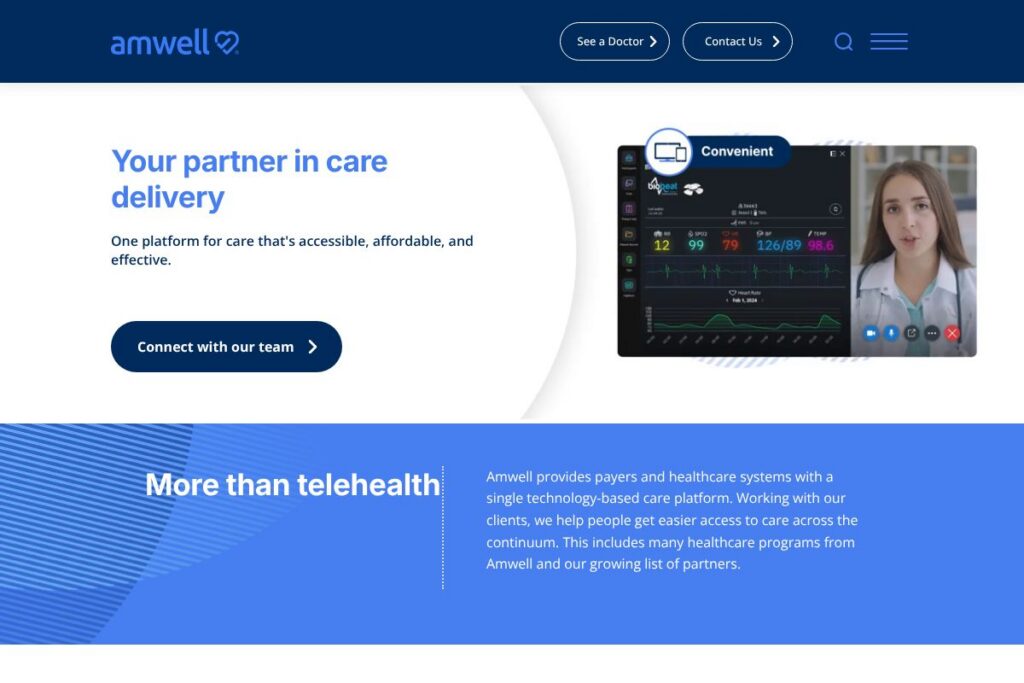
Getting to Know Amwell
Amwell is a technology-based care platform designed to help payers and health systems deliver virtual and digitally enabled care across the continuum. The platform combines synchronous telehealth visits, asynchronous tools, remote monitoring, and clinical services to improve access, close care gaps, and coordinate care across partners and programs.
Compared with competitors such as Teladoc, Doctor On Demand, and MDLive, Amwell emphasizes enterprise integrations with health systems and payer workflows, an in-house clinician network through Amwell Medical Group, and packaged Automated Care Programs for transitions of care and chronic condition management. While Teladoc is widely known for large-scale consumer and employer programs, and Doctor On Demand focuses on clinical visit workflows, Amwell positions itself as a platform partner for integrated care delivery and health system modernization.
All of this makes Amwell well suited for payers, large health systems, and provider groups that need a configurable, enterprise-grade telehealth and digital care stack with clinical services included. Organizations looking for an end-to-end partner that pairs technology, clinician operations, and population programs will find Amwell’s approach aligned with those needs.
How Amwell Works
Amwell provides a cloud-based platform that routes virtual care through configurable workflows tied to payer benefits and health system processes. Patients access care through branded web or mobile experiences while the platform integrates with electronic health records to pull scheduling, encounter, and documentation data into clinician workflows.
Implementation typically includes workflow mapping, integration with EHRs such as Epic or Oracle Cerner, clinician onboarding via Amwell Medical Group or client providers, and optional Automated Care Programs that use monitoring, alerts, and patient education to close care gaps. Operational teams use analytics and reporting to measure utilization, outcomes, and member engagement after launch.
What does Amwell do?
Amwell’s core capabilities center on virtual visit delivery, clinician services, digital care programs, and integrations that link virtual care into existing clinical and payer systems. Recent emphasis has been on Automated Care Programs and expanding the Amwell Medical Group to provide clinician capacity alongside platform tooling.
Let’s talk Amwell’s Features
Virtual Visit Platform
The platform supports video visits from web and mobile without lengthy downloads, with clinician-facing tools for scheduling, documentation, and e-prescribing. Integrations with EHRs reduce duplicate charting and help clinicians deliver visits in context of the patient’s record.
Amwell Medical Group
Amwell Medical Group supplies a nationwide clinician network that clients can use for on-demand or scheduled care, enabling organizations to scale access quickly while maintaining clinical governance. That service is often used to fill gaps in primary care or specialty access across benefit networks.
Automated Care Programs
These digital care programs combine remote monitoring, automated workflows, patient education, and clinician alerts to manage transitions of care and high-risk populations. They aim to reduce readmissions, improve follow-up, and close chronic care gaps through automated outreach and escalation rules.
EHR and Enterprise Integrations
Amwell integrates with major EHRs and enterprise systems to synchronize scheduling, clinical documentation, and billing workflows, which helps reduce administrative friction for clinicians. Clients report integrations with Oracle Cerner and Epic as part of broader deployment work.
Analytics and Population Health Tools
Reporting and analytics provide utilization metrics, clinical outcome tracking, and engagement signals so payers and health systems can monitor program performance and return on investment. These tools support quality measurement and operational decision making.
With these capabilities, Amwell combines platform technology, managed clinical services, and programmatic digital care to help large organizations expand access and manage population-level initiatives efficiently.
Amwell pricing
Amwell offers flexible enterprise pricing tailored to payers and health systems rather than standardized consumer plans; costs depend on deployment scope, clinical services, integrations, and program design. For organization-specific pricing and deployment options, contact their commercial team via Amwell’s enterprise contact channels.
What is Amwell used for?
Health systems use Amwell to deliver virtual urgent care, specialty telemedicine, virtual primary care, and integrated telebehavioral health, often embedding the platform into existing clinical workflows and the EHR. Payers use Amwell to extend covered benefits, provide network clinician capacity, and run population health programs tied to care gaps and utilization management.
Amwell’s Automated Care Programs are used to manage transitions from emergency or inpatient care, monitor chronic conditions, and automate follow-up outreach. These programs support care coordination, reduce avoidable readmissions, and improve patient engagement after discharge.
Pros and cons of Amwell
Pros
- Enterprise-grade integrations: The platform connects with major EHRs and enterprise systems, reducing duplicate workflows and making clinician adoption smoother.
- In-house clinical services: Access to Amwell Medical Group makes it easier for payers and systems to scale clinician capacity without separate staffing contracts.
- Programmatic digital care: Automated Care Programs combine monitoring, alerts, and education to address transitions of care and chronic disease management with measurable operational benefits.
- Proven scale: ~90M members have Amwell as a covered benefit and the platform has supported ~37.6M virtual care visits, demonstrating experience with large deployments.
Cons
- Enterprise deployment complexity: Large-scale integrations and customization can require significant implementation time and cross-team coordination, which may be resource intensive for smaller organizations.
- Custom pricing model: Pricing is negotiated per client, so prospective buyers must engage sales for detailed costs and ROI modeling rather than using public plan tiers.
- Dependence on systems integration: Organizations with limited EHR integration capability may face extra work to achieve seamless clinician workflows and data exchange.
Does Amwell Offer a Free Trial?
Amwell is enterprise software with custom pricing and does not offer a public free plan or consumer trial. Prospective payer and health system customers can engage Amwell for demos and pilot programs by contacting their sales team through the enterprise contact pages, which often include options for proof-of-concept pilots and limited-scope deployments.
Amwell API and Integrations
Amwell provides APIs and integration tools for EHR connectivity, scheduling, and patient experience customization; the developer resources document endpoints for authentication, session management, and clinical data exchange. See the Amwell developer documentation for technical details and API reference.
Key enterprise integrations commonly include Epic, Oracle Cerner, cloud providers for hosting and analytics, and identity/SAML single sign-on for secure clinician access. Integration partners and technical services are often part of enterprise engagements to accelerate go-live.
10 Amwell alternatives
Paid alternatives to Amwell
- Teladoc — A global virtual care company offering telemedicine, specialty telehealth, and integrated services for employers and health plans.
- Doctor On Demand — Focuses on virtual clinical visits and behavioral health with integrations for employers and health systems.
- MDLive — Virtual urgent care and telebehavioral health services used by payers and employers to extend access.
- Cisco Webex for Healthcare — Video collaboration and telehealth solutions with enterprise security and compliance capabilities.
- Epic Telehealth — Telehealth modules embedded directly within the Epic EHR ecosystem for organizations already on Epic.
- Google Cloud Healthcare — Cloud-native healthcare integration and telehealth enablement tools for large-scale deployments.
- Microsoft Teams for Healthcare — Secure collaboration and virtual visit capabilities integrated with Microsoft 365 and Azure services.
Open source alternatives to Amwell
- OpenEMR — An open source electronic health record with modules that can be extended for telehealth workflows and patient portals.
- OpenMRS — A modular open source medical record system often used in resource-limited settings and customizable for remote care programs.
- Jitsi — An open source video conferencing stack that organizations can self-host and integrate into telehealth workflows for video visits.
- BigBlueButton — Open source web conferencing designed for education and group sessions, which can be adapted for group therapy or remote education use cases.
Frequently asked questions about Amwell
What is Amwell used for?
Amwell is used to deliver virtual visits, digital care programs, and clinician services for health systems and payers. Organizations use it to expand access, manage transitions of care, and run population health initiatives.
Does Amwell integrate with Epic and other EHRs?
Yes, Amwell integrates with major EHRs such as Epic and Oracle Cerner. These integrations enable scheduling, documentation flow, and reduced duplicate charting during virtual encounters.
How much does Amwell cost for health systems?
Amwell uses custom enterprise pricing based on deployment scope, services, and integrations. Prospective buyers should contact Amwell for tailored pricing and pilot options via their enterprise contact pages.
Does Amwell provide an API for developers?
Yes, Amwell provides developer APIs for session management, scheduling, and integration with clinical systems. The Amwell developer documentation describes available endpoints and integration patterns.
Can providers join the Amwell Medical Group?
Amwell Medical Group offers clinician services to clients and maintains an active provider network. Health systems and payers can contract for clinician capacity as part of a broader deployment or use Amwell Medical Group for supplemental coverage.
Final verdict: Amwell
Amwell stands out as an enterprise-focused virtual care platform that pairs technology with clinician services and program-level automation to help payers and health systems scale access and manage populations. Its strengths are deep EHR integrations, packaged Automated Care Programs, and the operational capability of Amwell Medical Group to supply clinician capacity.
Compared with Teladoc, which also serves large employers and payers, Amwell leans more toward health system partnerships and deployed integrations within care delivery workflows, while both vendors pursue enterprise contracts and require custom pricing conversations. Organizations choosing between them should weigh integration depth, clinician service models, and program needs when comparing features and commercial terms.