Epic in a Nutshell
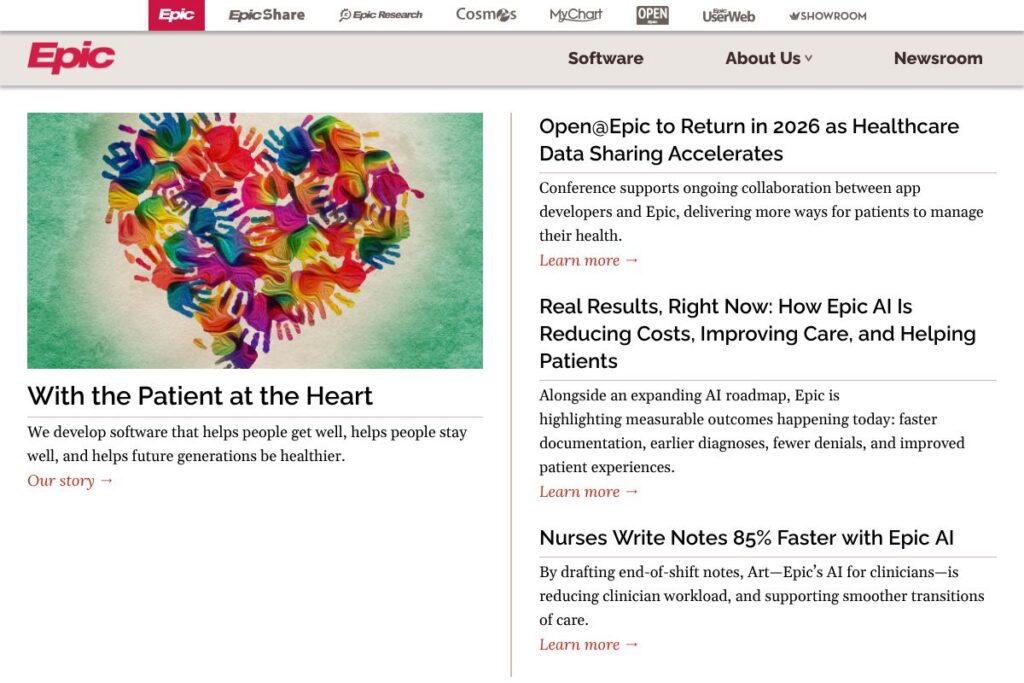
Epic is a vendor of enterprise electronic health record software that centralizes clinical, administrative, and financial data for hospitals, clinics, and health systems. Its platform includes inpatient and ambulatory EHR modules, patient-facing tools such as MyChart, revenue cycle management, analytics, and interoperability services that connect care across organizations. Visit Epic’s website for an overview of their platform and organization.
Compared with competitors Cerner, MEDITECH, and Athenahealth, Epic is often chosen by large academic medical centers and integrated delivery networks for its comprehensive feature set and deep integration across clinical and administrative functions. Cerner has a similar enterprise focus but emphasizes different deployment and hosting options, MEDITECH is frequently selected by mid-market hospitals for simpler implementations, and Athenahealth targets ambulatory and networked revenue-cycle-centric customers.
Epic excels at delivering an all-in-one EHR and patient engagement ecosystem for large, complex health systems that need robust interoperability and shared patient records. Its focus on a unified chart, scalable analytics, and integrated billing makes it particularly suitable for multi-hospital systems, academic centers, and organizations investing in long-term clinical IT consolidation.
How Epic Helps Health Systems
Epic implements as a suite of interconnected applications that run on a centralized patient record. Clinical modules capture provider documentation, orders, and results; scheduling and registration manage patient access; revenue cycle modules handle billing and claims; and patient portals let patients view records and manage appointments. These components are configured to reflect an organization’s workflows and data governance, with training and optimization provided during implementation.
Workflows typically begin with registration and scheduling, flow through clinical documentation and order entry via the EpicCare modules, and continue to billing and reporting through revenue cycle and analytics tools. Epic supports clinician efficiency with templates, order sets, and role-based views, and provides mobile apps for clinicians and patients to maintain continuity of care across settings. Health systems often run pilot programs, iterate configuration, and use Epic’s training resources to accelerate adoption and user proficiency.
What does Epic do?
Epic’s platform centers on the single patient record and includes clinical documentation, scheduling, results management, billing, population health, patient engagement, and analytics, with growing investments in AI and data sharing. Recent emphasis has been on clinical AI for documentation, interoperability through standards-based APIs, and improving patient financial experience via integrated billing and MyChart features. The system also supports specialty workflows, telehealth, and research-focused tools.
Clinical EHR
Epic provides inpatient and ambulatory EHR modules for documenting encounters, entering orders, and managing clinical workflows. These modules include specialty-specific templates and decision support to reduce variation and support evidence-based care, which benefits clinical teams by standardizing documentation and streamlining orders.
Patient Portal (MyChart)
MyChart is Epic’s patient-facing portal that lets patients view records, message clinicians, schedule appointments, and pay bills. It improves patient engagement and communication while providing a consistent channel for notifications, test results, and visit summaries.
Revenue Cycle Management
Epic’s revenue cycle tools handle registration, claims submission, denial management, and patient billing in one system connected to the clinical record. Integrating financial workflows with clinical data reduces billing errors, shortens cash cycles, and gives staff a consolidated view of account activity.
Interoperability and Data Exchange
Epic supports standards-based exchange, including FHIR APIs, CommonWell, Carequality, and custom interfaces to connect labs, imaging, public health, and regional HIEs. These capabilities enable data sharing across disparate systems so clinicians have a fuller view of patient history at the point of care.
Analytics and Reporting
Epic’s analytics tools aggregate clinical and operational data for dashboards, quality reporting, and research. Organizations use those capabilities for performance measurement, population health management, and to support value-based care initiatives.
Telehealth and Virtual Care
Epic includes telehealth workflows that integrate scheduling, virtual visits, and documentation into the patient record. Clinicians can launch visits from the chart and preserve visit notes, orders, and billing in the same workflow as in-person care.
AI and Automation
Epic is introducing AI-driven features for documentation drafting, clinical decision support, and coding assistance to reduce clinician burden and improve throughput. These tools aim to speed routine tasks such as end-of-shift notes and to surface relevant clinical suggestions during care delivery.
Research and Population Health
Tools for research and population health let hospitals run cohort queries, manage registries, and support clinical studies while preserving patient privacy controls. Integrated registries and reporting help organizations meet regulatory and research objectives.
With these capabilities Epic’s biggest benefit is delivering a tightly integrated, enterprise-grade health record that reduces fragmentation across clinical, administrative, and patient-facing systems.
Epic Pricing
Epic uses a custom enterprise pricing model that is tailored to organization size, deployment choices, required modules, and support needs, rather than public fixed-price tiers. Implementation costs, license structure, hosting or cloud options, and ongoing support all influence the total cost of ownership for a health system.
For specific pricing guidance and contract details contact Epic directly through their contact page or request a demonstration via Epic’s website. Procurement teams should plan for licensing, implementation services, training, and potential hardware or hosting investments when budgeting for deployment.
What is Epic Used For?
Epic is used to create and maintain a single longitudinal medical record across hospitals, clinics, and affiliated providers, enabling coordinated care, unified documentation, and consolidated administrative workflows. Health systems use Epic to manage clinical encounters, orders, results, and billing in a single system that spans inpatient, outpatient, and specialty care settings.
Beyond direct care, Epic is used for patient engagement through MyChart, population health management, quality reporting, and clinical research. Large organizations choose Epic when they require an integrated platform that supports complex specialty workflows, enterprise reporting, and broad interoperability for data sharing across the health ecosystem.
Pros and Cons of Epic
Pros
- Comprehensive enterprise platform: Epic unifies clinical, administrative, and financial systems into one record, reducing data fragmentation and simplifying cross-department workflows.
- Strong interoperability capabilities: The platform supports FHIR APIs, regional HIE connections, and exchange frameworks that facilitate data sharing and coordinated care.
- Robust patient engagement tools: MyChart provides patients with access to records, communications, scheduling, and billing, improving transparency and self-service options.
- Enterprise analytics and research support: Organizations gain access to reporting, registry, and research tools that support quality measurement and population health initiatives.
- Large partner and developer community: Epic’s app ecosystem and developer programs provide third-party integrations and extensions that expand functionality.
Cons
- Significant implementation effort: Deploying Epic often requires substantial time, resources, and change management, which can be challenging for smaller organizations.
- Custom pricing and procurement complexity: Contracts are negotiated for each client, which can make initial budgeting and vendor comparisons more complex.
- Steeper learning curve for users: The depth of functionality can lead to longer training requirements for clinicians and staff to reach high proficiency.
- Less attractive for very small practices: Smaller clinics may find lighter-weight or cloud-native competitors more cost-effective and faster to deploy.
Can You Test Epic Before Buying?
Epic offers paid demonstrations, pilot programs, and customer site visits rather than an open free trial. Prospective customers can arrange product demonstrations, review sandbox environments, and work with Epic on pilot deployments or phased rollouts to validate workflows before full production go-live.
Epic API and Integrations
Epic provides developer APIs and participates in programs such as Open.epic that enable third-party apps to connect via FHIR and other standards; the Open.epic developer program provides documentation and sandbox access for authorized partners. These APIs allow integration for apps, devices, analytics platforms, and patient-facing services.
In addition to APIs, Epic connects with national exchange networks, labs, imaging systems, and health information exchanges using standards and gateway connections, and it supports integrations with tools for billing, telehealth, and population health management.
10 Epic alternatives
Paid alternatives to Epic
- Cerner (Oracle Cerner): Enterprise EHR platform with inpatient and ambulatory modules and various hosting options, often chosen by large health systems seeking an alternative to Epic.
- MEDITECH: EHR vendor focused on community and mid-sized hospitals with streamlined deployments and integrated clinical and financial modules.
- Athenahealth: Cloud-native platform favored by ambulatory networks and revenue-cycle-centric customers for its services-led approach.
- NextGen Healthcare: EHR and practice management with strong ambulatory focus and specialty workflows for physician groups.
- eClinicalWorks: Offers integrated EHR and practice management for ambulatory care with cloud deployment options and patient engagement features.
- GE HealthCare (Centricity): Clinical and imaging-focused solutions that integrate with hospital systems and enterprise imaging workflows.
Open source alternatives to Epic
- OpenEMR: Open-source EHR and practice management system used by clinics and small hospitals for customizable clinical workflows.
- OpenMRS: Community-driven medical record system designed for flexibility in resource-limited and public health environments.
- GNU Health: Health and hospital information system that focuses on public health, medical records, and socio-medical aspects.
- VistA (OSEHRA forks): The VA’s historic EHR system whose open variants are used in certain public sector and research settings for customization and self-hosting.
Frequently asked questions about Epic
What is Epic used for?
Epic is used as an enterprise electronic health record and health IT platform. It supports clinical documentation, order entry, scheduling, billing, patient engagement, analytics, and interoperability across care settings.
Does Epic provide a patient portal called MyChart?
Yes, Epic offers MyChart as its patient portal. MyChart lets patients view their medical records, message clinicians, schedule appointments, and manage billing and payments.
Can Epic integrate with third-party apps and devices?
Yes, Epic supports integrations through FHIR APIs and developer programs such as Open.epic. These integrations enable third-party apps, devices, and analytics platforms to connect to the Epic record when authorized.
How does Epic handle interoperability with other hospitals?
Epic supports standards-based exchange and participation in national networks. The platform connects via FHIR, HIEs, CommonWell, Carequality, and custom interfaces to enable cross-organization data sharing.
Is Epic suitable for small clinics and single-site practices?
Epic is primarily targeted at large health systems and multi-site organizations. Smaller clinics often prefer lighter-weight or cloud-native EHRs that offer faster deployments and lower upfront costs.
Final verdict: Epic
Epic is a mature, feature-rich EHR platform designed for large, complex health systems that need a consolidated patient record, integrated billing, and robust interoperability. Its strengths are the depth of clinical capabilities, extensive patient engagement tools like MyChart, and enterprise-grade analytics and research support that help organizations standardize care and measure outcomes.
Compared with Cerner, which also targets enterprise customers and offers comparable clinical and financial modules, Epic tends to be chosen for its tightly integrated ecosystem and long history with large academic systems, while Cerner emphasizes different hosting and modular licensing options. Both use custom enterprise pricing and require significant implementation effort, so decisions often hinge on specific workflow fit, local partner relationships, and long-term strategy.
For health systems that prioritize a single unified record and extensive patient engagement across inpatient and ambulatory care, Epic remains a leading option. Contact Epic via their contact page to discuss deployment models, module options, and procurement timelines.