Veradigm: An Overview
Veradigm is a healthcare technology company that combines electronic health records, practice management, patient engagement, and a large clinical data network to support providers, payers, and life science organizations. The platform emphasizes validated, interoperable data and analytics to support clinical decision making, risk stratification, outcomes measurement, and research collaboration.
Compared with Epic, Cerner, and athenahealth, Veradigm positions itself as a modular, cloud-friendly option that pairs clinical systems with a managed data network. Unlike Epic, which targets large integrated delivery networks with heavy on-premise implementations, Veradigm offers more modular deployment choices. Versus Cerner, Veradigm focuses on packaged analytics and networked data services, and compared to athenahealth, Veradigm places more emphasis on curated datasets and life-science oriented data access.
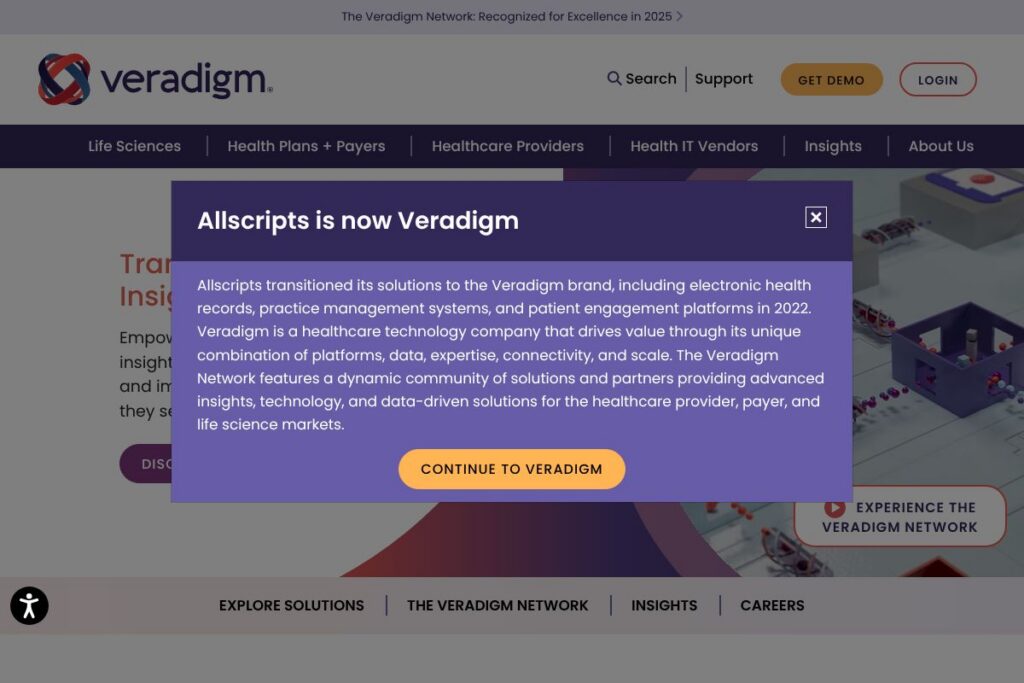
Veradigm is well suited for health systems and payers that need a combination of EHR capabilities plus access to a de-identified and consented clinical data network for analytics, quality programs, or real-world evidence studies. Its mix of clinical applications and data services makes it useful to organizations that want both operational IT and a connected data platform for reporting and research. Explore the Veradigm homepage to see how the company describes its product portfolio.
How Veradigm Works
Veradigm operates as both a clinical software provider and a managed data network. Providers use its EHR and practice management modules for documentation, billing, and patient engagement, while data flows into Veradigm’s analytics layer for quality measurement and population health insights.
For research and payer use cases, Veradigm aggregates de-identified clinical and claims-adjacent data into normalized datasets. Organizations can run cohort discovery, measure clinical outcomes, and export analytic results through reporting tools or API access for downstream workflows.
Implementation typically combines software deployment, data onboarding, and configuration of analytics or reporting. Teams can connect existing workflows to Veradigm’s services via integrations, then use the network and analytics to monitor performance, track utilization, and support evidence-generation projects.
What does Veradigm do?
Veradigm’s product set centers on clinical systems plus a data and analytics layer that supports operational and strategic programs. Core capabilities include electronic health records, practice management, patient engagement, a clinical data network, and analytic tools for quality, utilization, and research.
Let’s talk Veradigm’s Features
Electronic Health Record (EHR)
The EHR provides charting, order entry, and clinical documentation designed for ambulatory and specialty settings, with templates and workflows that support coding and quality reporting. It integrates with practice management for scheduling and billing which reduces duplicate data entry across administrative and clinical teams.
Practice Management and Revenue Cycle
Practice management covers appointment scheduling, billing, claims processing, and revenue cycle reporting to support clinic operations and financial performance. The system includes configurable rules for billing and payer management that help practices reduce denied claims and speed collections.
Clinical Data Network
Veradigm curates a large network of de-identified and consented clinical data from participating providers and systems for analytics, population health, and research. This dataset supports cohort discovery, benchmark reporting, and real-world evidence studies for life science and payer customers.
Analytics and Quality Reporting
Built-in analytics provide dashboards, quality measures, risk stratification, and benchmark comparisons to monitor performance against clinical and financial goals. The analytics layer is tuned for quality programs, HEDIS reporting, and population health interventions that require longitudinal patient views.
Patient Engagement
Patient engagement tools include patient portals, secure messaging, appointment reminders, and forms that support telehealth and remote care workflows. These features help practices maintain communication with patients and gather PROs, which feed back into analytics.
Interoperability and Integrations
Veradigm supports HL7, FHIR, and common connector patterns to integrate with labs, imaging, payer systems, and other EHRs which enables data exchange across the care continuum. These integration capabilities are designed so organizations can share data with external partners and third-party analytics platforms.
With its combined clinical systems and data network, the biggest benefit of Veradigm is the ability to run operational EHR workloads alongside access to a managed clinical dataset for measurement and research. That pairing shortens the path from operational data to actionable insights.
Veradigm pricing
Veradigm uses a custom enterprise pricing model that is tailored to deployment scope, product mix, and customer size. Pricing typically varies by the number of providers, modules selected, data access requirements, and support levels.
For detailed pricing, deployment options, and to request a quote, contact Veradigm through the Veradigm contact page or request a demo via the Veradigm homepage. Sales teams will provide proposals that reflect implementation, licensing, and any ongoing data access or analytics services.
What is Veradigm Used For?
Healthcare providers use Veradigm for day-to-day clinical documentation, scheduling, billing, and patient communication that supports outpatient and ambulatory workflows. The platform also supports practice-level quality programs and operational reporting needed for value-based care initiatives.
Payers and life science organizations use Veradigm’s data network and analytics for population health management, quality measurement, feasibility and cohort identification, and real-world evidence research. Its curated datasets are used to accelerate studies and to generate insights about treatment patterns and outcomes.
Pros and Cons of Veradigm
Pros
- Comprehensive data platform: Veradigm combines EHR and practice systems with a managed clinical data network, making it easier to move from operational data to analytics and research.
- Analytics designed for healthcare use cases: The platform includes reporting and quality measurement tools that support HEDIS, risk stratification, and performance tracking across clinical programs.
- Integration-friendly: Support for standards such as HL7 and FHIR, plus common connectors, helps link Veradigm to labs, payers, and third-party applications.
Cons
- Enterprise-focused commercial model: Pricing and deployment are typically enterprise-level which may require longer procurement cycles and budget planning for smaller practices.
- Customization effort: Deployments that rely heavily on custom templates or complex integrations may need substantial configuration and professional services.
Does Veradigm Offer a Free Trial?
Veradigm does not publish a public free plan; pricing, trial access, and pilot programs are arranged directly with sales. Organizations interested in evaluating the software can request a demo or pilot through the Veradigm contact page, where sales and solutions teams can discuss trial scope, data access, and implementation timelines.
Veradigm API and Integrations
Veradigm provides developer and integration capabilities to connect clinical systems, labs, analytics platforms, and payer systems. For details on developer tools and integration options, consult the Veradigm developer resources which describe supported standards and connectivity options.
Key integrations commonly include major lab interfaces, practice management connectors, payer feeds, and FHIR-based exchange endpoints that enable interoperability with other EHRs and downstream analytics systems.
10 Veradigm alternatives
Paid alternatives to Veradigm
- Epic — Enterprise-grade EHR with deep hospital and health system functionality, strong interoperability and large installed base across integrated delivery networks.
- Cerner — Comprehensive clinical and revenue cycle platform, now part of Oracle, that serves hospitals and health systems with on-premise and cloud options.
- athenahealth — Cloud-native EHR and practice management solution focused on ambulatory care and revenue cycle services.
- Optum (OptumInsight / Optum360) — Data and analytics suite within UnitedHealth Group that offers population health, claims, and clinical analytics at scale.
- Allscripts — Clinical and financial systems for ambulatory and acute settings that historically served many physician practices and hospital systems.
- Health Catalyst — Analytics platform focused on data warehousing, improvement analytics, and enterprise performance management for health systems.
- eClinicalWorks — Ambulatory EHR and practice management with integrated patient engagement and population health modules.
Open source alternatives to Veradigm
- OpenMRS — An open source medical record system platform used widely in global health settings, suitable for custom EHR deployments and research projects.
- OpenEMR — Community-supported EHR and practice management system with modules for scheduling, clinical charting, and billing.
- OpenEHR — An open specifications framework for health data modeling and interoperable clinical data repositories that can underpin custom analytic platforms.
- GNU Health — Free health and hospital information system focused on public health, epidemiology, and clinical record management.
Frequently asked questions about Veradigm
What is Veradigm used for?
Veradigm is used for EHR and practice management plus data and analytics to support clinical operations, quality measurement, and research. Providers use it for day-to-day clinical workflows while payers and life sciences teams use the data network for population analytics and studies.
Does Veradigm integrate with other EHR systems?
Yes, Veradigm supports interoperability through standards like HL7 and FHIR and common connectors. This enables data exchange with labs, payer systems, and third-party applications used across care settings.
Can Veradigm’s data network be used for research studies?
Yes, the Veradigm data network is designed to support cohort discovery, real-world evidence generation, and outcomes research. Life science and payer customers commonly use curated datasets and reporting tools for feasibility and analytic projects.
How does Veradigm charge for its services?
Veradigm uses custom enterprise pricing tailored to deployment scope, modules chosen, and data access requirements. Pricing details and proposals are provided through the sales team after scoping calls and requirements review.
Is there API documentation for Veradigm?
Veradigm provides developer and integration resources for API access and data exchange. Organizations should consult Veradigm’s developer resources or speak with a solutions representative to get API documentation and sandbox access.
Final verdict: Veradigm
Veradigm combines clinical software with a managed clinical data network and analytics capabilities, which makes it a practical choice for organizations that need both operational EHR functionality and access to curated datasets for quality, population health, or research. Its strength is the combination of operational systems and data services under a single commercial relationship.
Compared to Epic, which typically targets large health systems with substantial upfront implementation and long-term commitments, Veradigm offers a more modular approach with commercial models that can be tailored to specific product mixes and data access needs. For organizations that need integrated clinical systems plus networked data for analytics and research, Veradigm is a strong option; organizations seeking only a packaged hospital EHR or a heavy on-premise install may find vendor options such as Epic or Cerner more aligned with those needs.