What is eClinicalWorks
eClinicalWorks is a cloud-based electronic health record and practice management platform built for ambulatory care, specialty clinics, and multi-site organizations. The platform combines core EHR workflows, telehealth, patient self-service, revenue cycle management, and AI-enhanced functionality to cover clinical documentation through billing and population health management.
Compared with vendors like Epic, Cerner, and Athenahealth, eClinicalWorks emphasizes a single-platform approach for small to mid-size practices and community health centers, with tighter integration between patient engagement, telehealth, and RCM services. Epic and Cerner are often chosen by large health systems for deep inpatient and enterprise features, while Athenahealth focuses on cloud billing networks and marketplace integrations; eClinicalWorks sits between these approaches with a stronger focus on ambulatory workflows and integrated telehealth.
All of this makes eClinicalWorks especially useful for outpatient clinics, community health centers, and multi-site groups that need a cloud-first EHR with built-in telehealth, patient-facing portals, and RCM options. The platform is suited to practices that want a single vendor for clinical, administrative, and patient engagement features and are open to enterprise-style contracts and implementation services.
How eClinicalWorks Works
The platform runs as a cloud-hosted EHR with web and native client access, moving core clinical workflows online so practices can access patient charts, orders, and documentation from any internet-connected device. eClinicalWorks integrates scheduling, e-prescribing, lab interfaces, and billing in one system so encounters flow directly from intake to coding and claims submission.
Telehealth and patient engagement are embedded into the workflow: patients can self-schedule appointments, complete digital check-ins, join video visits, and exchange secure messages through the patient-facing healow apps. On the back end, RCM and claims processing tie into the same patient records so billing teams can manage denials, eligibility checks, and claims submission without moving data between systems.
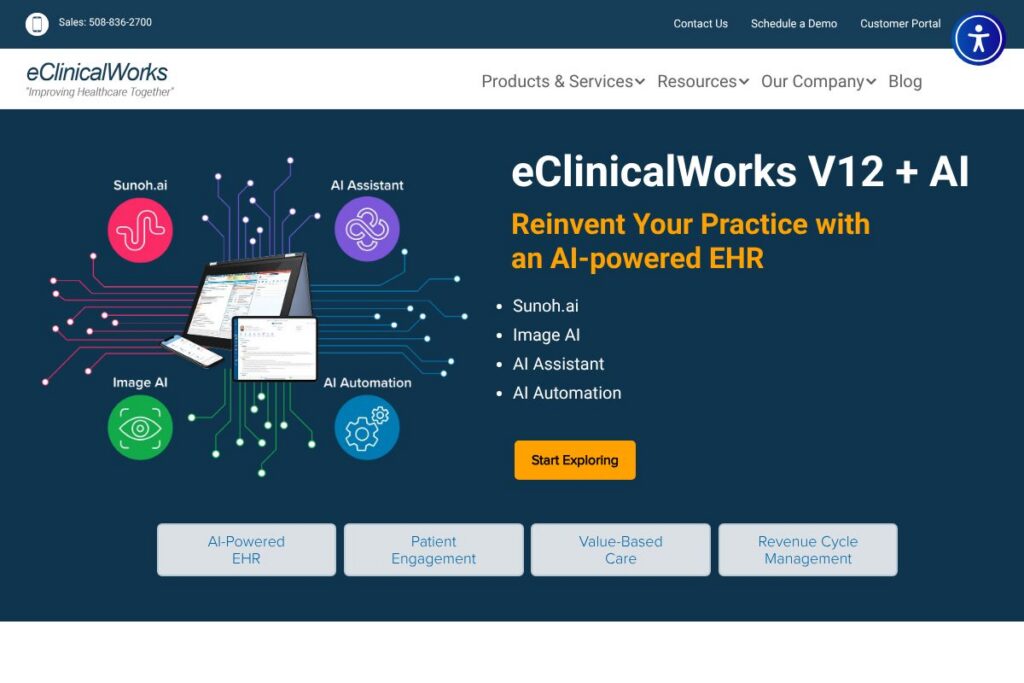
AI features such as Sunoh.ai and the platforms image and assistant tools augment documentation, triage, and coding workflows; these tools can generate draft notes, assist with problem list management, and apply clinical decision support to help identify care gaps and risk stratification.
eClinicalWorks features
eClinicalWorks bundles clinical documentation, telehealth, patient engagement, revenue cycle management, and AI-driven automation into one platform. Recent releases emphasize AI capabilities, image analytics, and virtual care tools that aim to reduce documentation time and improve patient access.
The platform includes several powerful capabilities:
Cloud EHR and clinical documentation
The EHR supports structured and free-text documentation templates, problem lists, encounter coding, and order management with integrated e-prescribing and lab results. Templates and specialty-specific content speed charting, while clinical decision support and quality measure tracking help with value-based programs.
Telehealth and virtual care
Built-in telehealth supports video visits, virtual waiting rooms, and documentation tied directly to the encounter, so clinicians can run telemedicine workflows without separate third-party tools. Patient intake and consents are integrated, and telehealth activity flows into scheduling and billing.
Patient engagement and healow
Patient-facing tools include online scheduling, secure messaging, digital check-in, appointment reminders, and the healow mobile apps for patients and providers. These capabilities help reduce no-shows and improve communication between care teams and patients.
AI Assistant and automation (Sunoh.ai)
AI-powered features assist with clinical documentation, automated summaries, and smart suggestions for coding and problem lists, while Sunoh.ai provides an AI scribe option to reduce charting time. AI automation can route tasks, pre-fill fields, and surface care gaps for proactive outreach.
Revenue Cycle Management and billing services
RCM offerings combine software and services to manage claims, denials, eligibility checks, and patient statements with an emphasis on first-pass acceptance rates and end-to-end revenue recovery. Integrated billing removes the need for extensive data exports between clinical and financial systems.
Population health and value-based care tools
Tools for risk stratification, registry management, and quality reporting help practices transition to value-based arrangements and track performance against payer measures. Analytics and reporting support outreach campaigns and chronic disease management.
With these features combined, eClinicalWorks aims to reduce administrative overhead, centralize clinical and financial workflows, and improve patient access through integrated telehealth and engagement tools.
eClinicalWorks pricing
eClinicalWorks uses a custom enterprise pricing model that is tailored to practice size, specialty mix, deployment scope, and selected services such as RCM and AI add-ons. Because pricing varies by configuration, organizations typically receive quotes based on seat counts, modules selected, and implementation requirements.
Enterprise
Enterprise – Custom pricing (Cloud EHR, telehealth, patient engagement, RCM, AI services; pricing varies by number of providers, modules, and service levels). For specific quotes and model comparisons, contact their sales team or request a demo through the eClinicalWorks contact options.
For organizations evaluating total cost of ownership, ask for bundled pricing that includes implementation, training, data migration, and optional managed RCM services to compare per-provider costs across vendors. You can also arrange demos and pilots to assess feature fit prior to committing to a contract.
What is eClinicalWorks Used For?
eClinicalWorks is commonly used for outpatient clinical documentation, scheduling, telehealth delivery, and practice management tasks that need to remain connected to billing and reporting. Primary care, family medicine, and many ambulatory specialties use the system to keep clinical data and financial workflows in a single platform.
The platform is also used for patient engagement workflows such as online scheduling, digital check-in, and secure messaging, which reduces front-desk workload and improves patient access. Larger multi-site groups and community health centers use eClinicalWorks for centralized RCM and population health reporting to support value-based care initiatives.
Pros and Cons of eClinicalWorks
Pros
- Comprehensive platform: The EHR, telehealth, patient engagement, and RCM are tightly integrated, reducing the need for multiple vendors and data handoffs.
- Strong ambulatory focus: Feature set and specialty templates are tailored to outpatient workflows, which helps smaller practices and clinics hit documentation and billing targets faster.
- AI and automation options: Built-in AI tools and partnerships such as Sunoh.ai provide medical scribe capabilities and automation to reduce documentation time.
- Patient-facing functionality: Robust patient portal and mobile apps such as healow improve access and support self-scheduling and secure messaging.
Cons
- Enterprise-style deployment: Implementation and pricing are typically enterprise-level, which can be heavier than lightweight SaaS EHRs for very small practices.
- Customization complexity: Extensive customization and templates can require more implementation time and training compared to simpler systems.
- Vendor lock-in risk: Choosing a broad set of services from a single vendor means moving modules away later can be more complex than using best-of-breed point products.
Does eClinicalWorks Offer a Free Trial?
eClinicalWorks does not offer a public free plan but provides demos, pilot programs, and site-specific trial options so prospective customers can evaluate workflows and AI features; organizations can request a demo or pilot through the contact and demo request options to see the system in action before committing.
eClinicalWorks API and Integrations
eClinicalWorks provides integration capabilities and partners with third-party vendors for labs, imaging, billing interfaces, and device integrations; developer and partner options support common standards such as HL7 and FHIR. For developer resources and integration guidance, review the eClinicalWorks integration and developer information.
Common integrations include practice productivity and communication tools, patient portals, diagnostic labs, and billing networks, and the platform supports configurable interfaces to connect with existing IT infrastructure.
10 eClinicalWorks alternatives
Paid alternatives to eClinicalWorks
- Epic — Enterprise EHR widely used by large hospitals and health systems, strong inpatient and ambulatory capabilities and deep interoperability options.
- Cerner — Large-scale health system EHR with broad clinical, operational, and population health features for enterprise deployments.
- Athenahealth — Cloud-native EHR and medical billing network with marketplace integrations and strong RCM emphasis.
- NextGen Healthcare — Ambulatory-focused EHR and practice management with specialty templates and revenue cycle services.
- Allscripts — Offers ambulatory and enterprise EHR options with practice management and population health tools.
- GE Healthcare Centricity — Provides ambulatory and enterprise solutions with imaging and clinical analytics capabilities.
- Greenway Health — Ambulatory EHR and practice management with integrated RCM and reporting tools.
Open source alternatives to eClinicalWorks
- OpenEMR — Feature-rich open source EHR and practice management system with active community support and customization options. See the OpenEMR project for downloads and documentation.
- OpenMRS — Modular open source medical record system used widely in global health and adaptable to resource-constrained settings, available at the OpenMRS site.
- GNU Health — Open source health and hospital information system that includes EHR, billing, and public health modules; more suited to hospitals and public health deployments. Learn more at the GNU Health site.
Frequently asked questions about eClinicalWorks
What specialties does eClinicalWorks support?
eClinicalWorks supports a wide range of specialties including primary care, behavioral health, dental, vision, urgent care, and ambulatory surgery centers. Specialty templates and workflows are available to tailor documentation, orders, and billing to each clinical area.
Does eClinicalWorks offer telehealth capabilities?
Yes, eClinicalWorks includes built-in telehealth for video visits, virtual check-in, and integrated documentation. Telehealth sessions are tied directly to the patient chart and billing workflows to streamline visits.
How much does eClinicalWorks cost?
eClinicalWorks uses custom enterprise pricing based on practice size, modules, and services selected. For detailed pricing and quotes, contact their sales team or request a demo through the eClinicalWorks contact options.
Can eClinicalWorks integrate with third-party labs and imaging systems?
Yes, the platform supports standard interfaces such as HL7 and FHIR for lab, imaging, and device integrations. Integration options allow results and orders to flow directly into the chart and clinical workflows.
Does eClinicalWorks provide APIs for developers?
Yes, eClinicalWorks provides integration and developer resources to connect third-party apps and services. Review the vendor’s integration information and partner resources through the eClinicalWorks developer and integration pages.
Final verdict: eClinicalWorks
eClinicalWorks is a strong choice for ambulatory and multi-site practices that need a single cloud platform to manage clinical documentation, telehealth, patient engagement, and revenue cycle workflows. Its integrated AI features, patient-facing healow apps, and optional RCM services make it a compelling option for organizations seeking tighter operational alignment between clinical care and billing.
Compared with Athenahealth, which emphasizes a marketplace and per-provider billing network, eClinicalWorks differentiates itself with deeper built-in telehealth and AI-driven documentation tools and a platform approach that reduces third-party connectors. Pricing for eClinicalWorks is custom and typically negotiated for each deployment, so practices should evaluate total cost of ownership, implementation scope, and available pilot options when comparing vendors.
For demos, implementation planning, and to request pricing tailored to your practice, contact their sales team or schedule a demonstration through the eClinicalWorks contact and demo options.