Brightspace: An Overview
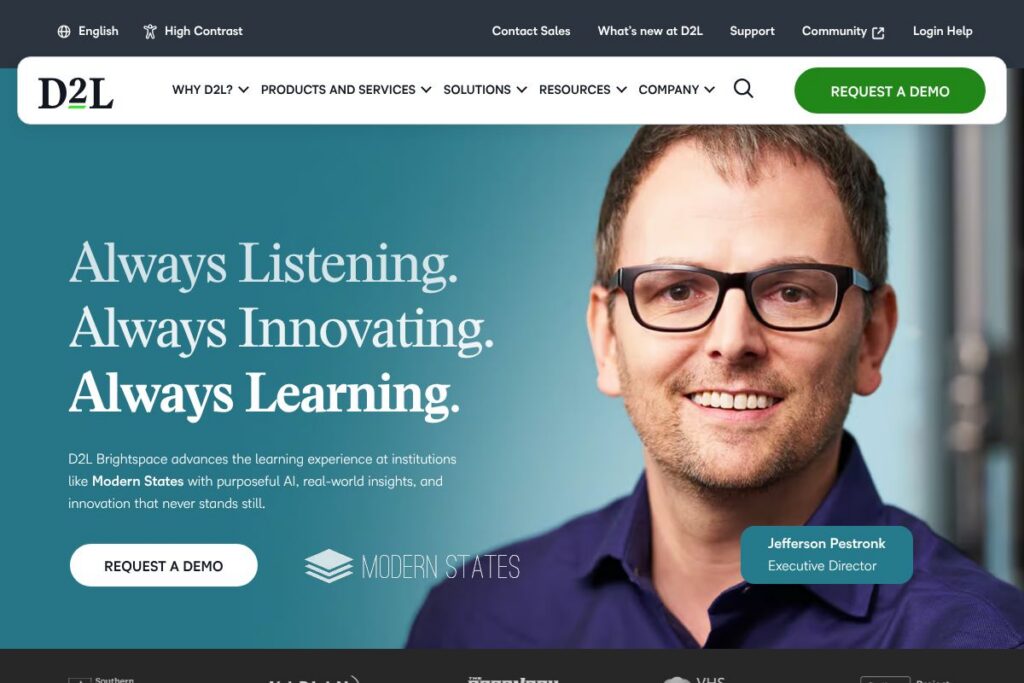
Brightspace is an enterprise-grade learning management system built to deliver online, blended, and competency-based learning. The platform combines course authoring, assessment, learning analytics, accessibility tools, and integrations to support education institutions and corporate training programs that need scalable, secure delivery.
Compared with Canvas, Blackboard Learn, and Moodle, Brightspace emphasizes built-in analytics and accessibility features along with flexible personalization workflows. Canvas focuses on straightforward course workflows and a large third-party app ecosystem, Blackboard has long-standing presence in large institutions, and Moodle is attractive where open-source customizability is a priority. All four are suitable for institutional deployments, but Brightspace stands out for its emphasis on analytics-driven interventions and enterprise support.
Brightspace works well for universities looking to improve retention, districts that must meet accessibility requirements, associations that need continuing education workflows, and businesses that require structured onboarding and compliance training. Its modular approach makes it a fit for organizations that want configurable learning paths and measurable outcomes.
How Brightspace Works
The platform organizes learning around courses and learning paths that instructors or instructional designers create using a web-based authoring environment. Content can include videos, assessments, SCORM/xAPI packages, and custom modules, with conditional release rules to personalize pacing and prerequisites for learners.
Brightspace captures learning activity across assessments and content to produce learner insights; instructors use dashboards and reports to identify at-risk learners and intervene. Administrators connect Brightspace to identity providers, SIS systems, and third-party tools using LTI, REST APIs, and prebuilt connectors to automate enrollments and provisioning.
Brightspace features
Brightspace centers on course delivery, assessment, analytics, accessibility, and integrations. Core capabilities include adaptive learning paths, an extensible gradebook, proctoring and assessment tools, detailed reporting, and support for standards like LTI, SCORM, and xAPI. The vendor has added AI-assisted tools and workflow automation to reduce administrative tasks and provide targeted recommendations.
The platform includes several powerful capabilities worth highlighting:
Adaptive learning and personalization
Adaptive pathways let instructors set competency-based or mastery conditions so learners see content and assessments tailored to their progress. This supports differentiated instruction at scale by automating remediation, extension activities, and alternative paths based on performance.
Assessment and gradebook
Robust assessment tools cover quizzes, assignments, rubrics, and secure proctoring integrations, with a configurable gradebook that supports weighted grading, categories, and visibility controls. This helps instructors manage large cohorts and maintain assessment integrity.
Learning analytics and dashboards
Brightspace provides dashboards and early-alert tools that aggregate engagement and achievement metrics to identify trends and at-risk students. Administrators can export data or use built-in reports to track program outcomes and accreditation requirements.
Content authoring and reusable objects
The platform supports web-based content creation, repository items, and reusable learning objects that simplify course updates and multi-section management. Content packaging supports SCORM and xAPI for interoperability with external content libraries.
Accessibility and inclusive design
Brightspace includes tools to improve accessibility, such as screen-reader compatibility, keyboard navigation, and customizable display options, enabling compliance with accessibility standards and improving retention for learners with disabilities.
Integrations and standards support
Support for LTI, SAML, SCORM, xAPI, and REST APIs makes Brightspace interoperable with student information systems, video platforms, proctoring services, and corporate HR systems. The platform also partners with resellers and government distributors for procurement workflows.
With these combined capabilities Brightspace is designed to scale across different learner populations while providing the reporting and integrations institutions need to manage programs and measure impact.
Brightspace pricing
Brightspace uses enterprise licensing and custom pricing that is tailored to an organization’s size, deployment model, feature set, and support requirements. Pricing is typically offered as annual subscriptions or multi-year agreements rather than fixed per-user plans.
For detailed contract options and to request a quote, contact D2L through their official contact channel to discuss implementation, hosting, and service levels. View the Brightspace platform overview on the D2L website and reach out to contact D2L sales for current pricing options and procurement guidance.
What is Brightspace Used For?
Higher education uses Brightspace for course delivery, competency-based learning, accreditation reporting, and student success initiatives that rely on learning analytics. Its toolset supports blended and online programs, proctored exams, and integrations with student information systems to manage enrollments and transcripts.
K-12 districts deploy Brightspace to centralize curriculum, monitor district-level performance, and provide teacher-facing tools for lesson planning and formative assessment. Associations and training organizations use the platform for continuing professional education, certification tracking, and monetized storefronts for selling courses.
Corporations and government agencies apply Brightspace to onboarding, compliance training, sales enablement, and leadership development programs, often integrating it with HR systems and single sign-on providers for enterprise workflows.
Pros and Cons of Brightspace
Pros
- Strong analytics and early alerts: Brightspace provides detailed engagement and performance reports that help instructors and administrators identify learners who need support and measure program outcomes.
- Accessibility-first approach: Built-in accessibility features and configurable learner settings improve inclusivity and help institutions meet compliance requirements.
- Flexible integration support: Support for LTI, SCORM, xAPI, and REST APIs enables connections to SIS, video platforms, proctoring, and HR systems to streamline operations.
- Modular personalization tools: Adaptive pathways and mastery-based flows let institutions deliver personalized learning at scale without rebuilding content for every cohort.
Cons
- Enterprise-focused pricing model: Custom agreements mean smaller organizations may find procurement and pricing less transparent compared with fixed-tier LMS options. Contacting sales is usually required to get a quote.
- Feature complexity for smaller teams: The breadth of administrative and reporting options can be overwhelming for small teams without dedicated LMS administrators or instructional designers.
- Implementation and migration effort: Migrating courses and integrations from another LMS requires planning and professional services, which can add to time and cost for deployment.
Does Brightspace Offer a Free Trial?
Brightspace provides demos and custom trial options rather than a public free tier. Institutions and organizations typically request a guided demo or pilot through D2L to evaluate feature sets, integrations, and deployment scenarios; request a demo via the Brightspace platform overview or contact D2L sales to arrange a pilot.
Brightspace API and Integrations
Brightspace exposes developer APIs and a developer platform for programmatic access to courses, users, enrollments, and activity data. The Brightspace developer documentation provides REST endpoints, authentication details, and examples for common automation tasks.
Key integrations include Google Workspace, Microsoft 365 and Teams, proctoring vendors, SIS connectors, and content standards such as LTI, SCORM, and xAPI. These integrations enable single sign-on, roster synchronization, and content interoperability across systems.
10 Brightspace alternatives
Paid alternatives to Brightspace
- Canvas — A widely used cloud LMS with straightforward course workflows, a large app ecosystem, and strong K-12 and higher education adoption.
- Blackboard Learn — An enterprise LMS with deep institutional features for assessment, analytics, and large-scale deployments.
- Cornerstone OnDemand — Corporate-focused learning and talent management tools that combine LMS capabilities with performance and succession planning.
- Schoology — K-12 focused platform that blends instruction, assessment, and classroom collaboration with district-wide management.
- TalentLMS — A scalable corporate LMS that emphasizes fast setup and a marketplace of integrations for training teams.
- Absorb LMS — Corporate learning platform with strong e-commerce and reporting capabilities for commercial training providers.
- iSpring Learn — A commercially focused LMS with integrated authoring tools and rapid course publishing for corporate learning.
Open source alternatives to Brightspace
- Moodle — A mature open-source LMS with a large community, extensive plugins, and flexibility for institutions that want self-hosting and customization.
- Sakai — An open-source academic LMS used by higher education institutions that prefer community-supported development and interoperability.
- Open edX — A scalable open-source platform used for MOOCs and enterprise deployments, with strong course authoring and analytics capabilities.
- Chamilo — An open-source e-learning and content management system focused on ease of use and lightweight deployments.
Frequently asked questions about Brightspace
What is Brightspace best used for?
Brightspace is best used for institutional learning and corporate training that require analytics, accessibility, and configurable learning paths. It supports online course delivery, competency-based learning, and enterprise integrations for reporting and compliance.
How much does Brightspace cost?
Brightspace uses custom enterprise pricing rather than public per-user tiers. Costs depend on deployment size, feature selections, hosting model, and service level agreements; contact D2L sales to request a quote via the Brightspace platform overview.
Does Brightspace integrate with Google Workspace or Microsoft Teams?
Yes, Brightspace integrates with Google Workspace and Microsoft 365 including Teams. These integrations support single sign-on, document embedding, and calendar synchronization to streamline collaboration.
Is Brightspace accessible for learners with disabilities?
Brightspace includes accessibility features and conforms to common accessibility standards. It provides screen-reader compatibility, keyboard navigation, and tools that help institutions meet legal and inclusion requirements.
Can Brightspace be extended with APIs and third-party tools?
Yes, Brightspace provides REST APIs and supports LTI, SCORM, and xAPI standards. Developers use the Brightspace developer documentation to automate enrollments, extract analytics, and connect external learning services.
Final verdict: Brightspace
Brightspace is a feature-rich LMS designed for organizations that need scalable course delivery, strong analytics, and accessibility features built into the platform. Its combination of personalization, reporting, and standards-based integrations makes it a solid choice for universities, districts, associations, and enterprises that require measurable outcomes and vendor-supported implementations.
Compared with Canvas, which also targets education with a strong third-party ecosystem, Brightspace emphasizes analytics and accessibility and typically requires an enterprise purchasing process; both platforms use custom pricing models, so institutions should evaluate total cost of ownership, integration needs, and professional services when choosing between them. For organizations that prioritize actionable learner insights and inclusive design, Brightspace is a practical, enterprise-ready option; contact D2L via the Brightspace platform overview to arrange a demo or pilot.