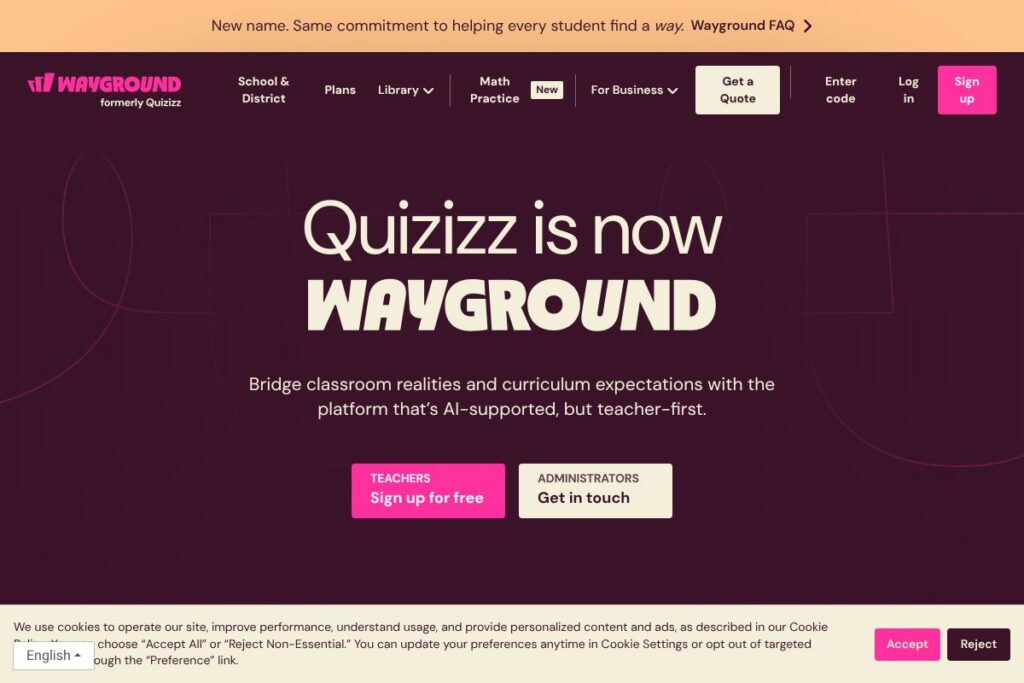
What is Wayground
Wayground is a learning platform that combines a large library of standards-aligned resources with classroom-focused AI to help teachers differentiate instruction and monitor student progress. The library covers ELA, math, science, social studies, career and technical education, foreign language, and grade-specific collections, and includes passages, presentations, videos, flashcards, simulations, and assessments that teachers can assign or adapt.
Compared with Kahoot!, Wayground places more emphasis on sustained instruction and standards mapping instead of live quiz play; compared with Quizlet, Wayground focuses on full lessons and assessments rather than primarily flashcard-driven study; and compared with Nearpod, Wayground emphasizes AI-driven differentiation and individual accommodations at scale. These comparisons highlight how Wayground is intended for teachers who need granular control over standards alignment and student-level modification.
Wayground performs well when schools need a single platform to search for vetted instructional materials, adapt them quickly, and collect performance data tied to standards. It is best suited for K-12 teachers and district curriculum teams that want to combine content, formative assessment, and individualized supports in one workflow.
How Wayground Helps Teachers
Teachers begin by searching the Wayground library for standards-aligned materials by grade, standard, or skill, then preview or assign items directly to classes. The platform’s AI assists with differentiating text complexity, generating scaffolds, and suggesting alternate question types so materials better match diverse student needs.
Assignments flow into the classroom through rostering and LMS connections, students complete interactive items on any device, and teachers get per-student and per-standard reports that show mastery, common misconceptions, and time-on-task. Workflows support whole-class lessons, small-group practice, intervention cycles, and end-of-unit assessments all from the same content base.
Wayground features
Wayground organizes its core capabilities around a standards-aligned content library, flexible assignment and assessment formats, AI-driven differentiation, and student-level reporting. The platform also emphasizes accessibility and classroom rostering to apply accommodations automatically.
Standards-aligned content library
A searchable library includes passages, presentations, videos, flashcards, and assessments mapped to common standards and grade bands. This lets teachers find ready-to-use lessons or starting points to customize, and it supports cross-subject planning and vertical alignment.
AI-powered differentiation
AI tools adjust reading level, scaffold questions, and recommend alternate formats so the same core material can be appropriate for mixed-ability classrooms. These adjustments save prep time and help teachers provide targeted supports without creating separate lessons for every student.
Assessment and reporting
Formative and summative assessments come with item-level analytics, standard mastery reports, and classwide performance dashboards. Teachers can use results to target interventions, group students by need, and generate parent-facing progress summaries.
Content authoring and customization
Teachers can import their own materials, create slides and question sets with dozens of question types, and mix media with interactive elements. Custom content can be saved, reused, or shared with colleagues to support consistent instruction across a department or grade.
Interactive media and simulations
Resources include paused-for-discussion videos, simulations such as PhET-style interactives, and embedded tools like Desmos for math visualizations. These media-rich items increase engagement and provide alternative entry points for complex concepts.
Accessibility and accommodations
Wayground supports 25+ modification and accommodation options that can be assigned at the student or group level and applied automatically. Options include adjusted reading levels, text-to-speech, extended time, and simplified prompts to reduce the need for separate documents.
Integrations and rostering
The platform connects to common rostering and classroom systems so teachers do not have to recreate classes or manage extra passwords. Integration reduces administrative overhead and helps ensure student identities and grades sync with school systems.
With these features, the biggest benefit is that teachers can find, adapt, assign, and measure learning from a single place while tailoring the student experience with automated supports and targeted reporting.
Wayground pricing
Wayground uses school- and district-focused licensing with plans that scale from individual teachers to site and district agreements. Pricing typically reflects the number of users, rostering needs, and the level of administrative services required.
For specific plan details, pilot options, or to request a district quote, visit the Wayground homepage or contact their team through the Wayground contact page to get current pricing and purchasing options.
What is Wayground Used For?
Wayground is used to deliver standards-aligned instruction, run formative and summative assessments, and provide differentiated practice across K-12 subjects. Teachers deploy the platform for whole-class lessons, small-group interventions, independent practice, and assessment review sessions.
District leaders and curriculum specialists use Wayground to ensure materials map to standards, run pilots across schools, and view aggregated data for instructional decision making. The platform is also used for test preparation, writing instruction with rubrics, and career and technical education scenario-based learning.
Pros and Cons of Wayground
Pros
- Standards-aligned library: The platform contains a wide range of vetted resources across subjects and grade levels, making lesson planning faster and more consistent for teachers.
- AI-driven differentiation: Automated adjustments to reading level and scaffolds reduce prep time and help teachers meet diverse learning needs without multiple versions of each lesson.
- Classroom rostering and integrations: Seamless connection to school systems cuts down on manual class setup and password issues, improving workflow efficiency.
- Rich media and tools: Built-in support for simulations, paused videos, and embedded graphing calculators provides multiple representations of content to support conceptual understanding.
Cons
- District procurement focus: The platform is optimized for school or district licensing, so small teams or individual teachers may need to engage school administration to access full features.
- Learning curve for advanced features: Getting the most out of the AI differentiation and assessment analytics requires time and some training for teachers unfamiliar with data-driven instruction.
- Limited public pricing transparency: Pricing is typically handled through sales conversations, which can slow evaluation for teachers seeking immediate, line-item comparisons.
Does Wayground Offer a Free Trial?
Wayground offers trial and pilot options for educators and districts. Individual teachers can often request classroom-level access to explore core resource search and assignment features, while pilot programs unlock rostering and AI differentiation for school or district evaluations; contact Wayground through the Wayground contact page to arrange a trial or pilot.
Wayground API and Integrations
Wayground provides integration paths for common rostering and classroom systems to sync classes and student data, which helps apply accommodations and collect verified student performance without manual setups. Typical integrations include Google Classroom, single sign-on, and SIS connectors used by districts.
For technical integration details or developer access, check the Wayground support and integration resources or contact their team to discuss API or rostering requirements.
10 Wayground alternatives
Paid alternatives to Wayground
- Kahoot! — A live game-based learning platform and library of activities suited for formative checks and engagement in synchronous lessons, with classroom and school plans.
- Quizlet — Flashcards, study sets, and practice tests that focus on retrieval practice and vocabulary building, often used for homework and independent review.
- Nearpod — A lesson delivery platform with interactive slides, VR, and student pacing features designed for whole-class instruction and formative assessment.
- IXL — Standards-aligned practice and diagnostics, particularly strong in math and language arts adaptive practice with deep skill tracking for districts.
- Edpuzzle — Video-based lessons that pause for comprehension checks and teacher feedback, useful for flipped classroom models.
- Gimkit — Game-based review activities with a focus on engagement and repeated practice rounds, popular for formative review.
Open source alternatives to Wayground
- Moodle — An open source learning management system that supports course creation, quizzes, and plugins for content interactivity when self-hosted or run through managed providers.
- H5P — A content authoring framework that creates interactive videos, quizzes, and presentations embeddable in LMS platforms like Moodle and Drupal.
- Open edX — A scalable open source platform for course delivery with strong support for rich content and assessments when hosted by institutions.
Frequently asked questions about Wayground
What subjects does Wayground cover?
Wayground covers ELA, math, science, social studies, foreign language, CTE, and grade-specific collections. The platform includes passages, presentations, videos, flashcards, simulations, and assessments across those subjects.
Does Wayground integrate with Google Classroom?
Yes, Wayground supports rostering and integrations with Google Classroom and other common school systems. These connections enable sync of class lists and assignment distribution without extra manual setup.
Can Wayground apply accommodations automatically for students?
Yes, Wayground can apply a set of 25+ accommodations tied to student profiles or groups. Once set, accommodations persist across assignments to avoid duplicative teacher work.
Is student data protected on Wayground?
Wayground uses enterprise-grade security and data protection measures and offers signed agreements to preserve school and student privacy. The company emphasizes verified student data protection and compliance with common educational privacy expectations.
How do teachers customize Wayground resources?
Teachers can import materials, edit question sets, adjust reading levels, and add scaffolds using the platform’s authoring tools and AI suggestions. Custom content can be saved, shared, and assigned to individual students or whole classes.
Final verdict: Wayground
Wayground is strongest as a single source for standards-aligned instructional materials combined with classroom-aware AI that helps teachers differentiate at scale. Its library breadth, built-in media, automatic accommodations, and reporting make it a practical choice for districts seeking a consistent instructional workflow across grades and subjects.
Compared with a competitor like Nearpod, Wayground skews more toward individual student differentiation and accommodations within a standards-mapped content set, while Nearpod emphasizes synchronous lesson delivery and immersive whole-class experiences. In pricing structure, Wayground typically operates through school or district agreements tailored to rostering and scale, while competitors may offer more visible per-teacher or small-team plans; contact Wayground via the Wayground contact page for purchasing details and pilot options.