Getting to Know Docebo
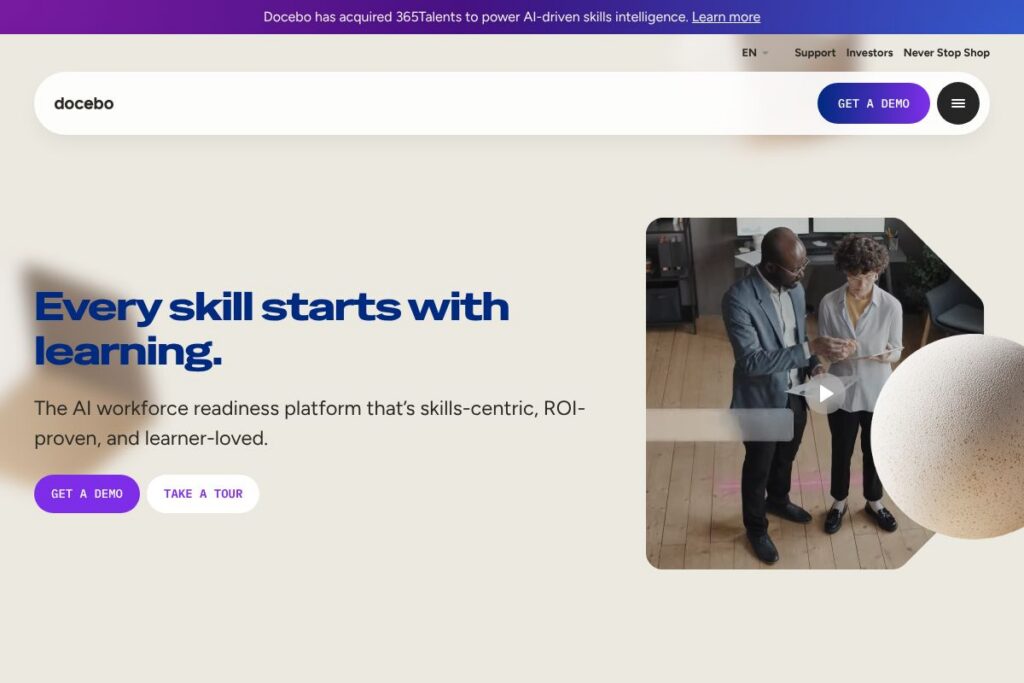
Docebo is an AI-first learning platform designed for enterprise learning, skills development, and customer and partner training on a single system. The platform combines generative AI content creation, skills intelligence after the acquisition of 365Talents, and analytics to connect learning activity to business outcomes like ramp time, win rates, and retention. Organizations use Docebo to centralize multiple learning use cases, reduce admin overhead, and scale programs globally with localization and role-based audiences.
Docebo competes with established enterprise LMS and LXP vendors such as Cornerstone OnDemand, SAP SuccessFactors, and Skillsoft. Compared with Cornerstone OnDemand, Docebo places stronger emphasis on AI-driven content creation and skills intelligence, while Cornerstone may offer deeper talent management tie-ins. Against SAP SuccessFactors, Docebo is often chosen for multi-audience learning programs and quicker time-to-value, while SuccessFactors integrates more tightly into broader HR suites.
All of this makes Docebo particularly well suited for medium-to-large enterprises that need a single platform to train employees, partners, and customers, and for teams that want to apply skills data to workforce planning. It excels at AI-assisted content creation, skills mapping, and measuring learning impact at scale.
How Docebo Works
Docebo streamlines learning around three core activities: create, manage, and measure. Administrators build interactive courses and coaching scenarios using Docebo Creator and AI-assisted templates, then personalize delivery with learning paths and targeted audiences to accelerate skill acquisition.
Once content is live, Docebo automates enrollments, notifications, and learner workflows so programs scale with minimal manual work. Integrations with CRM and HRIS systems allow administrators to trigger learning from business events and correlate training with outcomes like revenue and retention.
Analytics and skills intelligence close the loop by surfacing where capability exists and where gaps remain; teams use those insights to adjust curricula, assign targeted development, and prove ROI with pre-built dashboards or custom reports. Explore Docebo’s platform capabilities for implementation details.
What does Docebo do?
Docebo combines LMS, LXP, authoring, content marketplace, virtual classroom, and analytics into one platform with a strong AI focus. Core capabilities include AI content generation, skills intelligence from 365Talents, multi-audience management, role-based personalization, and enterprise security. Recent platform additions emphasize generative AI for content creation, virtual coaching, and enhanced search that surfaces learning tied to needed skills.
What Makes Docebo Stand Out
AI Content Creation
Docebo Creator uses generative models to produce interactive course material, assessments, and coaching scenarios in minutes, reducing authoring time and cost. This speeds curriculum rollout and helps subject matter experts publish polished learning without specialist tooling.
Skills Intelligence
Skills data, powered by the integration with 365Talents, maps learning to workforce capability so organizations can see where skills exist and where development is needed. That visibility helps prioritize learning investments and align training with business priorities.
Personalized Learning Paths
Docebo personalizes recommendations and learning plans based on role, skills gaps, and previous activity, which increases relevance and completion rates. Personalized paths support both mandatory compliance workflows and optional career development tracks.
Virtual Coaching and AI Assistants
AI-driven virtual coaching provides scenario-based practice and feedback, helping learners apply knowledge to real tasks. Administrators also benefit from AI assistants for search and admin tasks, which cut down on routine support work.
Reporting and Analytics
Pre-built dashboards and custom reports connect learning activity to KPIs like ramp time, win rates, and retention, enabling data-driven program improvements. Analytics also let learning teams measure ROI and report impact to stakeholders.
Content Marketplace
Docebo’s marketplace offers thousands of third-party courses and certifications across leadership, technical, and compliance topics, enabling faster program expansion without building everything in-house. Marketplace content can be combined with internally authored material for blended learning.
Multi-audience Management
A single platform architecture supports employees, partners, and customers with distinct branding, catalogs, and access controls, simplifying governance across audiences and regions. This reduces the need for separate platforms for customer education or partner enablement.
Security and Compliance
Docebo is built with enterprise security and compliance in mind, including ISO 27001 and SOC 2 controls and GDPR-aligned protections; see Docebo’s Trust Center for details. Security-by-design and monitoring help meet corporate and regulatory requirements.
With Docebo you get end-to-end learning that scales: create AI-assisted content, deliver personalized skill-based paths, and measure business impact with integrated analytics.
Docebo pricing
Docebo uses an enterprise-oriented subscription model with custom configurations for different audiences, deployment needs, and support levels. Pricing is tailored by scope, number of learners, multi-audience management, and optional modules such as advanced AI content creation or premium marketplace access.
Docebo offers flexible, custom pricing for enterprise deployments; for the most up-to-date information and to discuss a quote tailored to your organization, review Docebo’s current pricing options or contact sales through the vendor’s site. Enterprise buyers should expect pricing to reflect seat counts, required integrations, and service-level needs.
What is Docebo Used For?
Docebo is used to centralize and scale training across employees, partners, and customers, supporting use cases like onboarding, compliance, sales enablement, partner certification, and customer education. Its multi-audience capabilities make it practical for organizations that need separate catalogs and branding while keeping management centralized.
Teams also use Docebo to operationalize skills programs: identify skills gaps, deliver targeted learning, and measure impact on performance metrics such as time-to-competency and retention. Organizations that prioritize tying learning to business outcomes and workforce planning find this approach especially valuable.
Pros and Cons of Docebo
Pros
- AI-assisted content creation: Reduces time to publish learning through Docebo Creator and generative workflows, so subject matter experts produce quality courses faster. This lowers authoring costs and speeds training rollout.
- Skills intelligence: Maps learning to real workforce capabilities and uncovers where to focus development, which helps HR and L&D align programs with business priorities. Skills insights enable targeted reskilling and internal mobility.
- Multi-audience support: Centralized management for employees, partners, and customers cuts platform sprawl and simplifies governance across global programs. Distinct catalogs and branding keep experiences appropriate for each audience.
- Enterprise security and compliance: Built-in ISO 27001 and SOC 2 controls, plus GDPR-aligned features, make the platform suitable for regulated industries and large organizations.
Cons
- Enterprise pricing model: Custom pricing means costs can be higher than off-the-shelf solutions for smaller teams, and procurement timelines may be longer. Smaller organizations may find simpler LMSs more budget-friendly.
- Implementation complexity: Robust functionality and multi-audience features can increase implementation scope, requiring planning and possibly professional services to configure optimally. Organizations should plan for configuration, integrations, and change management.
- Learning curve for advanced features: Administrators may need time and training to make full use of advanced analytics, AI workflows, and skills intelligence. Internal L&D resources should be prepared for an initial ramp-up phase.
Does Docebo Offer a Free Trial?
Docebo offers free trials and personalized demos for prospective customers. Prospective buyers can request a demo or trial through Docebo’s site to evaluate core features like AI content creation, learner experience, and analytics, and to see how the platform handles multiple audiences.
Docebo API and Integrations
Docebo provides developer APIs and integration connectors to connect with CRM, HRIS, SSO providers, and other enterprise systems; see Docebo’s API documentation for available endpoints and authentication details. Common integrations include Salesforce, Workday or other HRIS systems, and single sign-on providers to streamline user provisioning and reporting.
The platform also offers pre-built connectors and LTI support for virtual classrooms and content providers so learning activity and business systems stay synchronized. Administrators typically pair Docebo with analytics and CRM data to correlate learning with revenue and retention metrics.
10 Docebo alternatives
Paid alternatives to Docebo
- Cornerstone OnDemand — Comprehensive talent and learning suite with deep HR and talent management integrations for enterprise customers.
- SAP SuccessFactors — Enterprise HR suite with integrated learning modules that tie training to broader talent workflows and HR data.
- Skillsoft — Large content library and learning platform focused on enterprise upskilling and compliance with an emphasis on off-the-shelf courses.
- Workday Learning — Native learning tied to Workday’s HR platform, useful where HR and payroll integration is a priority.
- Lessonly (by Seismic) — Sales and customer-facing training focused on enablement and practice-based learning for revenue teams.
- TalentLMS — Flexible LMS with simpler pricing tiers suitable for organizations that need fast deployment and lower complexity.
Open source alternatives to Docebo
- Moodle — Highly extensible open-source LMS with a large plugin ecosystem and control for self-hosters. Good for organizations that want customization without licensing fees.
- Open edX — Scalable platform originally built for MOOCs, often used for enterprise learning that requires custom course experiences and large-scale deployments.
- Chamilo — Lightweight open-source LMS focused on ease of use and rapid deployment for smaller to mid-sized organizations.
- Sakai — Open-source learning environment used mainly in higher education but adaptable for institutional learning needs.
Frequently asked questions about Docebo
What does Docebo do for enterprise learning?
Docebo provides an enterprise learning platform that combines AI content creation, skills intelligence, and analytics. It supports multi-audience training programs for employees, partners, and customers and links learning activity to business outcomes.
Does Docebo integrate with Salesforce and HR systems?
Yes, Docebo integrates with CRM and HRIS platforms. Pre-built connectors and APIs allow data exchange with systems like Salesforce and Workday to correlate learning with sales performance and HR metrics.
How does Docebo handle security and compliance?
Docebo implements enterprise-grade controls including ISO 27001 and SOC 2 and aligns with GDPR requirements. For more details on certifications and data protection, see Docebo’s Trust Center.
Can Docebo support global, multi-language training programs?
Yes, Docebo supports global deployments with localization, translations, and multi-catalog capabilities. Administrators can manage regional catalogs, language variants, and audience-specific branding from a single platform.
Does Docebo provide APIs for custom automation?
Yes, Docebo publishes REST APIs for automation, user provisioning, and reporting. The Docebo API documentation provides endpoints for common integration tasks and guidance for authentication and rate limits.
Final Verdict: Docebo
Docebo stands out for combining AI-assisted content creation, skills intelligence from the 365Talents acquisition, and enterprise analytics in a single platform that supports employees, partners, and customers. Its strengths are rapid content authoring with Docebo Creator, skills-driven visibility into workforce capability, and a scalable multi-audience architecture that reduces platform fragmentation for large organizations.
Compared to Cornerstone OnDemand, Docebo often delivers faster time to value for teams prioritizing AI content workflows and skills mapping, while Cornerstone may be preferred where deeper talent management and HR integrations are the priority. Pricing for both vendors is enterprise-focused and custom; organizations should evaluate required modules, expected learner volume, and integration scope when comparing total cost of ownership.
For enterprises that need an AI-forward LMS with skills intelligence and multi-audience support, Docebo is a strong option. To assess fit for your organization, request a demo or trial and review Docebo’s platform pages and Trust Center for technical, security, and compliance details.