Thinkific: An Overview
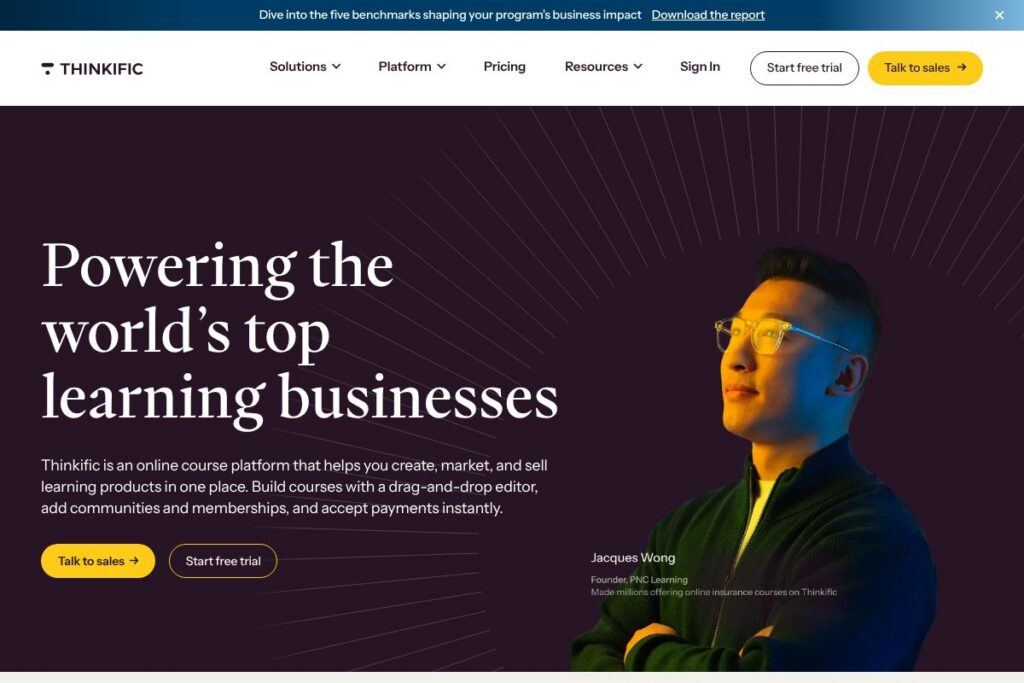
Thinkific is an all-in-one platform for building, marketing, and selling online courses, memberships, and communities. It combines a visual drag-and-drop course builder with learner management, commerce tools, and customer support features so creators can publish learning products without stitching multiple systems together.
Compared with competitors, Thinkific focuses on modular course creation and scalable delivery. Teachable is similar in core LMS features but emphasizes marketplace-style selling and often targets solo creators. Kajabi bundles email marketing and funnels with course hosting and is positioned as a higher-priced, all-in-one business platform. Udemy operates primarily as a marketplace, which can drive discoverability but at the cost of pricing control and platform dependence.
Thinkific does particularly well for educators and organizations that want a stable, extensible course platform with options for memberships and communities. It suits independent creators launching paid courses, agencies or training teams scaling customer education, and companies that need a dedicated learning presence without building custom software.
How Thinkific Works
Thinkific organizes content as courses, lessons, and modules that you assemble using a visual editor. The course builder accepts video, text, quizzes, downloads, and custom pages, and it supports drip schedules, prerequisites, and completion certificates to structure learning paths.
Commerce is handled inside the platform so you can price courses, set up memberships, offer coupons, and configure one-time or recurring payments. Enrollments and access rules map to purchases or manual assignments, and you can create bundles and upsells to increase lifetime value.
Operational workflows include student management, email notifications, and progress tracking. Creators commonly pair Thinkific with external tools for advanced marketing or CRM workflows via integrations or the API, enabling automated onboarding, segmented email campaigns, and analytics pipelines.
Thinkific features
Thinkific centers around course creation, learner engagement, and commerce. Core capabilities include a drag-and-drop builder, membership and community support, payment processing, basic LMS tools like quizzes and certificates, and reporting. Recent updates emphasize AI-assisted course creation and enhanced commerce that supports upsells and subscriptions.
Let’s talk Thinkific’s Features
Drag-and-drop course builder
The builder lets you assemble lessons and modules without coding, upload video and file assets, and arrange content with a visual layout. This reduces time to launch and enables non-technical creators to iterate course structure quickly.
Communities and memberships
Thinkific supports member-only spaces and recurring-access memberships so you can run cohort communities or gated content funnels alongside courses. Memberships allow recurring billing and group-based access control to tie community access to subscription status.
Commerce and payments
Built-in commerce tools let you accept payments with Stripe and PayPal integrations, create coupons, set up subscriptions, and offer bundles. Native checkout and upsell capabilities make it easier to convert visitors and increase average order value.
Learning management tools
Quizzes, completion certificates, and drip schedules provide basic learner assessment and progress mechanics. These tools help structure learning experiences for cohorts or self-paced students and support credentialing workflows.
Marketing and sales features
Thinkific includes landing pages, coupon codes, affiliate support, and integrations for email marketing so you can capture leads and run promotions. Native pages and checkout flows reduce the need for external funnel tools for many creators.
Analytics and reporting
Enrollment, revenue, and engagement reports show how courses are performing and where students drop off. Reporting supports practical decisions about content updates, pricing changes, and promotional focus.
Integrations and API access
Thinkific provides integration points for Zapier, Stripe, PayPal, major email platforms, and analytics tools, plus a developer API for custom workflows. This lets teams connect Thinkific to CRMs, membership systems, and bespoke dashboards.
With these capabilities, Thinkific is best known for making it straightforward to launch paid learning products while supporting scale through commerce and integration options.
Thinkific pricing
Thinkific uses a subscription model with a free tier plus paid plans and enterprise options tailored to creators and businesses. For the most accurate and up-to-date details about features by tier and any promotional offers, review Thinkific’s current pricing options on the official site.
What is Thinkific Used For?
Thinkific is used to create and sell online courses, run subscription-based memberships, and host learner communities. It is commonly adopted by independent experts packaging knowledge into paid courses, companies delivering customer or employee training, and educational businesses building repeatable revenue streams.
Teams use Thinkific to convert in-person workshops into evergreen online courses, to add credentialed learning paths for customers, or to centralize user onboarding content. The platform supports use cases that range from single-course launches to full academies with multiple programs and cohorts.
Pros and Cons of Thinkific
Pros
- Comprehensive course creation tools: The drag-and-drop builder, content types, and LMS features let creators publish structured learning without custom development.
- Flexible commerce options: Built-in payment processing, subscriptions, coupons, and upsells enable direct monetization and recurring revenue strategies.
- Extensible via integrations and API: Native integrations plus API access allow teams to connect Thinkific with CRMs, email platforms, and analytics systems for automated workflows.
- Strong customer support and onboarding: Thinkific emphasizes customer success with onboarding resources and support that help creators launch faster.
Cons
- Advanced marketing features limited out of the box: While Thinkific includes landing pages and basic funnels, teams with complex marketing automation needs may still require external tools.
- Customization can require technical work: Deep theme or checkout customizations often need developer resources or the enterprise-grade Thinkific Plus capabilities.
- Marketplace discoverability not included: Unlike marketplace platforms, Thinkific relies on your own marketing to drive sales rather than offering built-in marketplace traffic.
Does Thinkific Offer a Free Trial?
Thinkific offers a free plan and paid plan trials. The free tier supports basic course creation and student enrollments so you can build and test a course before upgrading, while paid plans add advanced commerce, memberships, and support features; check the platform for current trial terms and eligibility.
Thinkific API and Integrations
Thinkific provides a RESTful API for developers to manage courses, users, enrollments, and orders; the API documentation explains endpoints and authentication for building custom integrations. See Thinkific’s API documentation for developer resources and examples.
Key third-party connections include Zapier for automation, Stripe and PayPal for payments, Shopify and ecommerce tools for storefront workflows, and popular email platforms for marketing automation. These integrations let you automate enrollments, sync learner data, and build custom reporting pipelines.
10 Thinkific alternatives
Paid alternatives to Thinkific
- Kajabi — All-in-one business platform that bundles courses, email marketing, and funnels aimed at creators who want built-in marketing tools.
- Teachable — Course hosting with an emphasis on creator monetization and an intuitive course builder for solo entrepreneurs.
- Podia — Simple storefront for courses, digital downloads, and memberships with straightforward pricing and an easy setup.
- LearnWorlds — Focuses on interactive learning with assessments and video engagement tools for course creators who need richer learner interactions.
- Kartra — Combines course hosting with marketing automation and funnel building for teams that want tight sales and marketing integration.
- MemberPress — WordPress-based membership plugin that integrates with WP sites to sell gated content and subscriptions.
Open source alternatives to Thinkific
- Moodle — Mature open-source LMS widely used by institutions for self-hosted course delivery and robust extensibility.
- Open edX — Scalable open-source platform designed for enterprise and academic use with support for complex learning workflows.
- Chamilo — Lightweight open-source LMS focused on simplicity and straightforward course management for small organizations.
- WordPress with LearnPress — A self-hosted option combining WordPress flexibility with LMS plugins to create a customizable course site.
Frequently asked questions about Thinkific
What is Thinkific used for?
Thinkific is used to build, host, and sell online courses, memberships, and communities. Creators use it to package knowledge into paid products and manage learner access and payments.
Does Thinkific integrate with payment providers?
Yes, Thinkific integrates with Stripe and PayPal for payments. These integrations support one-time payments, subscriptions, and refunds through the platform.
Can Thinkific support enterprise or large-scale training?
Thinkific offers enterprise-grade options and API access for large programs. Thinkific Plus and custom implementations provide onboarding, API extensibility, and dedicated support for high-volume needs.
How does Thinkific handle student progress and assessments?
Thinkific includes quizzes, completion tracking, and certificates. These LMS features let you measure learner progress and issue credentials after course completion.
Is Thinkific suitable for selling memberships and communities?
Yes, Thinkific supports memberships and community features tied to access and recurring billing. You can run subscription-based content, cohort communities, and gated member areas within the platform.
Final verdict: Thinkific
Thinkific is a practical choice for creators and organizations that need a dedicated course platform with solid LMS features, built-in commerce, and integration options. It excels at making course creation accessible while providing the commerce tools required to sell and scale learning products.
Compared with Kajabi, Thinkific typically offers more modular course-focused functionality and flexible API access, while Kajabi bundles in marketing automation and funnels as part of its core offering. For teams prioritizing a course-first platform with extensibility, Thinkific is often a better fit; for teams that want an all-in-one marketing and course stack and are comfortable with a higher bundled cost, Kajabi is worth evaluating.