About Podia
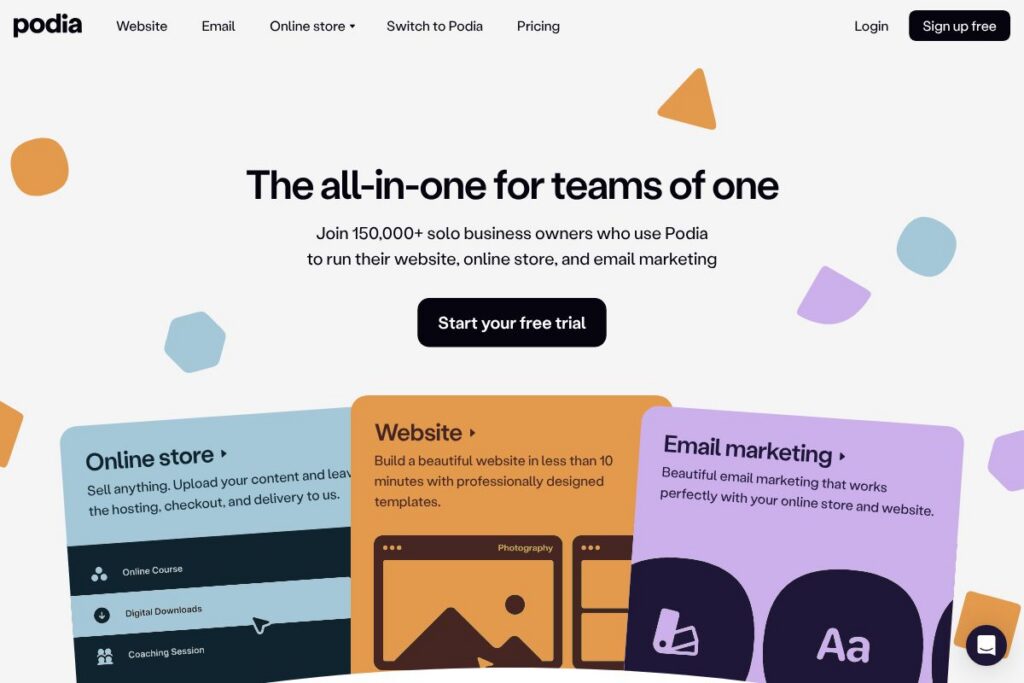
Podia is an all-in-one platform that combines a website builder, storefront, course hosting, membership management, and email marketing into a single product aimed at creators and small online businesses. It is designed to let people sell online courses, digital downloads, memberships, coaching, tickets, and multimedia products without assembling multiple separate services. The platform also includes built-in checkout, tax and currency support, and basic SEO tools that cover the common needs of solo entrepreneurs.
Compared with Teachable and Thinkific, Podia places more emphasis on integrated email and storefront features instead of deeper course authoring tools. Compared with Kajabi, Podia is positioned for smaller teams and solo creators who want fewer moving parts rather than enterprise-level funnels and native advanced analytics. All of this makes Podia well suited for creators who prefer a single, easy-to-manage platform for selling digital products and running email campaigns from one place.
How Podia Works
Podia lets you build a branded website using professionally designed templates, then add products directly to your store. You create products such as online courses, memberships, digital downloads, tickets, and coaching products, configure pricing and access rules, and Podia handles product pages, secure delivery, and checkout.
Email marketing and automation are integrated with product events, so you can send newsletters, launch sequences, and fulfillment emails from the same account that hosts your products. Podia also connects to payment processors and third-party tools through native integrations and automation platforms to handle payments, analytics, and extended workflows; see the Podia features to explore specific capabilities.
Podia features
Podia groups the main capabilities needed to run a creator business into a unified interface. Core areas include website and page building, product management for courses and digital goods, membership and subscription handling, built-in email marketing and automations, and checkout tools with tax and multi-currency support. The platform also supports funnels like pre-sales and upsells, templates for quick setup, and promotional tools such as coupons and affiliates.
Website builder
A drag-and-drop website builder and professionally designed templates let you publish a lightweight site and landing pages without coding. Templates are geared toward creators and include built-in SEO fields and customizable sections to present products, testimonials, and lead capture forms.
Online courses
Course creation supports multimedia lessons, drip schedules, and content access controls, with a clean course player for students. Courses can be bundled or sold with subscriptions and are delivered securely through the Podia environment.
Memberships
Memberships support recurring billing and gated content, letting creators publish community areas, recurring lesson content, or member-only downloads. Membership tiers can be used with coupons, trials, and access rules to manage different subscriber levels.
Digital downloads and multimedia products
Podia handles single-download purchases and streaming or downloadable multimedia files, including audio, video, PDFs, and ZIPs. Delivery is automated and secure, with file hosting managed by the platform to simplify distribution.
Email marketing and automations
Built-in email tools combine newsletters, sequence automations, and product-triggered messages so marketing and fulfillment live in one place. Segmentation and signup forms let you target product owners or trialists and run behavior-based flows without a separate ESP; explore email features on the Podia features page.
Fast checkout and payments
Podia provides a simplified checkout flow with support for multiple currencies and tax settings appropriate for digital sales, plus integrations with common payment processors. Upsells and bundling options are available at checkout to increase average order value.
Affiliate marketing and coupons
Creators can run affiliate programs and generate coupon codes to incentivize partners and promote launches. Affiliates receive referral links and Podia tracks conversions and payouts within the platform.
Webinars and pre-sales
You can sell webinar tickets and host pre-sales for upcoming courses or products, collecting payments and registrations directly through Podia product pages. Integrations with webinar hosting tools let you combine live events with product fulfillment.
With these features Podia reduces the number of separate tools required to run an online storefront for digital products. The biggest benefit is the consolidated workflow between product management and email marketing, which simplifies launch and fulfillment processes for solo creators.
Podia pricing
Podia uses a subscription pricing model with multiple plan tiers to fit different creator needs, including options for individuals and teams and an enterprise-style approach for larger businesses. For the most accurate and current plan details and billing options, check the Podia homepage where plans and any promotional offers are listed.
What is Podia Used For?
Podia is commonly used to sell online courses, host memberships, distribute digital downloads, and deliver coaching or ticketed events. It is a practical choice for creators who want a single account to publish a website, list products, accept payments, and manage email marketing without stitching together separate services.
Podia is also used for building simple marketing funnels like pre-sales, launch sequences, and evergreen offers that rely on integrated email automations and checkout upsells. Small teams, solopreneurs, coaches, writers, and educators find Podia useful when they prioritize fast setup and manageable workflows.
Pros and Cons of Podia
Pros
- Integrated product and email platform: Combining storefront, course hosting, memberships, and email in one interface reduces the need to manage multiple services and simplifies launch workflows.
- Simple site and checkout setup: Templates and a straightforward checkout flow make it fast to publish product pages and start selling without developer support.
- Support for many digital product types: Courses, downloads, webinars, coaching, bundles, and memberships are all supported, which gives creators flexibility in how they monetize content.
- Built-in promotional tools: Coupons, affiliate management, upsells, and pre-sales help run marketing campaigns without outside plugins.
- Currency and tax features: Multi-currency support and basic tax handling ease international sales for digital goods.
Cons
- Limited advanced course authoring: Compared with platforms focused only on courses, Podia has fewer deep instructional design or assessment features for complex learning experiences.
- Simpler analytics and reporting: Reporting is practical for creators but lacks the granular enterprise analytics found in higher-end platforms like Kajabi or LMS systems.
- Fewer native integrations for enterprise tools: While common integrations are supported, very large teams may need custom integrations or third-party automation to match complex needs.
- Less control over hosting and extensibility: Creators who require full control of the hosting stack or advanced customization may prefer self-hosted options such as WordPress with plugins.
Does Podia Offer a Free Trial?
Podia offers a free plan that includes a basic website, product pages, and email capability. The free tier is designed to let creators publish a storefront and begin selling simple products, while paid plans unlock advanced features such as memberships, affiliate management, and expanded automation. Visit the Podia homepage to sign up and compare what each level includes.
Podia API and Integrations
Podia provides native integrations with payment processors, email and analytics tools, and supports automation platforms like Zapier for broader connections; see the Podia integrations page for a list of supported apps. These integrations enable common workflows such as sending purchase data to CRMs, syncing contacts to email providers, and connecting webinar tools.
For developer-focused extensions and custom workflows, Podia maintains resources and documentation for building automated connections; check the Podia help center for developer and integration guides.
10 Podia alternatives
Paid alternatives to Podia
- Kajabi — All-in-one creator platform that includes advanced funnels, built-in community features, and in-depth analytics for larger creators and teams.
- Teachable — Course-first hosting with flexible pricing tiers and more granular course authoring features for educators and training businesses.
- Thinkific — Focused on online education, Thinkific offers robust course creation tools and extended assessment options for learning programs.
- Gumroad — Simple storefront for digital creators that prioritizes lightweight selling and direct audience payments.
- SendOwl — Lightweight e-commerce for digital products with delivery, licensing, and checkout-focused features.
- LearnWorlds — Emphasizes interactive learning and assessment features for creators building structured learning experiences.
- Systeme.io — Marketing and funnel builder that includes membership and email tools, often chosen for tight budget funnels.
Open source alternatives to Podia
- WordPress + WooCommerce — A flexible, self-hosted option that pairs WordPress with WooCommerce and plugins like LearnDash for course and membership functionality.
- Moodle — Open-source learning management system suited for structured courses and academic-style delivery at scale.
- Open edX — Enterprise-grade open-source platform for large-scale online course delivery and complex learning programs.
- Ghost — Open-source publishing platform with built-in membership and newsletter capabilities for creators focused on subscriptions and written content.
Frequently asked questions about Podia
What is Podia used for?
Podia is used to build a creator storefront and sell digital products such as courses, memberships, and downloads. It centralizes website pages, checkout, delivery, and email marketing so creators can run their business from one account.
Does Podia include email marketing?
Yes, Podia includes built-in email marketing and automation tools. You can send newsletters, create drip sequences, and trigger emails based on purchases or subscriber behavior without a separate ESP.
Can I accept payments in multiple currencies with Podia?
Podia supports multi-currency sales and basic tax handling for digital products. That setup helps creators sell internationally and display appropriate pricing in several currencies.
Does Podia integrate with Zapier and third-party tools?
Yes, Podia integrates with Zapier and a range of third-party services for payments, analytics, and webinar tools. These integrations expand automation possibilities beyond Podia’s native features.
Is Podia suitable for coaching and one-on-one services?
Podia supports coaching products and ticketed events alongside courses and memberships. Creators can sell coaching sessions, set fulfillment details, and manage clients within the same platform.
Final verdict: Podia
Podia stands out as a practical, all-in-one platform for solo creators and small teams who want to consolidate website, storefront, product delivery, and email marketing in a single place. It does particularly well at reducing tool sprawl, offering straightforward product setup, and keeping launches and fulfillment connected to email flows and checkout tools.
Compared to Kajabi, which targets creators who need advanced funnels and enterprise-style analytics, Podia is generally easier to use and aimed at solo entrepreneurs and small teams who prioritize simplicity and an integrated workflow. If you need deep LMS features or enterprise reporting, consider a dedicated course platform; if you value fast setup and consolidated marketing and commerce tools, Podia is a strong option. For plan details and to compare tiers, visit the Podia homepage.