OpenTable: An Overview
OpenTable is a real-time booking network focused on restaurant reservations and diner reviews. The platform aggregates availability across more than 60,000 restaurants worldwide so users can search by date, time, location, cuisine, and special filters like outdoor seating or dietary accommodations.
OpenTable competes directly with Resy and Tock in the higher-end and curated dining space, and with Yelp Reservations and SevenRooms on the restaurant management side. Compared with Resy, OpenTable tends to emphasize breadth of selection and a large global inventory; compared with SevenRooms, OpenTable focuses more on consumer discovery while SevenRooms emphasizes guest data and operations for venues.
OpenTable works well for diners who want fast, reliable booking and verified reviews, and for restaurants that need a marketplace presence plus tools to manage covers and guest communications. Its combination of discovery, real-time booking, and rewards makes it useful for individuals, travelers, and hospitality teams that need predictable table management.
How OpenTable Works
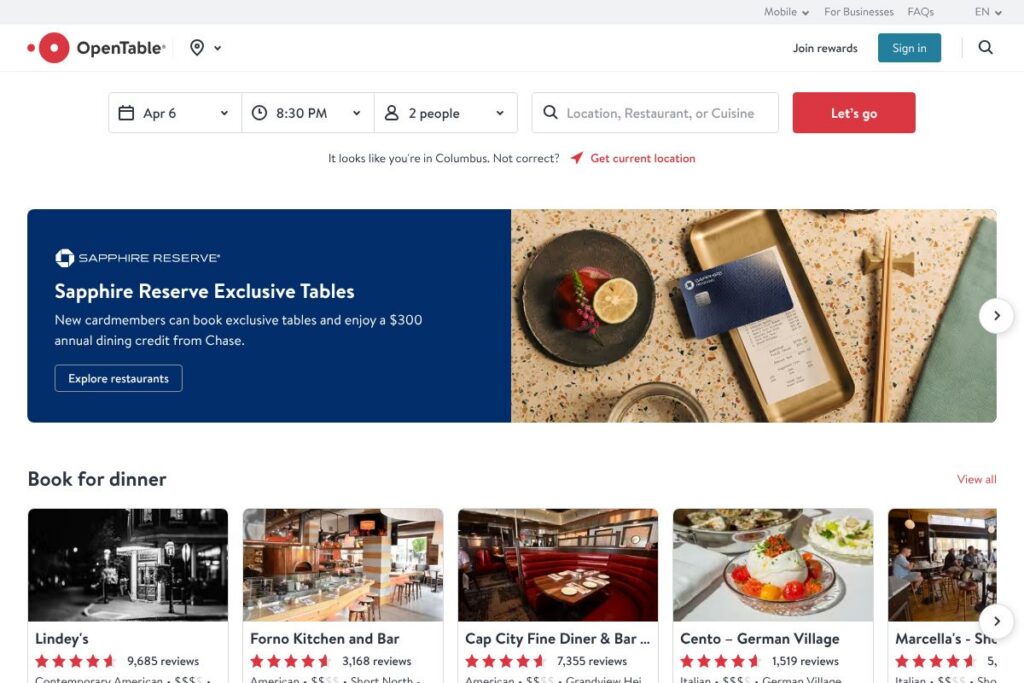
Search by city, neighborhood, date, and party size to surface available restaurants and time slots in real time. Results include filters for cuisine, price, accessibility, outdoor seating, and other features so you can narrow options quickly before you pick a time.
When you select a time, OpenTable confirms the reservation instantly and sends email and mobile notifications. You can modify or cancel bookings from the app or web interface, and restaurants see real-time updates on their side to manage seating and waitlists.
After dining, OpenTable prompts verified diners to leave reviews; those reviews are linked to a diner profile so the platform can surface recent, first-hand feedback. Dining on the platform also earns points that can be redeemed for future meals via the OpenTable rewards program.
What does OpenTable do?
OpenTable centers on three main capabilities: consumer discovery and search, real-time reservations and guest management, and verified diner reviews with rewards. Recent additions have strengthened mobile booking, neighborhood-based discovery, and integrations with reservation partners and mapping services.
Let’s talk OpenTable’s Features
Real-time reservations
The system shows live availability so users can pick from exact open times and receive instant booking confirmations. For restaurants, this reduces double-bookings and automates table allocation, while diners get predictable seat times and confirmation messages.
Search and filtering
Advanced search lets users filter by date, time, price range, cuisine, neighborhood, dining style, and amenities like outdoor seating or kid-friendliness. These filters speed up discovery and help diners find appropriate options for specific occasions such as date nights or family meals.
Verified diner reviews
Restaurant profiles display reviews from diners who actually booked through the platform, which helps maintain review relevance and trust. Reviews include ratings and written feedback so future diners can gauge food, service, and atmosphere.
OpenTable Dining Rewards
Dining on OpenTable earns points for eligible reservations that can be redeemed for dining credits. The rewards program encourages repeat bookings and can provide tangible value for frequent diners.
Restaurant management tools
OpenTable provides a restaurant-facing interface to manage floor plans, covers, waitlists, and guest profiles. These tools let staff handle no-shows, create shift-ready seating charts, and track repeat customers across visits.
Mobile app and notifications
The mobile apps provide booking, reminders, and one-tap management for reservations while on the go. Push notifications and email confirmations keep both diners and restaurants informed about changes and upcoming bookings.
Neighborhood and landmark discovery
OpenTable organizes search results around neighborhoods and local landmarks so users can find restaurants near venues like theaters, stadiums, and transit hubs. This is useful for planning dinners tied to events or travel itineraries.
With OpenTable you get fast access to available tables, verified feedback from recent diners, and a rewards program that adds value for frequent users. The combination of discovery and operational tools is the largest single benefit for both diners and restaurants.
OpenTable pricing
OpenTable uses a marketplace-style pricing approach: diners use the consumer booking service for free, while restaurants pay for reservation management, marketing exposure, and access to operational tools. Pricing for restaurants varies by market and package and is typically quoted directly to businesses.
For the most accurate information on restaurant fees, subscription options, and enterprise features, consult the OpenTable for Restaurants site where businesses can view product tiers and request a tailored quote.
What is OpenTable Used For?
OpenTable is commonly used to discover nearby restaurants and make instant reservations for specific dates and times. Users employ the platform for everyday dinners, special occasions, travel dining reservations, and finding MICHELIN-starred or highly rated eateries.
Restaurants use OpenTable to manage bookings, reduce front-of-house friction, and collect guest data. Hospitality teams rely on its table management tools and guest communications to improve service flow and measure demand trends.
Pros and Cons of OpenTable
Pros
- Large restaurant inventory: OpenTable lists tens of thousands of restaurants globally, making it likely you will find both local favorites and high-end dining options. This breadth helps travelers and locals alike locate reservations in many markets.
- Real-time booking and confirmations: The platform provides instant confirmations and updates, which reduces uncertainty for diners and simplifies operations for restaurants. Notifications and calendar integration help reduce no-shows.
- Verified diner reviews and rewards: Reviews are tied to verified bookings, which improves trustworthiness, and the rewards program gives frequent diners a reason to keep booking through the platform.
Cons
- Restaurant costs are not transparent: Pricing for restaurants varies by region and package and is typically provided only through sales, which makes vendor comparisons harder for smaller venues.
- Marketplace saturation for popular times: High-demand restaurants may still be difficult to book during peak hours despite the large inventory, requiring flexibility or waiting lists.
- Less emphasis on advanced guest analytics for some restaurants: Compared with guest-CRM-focused tools like SevenRooms, OpenTable prioritizes discovery and reservations over deep customer relationship management unless restaurants opt into premium packages.
Does OpenTable Offer a Free Trial?
OpenTable offers a free service for diners and does not charge consumers to search or make reservations. Dining through OpenTable earns rewards points on eligible bookings, and users can manage reservations at no cost. Restaurants, which pay for reservation management and exposure, should consult the OpenTable for Restaurants page for trial availability and sales contacts.
OpenTable API and Integrations
OpenTable provides integration options and partner connections for restaurants and platform partners, including syncs with mapping services, calendar apps, and third-party reservation partners. Restaurants can connect OpenTable to point-of-sale and guest-management systems through partner integrations available via the restaurant portal.
Businesses and developers interested in technical details can explore the OpenTable for Restaurants site to learn about connectivity, partner programs, and how to link booking data into operational workflows.
10 OpenTable alternatives
Paid alternatives to OpenTable
- Resy — Focuses on curated, often higher-end restaurants with a reservation and waitlist system oriented around experience and demand control.
- Tock — Emphasizes pre-paid and ticketed dining experiences, useful for tasting menus and events where prepayment or deposits are required.
- Yelp Reservations — Integrates discovery and bookings with the Yelp review ecosystem to connect local search with available times.
- SevenRooms — Prioritizes guest relationship management and CRM features for restaurants that want advanced guest profiling and marketing tools.
- TableAgent — Provides reservation management and table scheduling with simplified pricing for smaller operations.
- Hostme — Offers front-of-house management, waitlist functionality, and reservation tools aimed at mid-sized venues.
Open source alternatives to OpenTable
- Cal.com — An open-source scheduling platform that can be adapted for reservations and self-hosted to control data and customization, requiring development effort to tailor it for restaurants.
- Easy!Appointments — A self-hosted appointment and booking system suited for small venues that need a simple reservation interface without vendor fees.
- Booked (phpScheduleIt) — A mature open-source booking system for scheduling resources that can be customized for table reservations with additional development work.
Frequently asked questions about OpenTable
What is OpenTable used for?
OpenTable is used to discover restaurants and make instant reservations. Diners search by time, date, location, and filters to book tables and read verified reviews before choosing a venue.
Does OpenTable charge diners to make reservations?
No, OpenTable does not charge diners to book through the consumer platform. Dining on OpenTable can also earn rewards points for eligible reservations.
Can restaurants use OpenTable to manage seating and waitlists?
Yes, OpenTable provides restaurant-facing tools to manage floor plans, covers, waitlists, and guest communications. These tools are available through the OpenTable restaurant portal where venues can configure settings and staff access.
Does OpenTable integrate with other reservation or mapping services?
Yes, OpenTable supports integrations with mapping services, calendar apps, and partner reservation channels. Restaurants can access partner and integration options through the OpenTable restaurant platform.
How do I earn and redeem OpenTable rewards?
OpenTable rewards are earned on eligible reservations and can be redeemed for dining credits. The rewards program details and redemption options are described on the OpenTable Dining Rewards information pages.
Final Verdict: OpenTable
OpenTable excels at discovery and reliable, real-time booking for a wide range of restaurants worldwide. Its strengths are a large restaurant inventory, verified diner reviews, and a consumer-friendly rewards program, which together make it an efficient tool for finding and securing reservations.
Compared with Resy, which focuses on curated and high-demand experiences, OpenTable offers broader selection and deeper global coverage. In pricing and features, both platforms are free for diners, while restaurants choose different vendor packages; venues prioritizing CRM and guest analytics may prefer SevenRooms, whereas venues that want broad marketplace exposure often select OpenTable. For most diners and many restaurants, OpenTable remains a practical balance of discovery, booking reliability, and operational tooling.
For bookings and to explore restaurant-side products, visit the OpenTable homepage and the OpenTable for Restaurants portal.