What is Uber Eats
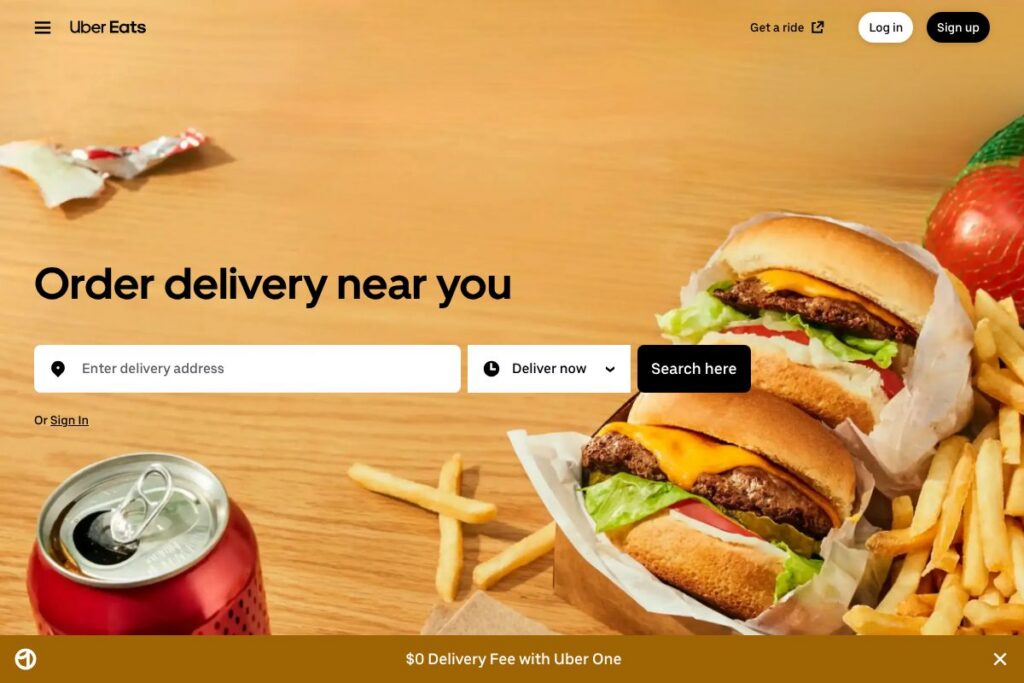
Uber Eats is a marketplace for ordering prepared food, groceries, and convenience items from local merchants for delivery or pickup. The platform connects customers, restaurants and stores, and delivery partners through mobile apps and a web interface, supporting contactless delivery, real-time order tracking, and scheduling.
Uber Eats competes directly with services like DoorDash and Grubhub in the United States and with Deliveroo in several international markets. Compared with those competitors, Uber Eats typically emphasizes integration with the broader Uber rider ecosystem and global geographic coverage, while competitors may focus more on local promotions or specific merchant categories.
All of this makes Uber Eats a practical choice for consumers who want a wide selection of restaurants and grocery options in one app, for restaurants that need a digital ordering channel, and for businesses looking to provide meals to employees. Its scale and multi-country presence suit large metropolitan areas where on-demand logistics and coverage matter most.
How Uber Eats Works
Customers place orders from the Uber Eats app or website by entering a delivery address, browsing available restaurants or grocery stores, and checking out with saved payment methods. Orders are routed to the chosen merchant, then assigned to a nearby delivery partner for pickup and drop-off; customers receive live updates and an estimated arrival time.
Restaurants receive orders through a tablet app or integrated point-of-sale connection and can manage availability, menus, and preparation timing. Drivers and couriers use a dedicated delivery app to accept trips, navigate to pickup and drop-off points, and mark delivery confirmations; options include contactless handoff and in-app photo confirmation.
What does Uber Eats do?
Uber Eats centralizes ordering and last-mile delivery for restaurants and retailers and provides separate tools for each participant: customer apps for ordering, merchant dashboards for order management, and driver apps for logistics. Recent enhancements focus on grocery and convenience delivery, improved tracking, and tools for restaurants to manage promotions and in-store workflow.
Let’s talk Uber Eats’s Features
On-demand food delivery
Customers can browse thousands of restaurants by cuisine, price, and delivery time, place orders for immediate delivery, and track drivers in real time. This speeds up ordering for takeout and supports restaurant partners by increasing order volume without requiring in-house delivery staff.
Grocery and convenience delivery
The platform aggregates grocery stores, corner stores, and specialty retailers so customers can order groceries and household essentials alongside restaurant meals. For retailers this provides an additional online sales channel and a fast delivery option for customers who need same-day items.
Real-time tracking and estimated arrival
Order status updates show merchant acceptance, preparation progress, and the delivery partner’s route and ETA. Real-time tracking reduces uncertainty for customers and lowers missed deliveries for merchants.
Contactless delivery and pickup options
Customers can select contactless drop-off and provide delivery notes for safe handoffs; pickup orders let customers collect meals directly from merchants. These options add flexibility for customers and reduce friction during busy periods.
Merchant dashboard and menu controls
Restaurants use a merchant dashboard to manage menus, set availability, run promotions, and view order history and payouts. Integration with point-of-sale systems and analytics helps merchants reconcile orders and adjust operations.
Driver app and logistics features
Delivery partners access navigation, batching for multiple pickups, and earnings summaries through the driver app. These logistics features aim to optimize routes and let drivers accept or decline opportunities based on location and timing.
With these capabilities Uber Eats provides end-to-end ordering, fulfillment, and partner tools that benefit consumers, merchants, and delivery partners by simplifying digital sales and last-mile delivery.
Uber Eats pricing
Uber Eats uses a combination of consumer-facing fees and partner-facing commissions rather than fixed subscription plans. Customers typically pay restaurant menu prices plus delivery fees and service fees that vary by market and order size, while restaurants pay commission and optional marketing fees to appear more prominently in search results. For specific fee structures and any recent changes, check Uber Eats’ help pages on fees and partner pricing on the official site.
Merchant pricing and delivery partner compensation are market-dependent and may include volume discounts, tiered commission programs, or flat-fee arrangements in certain regions. To review details for restaurants, delivery partners, or business accounts, consult the relevant sign-up and support pages such as the pages for adding a restaurant, signing up to deliver, and business accounts on Uber Eats’ site.
What is Uber Eats Used For?
Consumers use Uber Eats to order restaurant meals and groceries when they want fast delivery or convenient pickup without calling the restaurant. It is commonly used for dinner delivery, office lunches, last-minute grocery runs, and scheduling meals for events.
Restaurants use Uber Eats to reach customers who prefer delivery or pickup, broaden their digital presence, and access order management tools. Businesses and teams use the platform to provide employee meals through a business account or group ordering features.
Pros and cons of Uber Eats
Pros
- Wide city coverage: Uber Eats operates in hundreds of cities and dozens of countries, giving customers broad geographic options and merchants access to many potential customers.
- Integrated rider ecosystem: The platform benefits from Uber’s existing rider and driver network, simplifying cross-service account management and logistics for urban markets.
- Multiple merchant categories: Restaurants, grocery stores, and convenience retailers can all list on the platform, which increases choice for customers and revenue channels for partners.
- Real-time tracking and contactless options: Order transparency and safety options improve the customer experience and reduce delivery friction.
Cons
- Fee variability and complexity: Delivery fees, service fees, and merchant commissions vary by market and can make costs unpredictable for customers and margin management challenging for small restaurants.
- Commission pressure on merchants: Commission and marketing fees can be significant for restaurants, particularly those with thin margins that rely heavily on on-platform orders.
- Market competition: High competition in major cities means restaurants may need to use promotions or paid placement to stand out, increasing cost of acquisition.
Is Uber Eats Free to Try?
Uber Eats does not offer a free trial in the traditional software sense, but the app is free to download and use. Customers can install the Uber Eats app at no cost, browse menus, and place orders; any costs arise when orders are placed, including menu prices, delivery fees, and service fees. Restaurants and delivery partners sign up through separate onboarding processes that explain commission and payout terms.
Uber Eats API and Integrations
Uber Eats provides partner APIs and POS integrations for restaurants and delivery partners; developers can consult the Uber Eats developer resources and API documentation for details on endpoints, authentication, and webhook support. See the Uber Eats API documentation for technical references and onboarding instructions.
Key integrations include point-of-sale providers and third-party delivery management systems that sync orders and status updates into merchant workflows, reducing manual entry and speeding fulfillment. For merchant integration guides and POS partners, review the restaurant partner pages and integration resources on the official site.
10 Uber Eats alternatives
Paid alternatives to Uber Eats
- DoorDash – A major food delivery platform in North America with strong local market penetration and subscription options for frequent users.
- Grubhub – A long-standing U.S. player focused on restaurant delivery and marketplace features for local dining.
- Deliveroo – A prominent delivery service in Europe and parts of Asia with emphasis on urban logistics and rider networks.
- Instacart – Focused on grocery and supermarket delivery with partnerships across large retail chains.
- Postmates – A versatile delivery marketplace for food and goods that operates in select regions and integrates with local couriers.
- Caviar – A curated marketplace that emphasizes premium restaurants and higher-end delivery options in select cities.
- Seamless – Marketed primarily in certain U.S. cities as an online ordering option for local restaurants and delivery.
Open source alternatives to Uber Eats
- Open Food Network – An open-source platform designed to connect local producers, food hubs, and customers for community-driven ordering and distribution.
- WooCommerce – An open-source WordPress e-commerce solution that can be extended with delivery and marketplace plugins to create a local ordering system.
- Sharetribe – An open-source marketplace platform that can be adapted to build localized delivery marketplaces and manage listings and orders.
- Solidus – An open-source e-commerce framework for developers that can be extended to support on-demand ordering and delivery workflows.
Frequently asked questions about Uber Eats
What is Uber Eats used for?
Uber Eats is used to order meals, groceries, and convenience items for delivery or pickup. Customers place orders via the app or web and receive real-time tracking and estimated arrival times.
Does Uber Eats charge delivery fees?
Yes, Uber Eats charges delivery and service fees that vary by market and order. Fees depend on factors like distance, demand, and order subtotal and are displayed at checkout.
Can restaurants join Uber Eats?
Yes, restaurants can sign up to list on Uber Eats through the merchant onboarding process. Merchant tools let restaurants manage menus, availability, promotions, and order flow.
Does Uber Eats offer a business account?
Yes, Uber Eats provides business accounts for companies that want to manage team meals or corporate orders. Business accounts include centralized billing and ordering controls for administrators.
Does Uber Eats have an API for partners?
Yes, Uber Eats provides APIs and partner integration resources for restaurants and developers. Refer to the Uber Eats API documentation for endpoints, authentication, and integration guides.
Final verdict: Uber Eats
Uber Eats is a comprehensive on-demand delivery platform that combines broad merchant selection, real-time tracking, and multi-category delivery for restaurants and retailers. It performs particularly well in large urban markets where its existing driver network and app reach provide consistent coverage and fast fulfillment for customers.
Compared with DoorDash, Uber Eats offers similar marketplace functionality and geographic reach, while each service varies by local merchant partnerships and promotional programs. Pricing and fee structure for both platforms are variable by market, so businesses evaluating both should compare commission terms and consumer fee expectations in their specific region before choosing a primary partner.
Overall, Uber Eats is a strong option for consumers seeking convenience, restaurants that need an additional digital ordering channel, and businesses that require group or scheduled deliveries. For implementation details, merchant sign-up, and partner resources, review the restaurant sign-up and delivery partner pages on the official Uber Eats site.