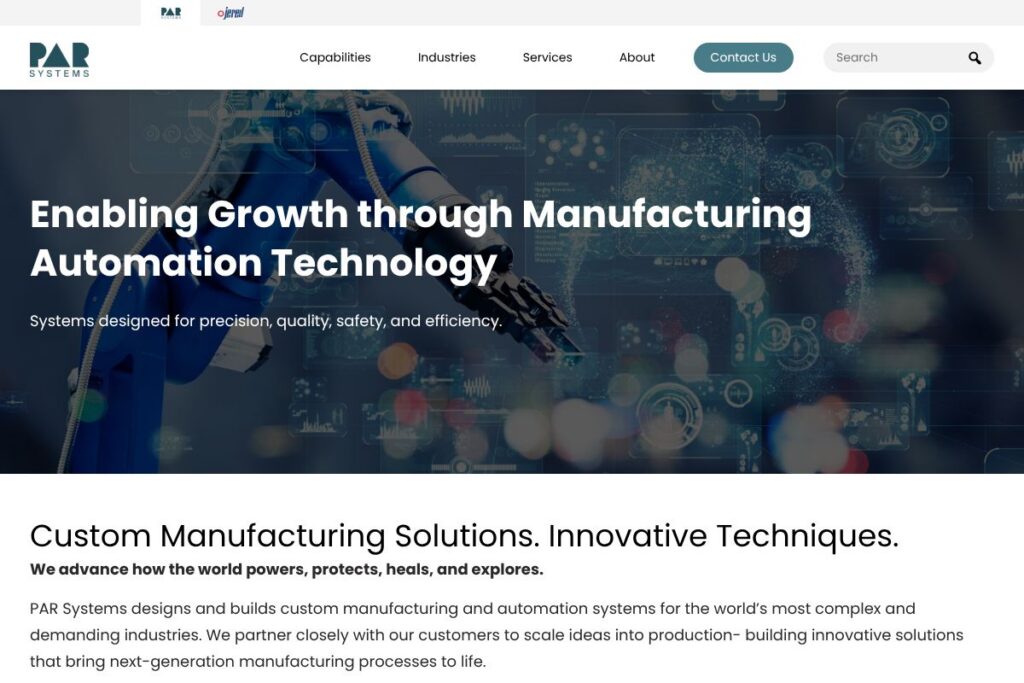
PAR Systems: An Overview
PAR Systems builds custom automation and manufacturing systems for complex, high-reliability industries including life sciences, aerospace, nuclear, semiconductor, and electric vehicles. The company focuses on end-to-end delivery from concept and engineering through fabrication, controls integration, installation, and lifecycle support, allowing customers to move specialized processes into production with predictable results.
Compared with general robotics and automation vendors such as ABB, KUKA, and Rockwell Automation, PAR Systems emphasizes bespoke system design and heavy mechanical integration rather than selling off-the-shelf robot cells or PLC packages. Where ABB and KUKA supply industrial robots and ecosystem components, PAR assembles multi-technology solutions around specific production challenges. Compared to Rockwell Automation, which is strong on controls and industrial software, PAR combines controls expertise with large-scale mechanical systems and specialized cranes for outage-critical or hazardous environments.
PAR Systems does particularly well when projects require deep application engineering, tight integration of mechanical and control systems, and long-term service commitments. This makes PAR a practical choice for manufacturers that need bespoke automation and qualified deliveries for regulated or safety-sensitive operations, rather than standard robot deployments or preconfigured conveyor lines. Explore the PAR Systems homepage for examples of vertical solutions and case studies.
How PAR Systems Helps Manufacturers
PAR works as a full project partner, starting with application assessment and feasibility studies to define process requirements and production goals. Engineers develop concept designs, detailed mechanical and electrical engineering packages, and factory acceptance testing plans so stakeholders can validate performance before site installation.
During build and integration PAR assembles mechanical structures, integrates robotics, lasers, welding stations, precision feeders, and control systems, and executes software commissioning to synchronize motion, vision, and inspection. After installation PAR provides onsite and remote support, spare parts programs, and retrofit services so systems remain productive through lifecycle changes and capacity increases.
PAR Systems features
PAR’s capabilities span custom mechanical design, advanced welding and joining technologies, precision small-parts handling, and heavy specialized cranes, supported by controls engineering and lifecycle services. Core strengths include friction stir welding, micro-precision handling, and fuel handling or outage-critical crane systems for nuclear power facilities.
The platform includes several powerful capabilities worth highlighting:
Custom System Design
PAR develops end-to-end manufacturing systems tailored to the process, not just individual modules. This includes mechanical fixtures, material flow, tooling, metrology, and quality controls designed around customer tolerances to ensure repeatable, automatable production.
Friction Stir Welding
PAR designs and builds friction stir welding machines that pair advanced FSW heads with custom tooling and motion systems for large or complex weld joints. Integrated advanced controls allow customers to exploit FSW benefits such as reduced distortion and improved joint properties while scaling the process to production volumes. Learn more about PAR’s friction stir welding capabilities on the PAR Systems homepage.
Small Parts Precision Handling
Systems for micro-assembly and small-part handling combine part feeding, laser processing or ablation, micro-welding, micro-dispensing, and inline inspection into tightly integrated cells. The result is higher yield and lower manual intervention for medical devices, sensors, and precision electronic assemblies.
Specialized Crane Systems
PAR engineers and manufactures specialty cranes for applications that require unique reach, payload, or contamination controls, including fuel handling cranes for power plants and cranes used in launch vehicle assembly. These cranes are designed and tested for mission-critical operations in demanding environments.
Advanced Control and Integration
Control systems integrate PLCs, motion controllers, robot controllers, vision systems, and inspection tools into deterministic, traceable production workflows. PAR teams design HMI and data flows to connect with MES or ERP systems so production data and quality records are available for downstream analytics.
Lifecycle Support and Services
PAR offers commissioning, validation support for regulated industries, preventative maintenance programs, spare parts kits, and retrofit services to extend system life and adapt to evolving product requirements. Onsite and remote support options help minimize downtime and maintain throughput.
With these capabilities PAR’s biggest benefit is delivering production-ready systems that combine mechanical scale, process expertise, and controls integration, reducing the risk of moving a complex process from prototyping into regular manufacturing.
PAR Systems pricing
PAR Systems follows a project-based, enterprise pricing model that scales with system complexity, scope, and regulatory requirements. Pricing is tailored to each engagement, reflecting factors such as tooling, controls, custom fixtures, materials handling, integration effort, and long-term support commitments.
Project-based pricing
Custom projects: Pricing is determined per project and can range widely depending on system size, automation level, and required certifications; PAR has executed projects historically from $100,000 to $50 million+ reflecting small automation cells up to complete production lines and large specialty cranes. For a detailed estimate and scope-based pricing, contact PAR via their contact page to request a consultation.
Enterprise engagements
Enterprise services: Large programs typically include engineering, prototype builds, factory acceptance testing, installation, validation support, and multi-year service agreements that are priced by negotiated contract. Prospective customers should request proposals to compare timelines, deliverables, and support options on a per-project basis.
What is PAR Systems Used For?
PAR Systems is used to design and build manufacturing lines and automation equipment where off-the-shelf solutions do not meet performance, safety, or regulatory needs. Typical uses include medical device assembly cells, precision laser processing for electronics, large-structure friction stir welding, and outage-critical crane systems for power plants.
The tool is ideal for OEMs and contract manufacturers that require highly engineered solutions, such as life sciences companies needing validated, high-yield assembly processes; aerospace firms requiring unique tooling and traceability; and utilities or defense contractors that need specialized cranes or material handling in constrained or hazardous environments.
Pros and Cons of PAR Systems
Pros
- Deep industry experience: With more than 65 years of project execution and over 8,000 systems delivered across 30+ countries, PAR brings proven engineering processes and field-tested designs that reduce deployment risk.
- Full system integration expertise: PAR combines mechanical, controls, robotics, and inspection into turnkey solutions, which reduces the ambiguity and integration overhead that customers face when coordinating multiple vendors.
- Strong support and lifecycle services: The company provides onsite and remote support, retrofit services, and maintenance programs that help preserve uptime and adapt systems as products evolve.
Cons
- Project lead times and capital intensity: Custom system design and fabrication typically require longer lead times and higher up-front capital than modular, off-the-shelf equipment, which can be a drawback for organizations needing rapid, low-cost pilots.
- Limited off-the-shelf scalability: For customers whose needs fit standard robot cells or packaged automation platforms, PAR’s bespoke approach may be more complex and expensive than preconfigured alternatives.
Does PAR Systems Offer a Free Trial?
PAR Systems does not offer a free trial; engagements start with paid engineering studies or project proposals. Prospective customers can request feasibility studies, pilot builds, or factory acceptance demonstrations to validate concepts before full-scale production commitments, and detailed proposals are available through the PAR Systems contact page.
PAR Systems API and Integrations
PAR provides controls integration and system-to-enterprise connectivity using industry-standard protocols and interfaces. Integrations commonly include MES and ERP connections, OPC UA, Ethernet/IP, Profinet, and custom APIs to exchange production, quality, and traceability data with plant systems.
The company’s controls groups prepare system HMI and data exchange specifications during engineering; for developer-level information or integration planning contact PAR or reference their systems integration resources on the PAR Systems homepage.
10 PAR Systems alternatives
Paid alternatives to PAR Systems
- Rockwell Automation — Offers industrial controls, software, and system integration services focused on controls and process automation for manufacturing sites worldwide.
- Siemens — Provides automation hardware, industrial software, drives, and digitalization platforms with strong offerings for large-scale manufacturing and process industries.
- ABB — Supplies industrial robots, automation components, and integrated manufacturing solutions with global service networks for robotics-centric automation.
- KUKA — Specializes in robotic arms and automated production cells, with system integrator partners for custom applications.
- Fanuc — Industrial robots and CNC systems with broad adoption in machining and assembly automation.
- Schneider Electric — Automation and energy management systems with integrated controls and digital services for manufacturing operations.
- Bosch Rexroth — Motion control, hydraulics, and mechatronics solutions for bespoke machinery and assembly systems.
Open source alternatives to PAR Systems
- ROS-Industrial — An open-source project extending the Robot Operating System for industrial applications, useful for custom robotic integration work.
- OpenPLC — An open-source programmable logic controller runtime and development environment for low-cost automation proofs of concept and educational projects.
- LinuxCNC — Open-source motion control software for CNC machines and custom motion applications.
- OpenPnP — Open-source pick-and-place software and community designs used by labs and small manufacturers building custom assembly cells.
Frequently asked questions about PAR Systems
What industries does PAR Systems serve?
PAR Systems serves life sciences, aerospace, nuclear, semiconductor, EV, marine, and specialty industrial markets. Their projects often target industries with strict quality, safety, or regulatory requirements that benefit from bespoke automation.
Does PAR Systems provide friction stir welding systems?
Yes, PAR Systems designs and builds friction stir welding equipment. Their FSW solutions combine advanced welding heads with motion control and tooling for large, complex welds used in aerospace, defense, and transportation applications.
How much do PAR Systems projects typically cost?
PAR Systems projects are priced per engagement and historically range from around $100,000 to over $50 million depending on complexity and scope. Final pricing depends on system size, required certifications, tooling, and long-term service agreements.
Can PAR Systems integrate with existing factory systems like MES or ERP?
Yes, PAR integrates controls with MES and ERP systems using standard industrial protocols and custom APIs. Their controls engineering team defines data exchange and HMI requirements during project design to enable traceability and production reporting.
Does PAR Systems offer service and support after installation?
Yes, PAR offers onsite and remote support, preventative maintenance programs, and retrofit services. Customers can choose multi-year service agreements and spare parts programs to maintain uptime and accommodate product changes.
Final verdict: PAR Systems
PAR Systems is a strong choice for organizations that need highly engineered, production-ready automation rather than modular or boxed solutions. The company combines mechanical fabrication, controls integration, and domain experience to deliver systems for regulated and mission-critical industries, and it supports projects through commissioning and long-term service.
Compared with a large controls vendor such as Rockwell Automation, PAR focuses more on end-to-end system delivery including heavy mechanical integration and specialized crane systems, while Rockwell emphasizes controls platforms, software, and distributed automation components. Pricing at PAR is project-based and scales with scope, as reflected by historical project sizes from $100,000 to $50 million+, which contrasts with component-based purchasing models from controls vendors where individual items or software licenses are priced separately.
For manufacturers with unique production challenges, stringent quality or safety requirements, and the need for a single accountable integrator, PAR Systems offers the engineering depth and lifecycle support to move complex processes into reliable production. Contact PAR through their contact page to start a feasibility discussion and request a proposal.