Silverware: An Overview
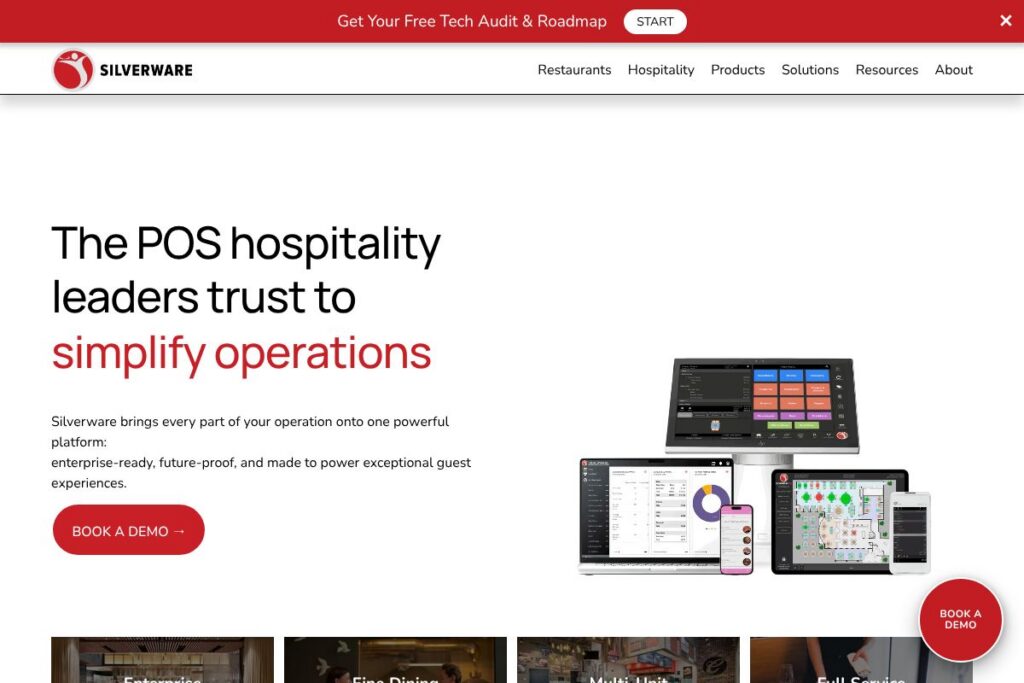
Silverware is a cloud-enabled POS and hospitality management platform built for multi-location restaurants, hotels, and large venues. It combines front-of-house ordering, payments, kitchen display, CRM and loyalty, self-service kiosks, and analytics into one modular system that can scale from a single site to enterprise rollouts.
Compared with Toast, which emphasizes integrated payments and a broad app marketplace, Silverware focuses on modular enterprise deployments and integrations with property management systems for hotels. Against Square for Restaurants, Silverware targets larger hospitality operations and multi-venue brands rather than small independent restaurants, offering broader venue and staff management tools. Compared with legacy systems such as Oracle MICROS, Silverware provides a modern hybrid-cloud architecture, faster deployment options, and built-in mobile and self-service features.
All of this makes Silverware particularly well suited for hotel restaurant operators, multi-concept groups, and venues that need unified control across locations, deep PMS and loyalty integrations, and white-glove implementation support. Its strengths are enterprise-grade controls, flexible deployment, and tools focused on improving guest experience and operational throughput.
How Silverware Helps Hospitality Teams
Silverware runs as a hybrid-cloud POS where local terminals handle transactions and sync to a centralized cloud for reporting, menu management, and guest profiles. Deployments typically include preconfigured terminals, mobile ordering apps for staff, and cloud services for analytics and centralized control.
Typical workflows start with front-of-house teams using tableside ordering or QR-driven guest ordering, route orders to the kitchen via the Kitchen Display System, and record guest interactions into a centralized guest profile. Corporate teams use the same platform to push menu changes, manage staff permissions, and analyze performance across locations. For hotels, Silverware integrates with property management systems to surface room charges, guest preferences, and in-room dining workflows.
What does Silverware do?
Silverware’s platform centers on POS operations tied to guest experience and enterprise control. Core capabilities include an enterprise POS, mobile ordering and payments, a kitchen display system called Annoncer, CRM and loyalty tools, self-serve kiosks, online ordering, and a dashboard for real-time analytics. The platform also offers Device as a Service for hardware, white-glove implementations, and 24/7 technical support.
What Makes Silverware Stand Out
Point of Sale
The POS is designed for speed and reliability across high-volume service periods, with role-based screens, fast modifiers, quick payment flows, and offline transaction handling. It supports multi-station setups and centralized menu management so operations can keep running during network interruptions.
Scan & Pay
QR-based check settlement enables guests to pay without downloading an app, reducing queue time and exposure for staff while preserving the ability to collect guest data and receipts. This improves table turnover and can be integrated into loyalty programs to recognize returning guests.
Online Ordering
Silverware offers direct online ordering that routes orders to in-house operations, reducing reliance on third-party marketplaces and preserving margins. The system keeps brand control and can sync online menu items and modifiers with in-venue menus.
Guest X (Guest Experience)
Real-time guest profiles aggregate preferences, allergies, and order history so staff can personalize service and identify upsell opportunities. Automated prompts for feedback and tailored offers help improve repeat visits and guest satisfaction.
Mobile Technology
Staff can take orders, manage tabs, and accept payments from anywhere on the floor with a dedicated app that syncs to the central system. Mobile ordering speeds service, reduces errors, and supports split checks or table merges on the fly.
Payments and Processing
Silverware includes a built-in payment solution designed for secure, efficient processing with end-to-end encryption and PCI-compliant architecture. The platform supports multiple payment methods, EMV, and contactless options to reduce friction at checkout.
Heartbeat Dashboard
Real-time analytics show sales, covers, labor metrics, and menu performance from a centralized dashboard so managers can make faster operational decisions. Reports can be segmented by location, shift, or menu category for targeted analysis.
Self-Serve Kiosks
Kiosks provide a guest-facing ordering option that speeds service and increases average check through suggested items and upsell flows. The kiosk UI is designed for quick navigation and integrates orders directly into the kitchen workflow.
CRM & Loyalty
Customer relationship tools capture guest data, enable targeted campaigns, and issue automated rewards based on visit frequency or spend. This supports retention strategies and ties promotions back to measurable revenue outcomes.
Kitchen Display System (Annoncer)
Annoncer prioritizes and organizes incoming orders, shows prep times and modifiers, and supports routing between kitchen stations to improve throughput and reduce ticket times. It is built to integrate with the POS to ensure accurate order states and timing.
With these capabilities, Silverware aims to reduce operational friction, centralize data for enterprise teams, and deliver faster, more personalized guest experiences.
Silverware pricing
Silverware follows an enterprise-style pricing model, with custom pricing and implementation packages tailored to venue size, number of locations, hardware needs, and integration requirements. Contacting Silverware for a tailored quote is the standard path for most businesses evaluating the platform.
For details on commercial options and to discuss deployment, reach out via Silverware’s contact channels or request a demo through the official contact page. If you need hardware financing or a Device as a Service plan, inquire about those options during the sales process to get terms that match your rollout schedule.
What is Silverware used for?
Silverware is used to manage front-of-house sales and payments, kitchen operations, guest profiles, and loyalty programs across single-site restaurants, hotel outlets, and multi-location groups. Operators use it to unify online ordering, manage menus centrally, and maintain consistent guest experiences across venues.
It is especially useful for hotel restaurants and venue groups that need PMS connectivity, centralized reporting, and enterprise controls such as role-based permissions, remote menu updates, and coordinated loyalty campaigns. The system is also deployed where rapid checkout, mobile ordering, and kiosk options are important to throughput and guest satisfaction.
Pros
- Enterprise-grade control: Centralized menu management, role-based permissions, and cross-location syncing make multi-site rollouts easier to manage and maintain. This helps chains and hotel groups reduce the workload of local teams and maintain consistent standards.
- Guest-centric features: Real-time guest profiles, QR checkouts, and integrated loyalty tools enable personalized service and targeted marketing that can improve repeat business and average check. These features link operational data to guest behavior for practical follow-up actions.
- White-glove implementation and support: The combination of preprogrammed terminals, onboarding services, and 24/7 technical support reduces rollout friction and shortens training time for staff. Dedicated success managers help align deployments to business goals.
- Flexible hardware and DaaS: Device as a Service provides enterprise-grade POS hardware with predictable monthly costs, reducing upfront capital expenditure and simplifying hardware lifecycle management.
Cons
- Custom pricing model: Enterprise-focused, custom pricing means there is no transparent list price for small operators evaluating cost quickly, which can slow initial evaluation for independents. Discussions with sales are generally required to understand total cost of ownership.
- Implementation scope: White-glove implementations are valuable but can require longer lead times and coordination; smaller restaurants seeking immediate out-of-the-box deployment may find the process more involved. Planning and professional services are often part of larger rollouts.
- Platform complexity for small venues: The depth of features and enterprise controls can be more than smaller single-site restaurants need, potentially adding complexity where simpler POS solutions might suffice.
Does Silverware Offer a Free Trial?
Silverware provides enterprise licensing and tailored demonstrations rather than a public free plan or self-serve trial. Prospective customers can request a live demo, pilot program, or proof-of-concept and discuss white-glove onboarding, implementation timelines, and trial arrangements through the official contact page.
Silverware API and Integrations
Silverware offers a range of integrations for PMS, loyalty platforms, accounting, payroll, and delivery partners, and it supports API-based connections for custom workflows. Explore the platform’s integration options and partners in the integrations directory.
Developers and partners can extend functionality using available developer resources and integration guides; contact Silverware for access to API documentation and developer support to ensure secure, supported connections to your tech stack.
10 Silverware alternatives
Paid alternatives to Silverware
- Toast — A widely used restaurant POS with integrated payments, online ordering, and a large app marketplace designed for U.S.-centric operations and multi-location scaling.
- Square for Restaurants — A flexible POS that is easy to deploy and cost-effective for small to mid-size restaurants, with built-in payments and simple reporting.
- TouchBistro — A tableside-focused POS with strong restaurant workflow features, offline mode, and integrated payments tailored to independent restaurants.
- Oracle MICROS — An enterprise legacy POS often used by large hotels and chain restaurants, known for extensive functionality and integrations in hospitality ecosystems.
- Lightspeed — Cloud POS that supports restaurants, retail, and multi-location brands with inventory and reporting features and an app ecosystem.
- Clover — A modular POS platform with a wide hardware selection and app market, often chosen by small to medium operations seeking fast setup.
- Revel Systems — A hybrid-cloud POS with strong reporting, inventory, and hardware options for multi-location and quick-service restaurants.
Open source alternatives to Silverware
- Odoo POS — Part of the broader Odoo ERP suite, offering an open approach to POS and inventory with self-hosting and modular apps.
- uniCenta — A flexible, open-source POS that supports multiple terminals and receipt printers and can be customized for specific workflows.
- Floreant POS — Community-driven restaurant POS with core ordering and ticketing features suitable for smaller operations and customization.
- Chromis POS — A fork of Floreant with additional features and community support for hardware integration and kitchen printing.
Frequently asked questions about Silverware
What is Silverware used for?
Silverware is used for restaurant and hotel point-of-sale, guest management, kitchen display, and centralized reporting. Operators deploy it to handle ordering, payments, guest profiles, loyalty, and analytics across one or more locations.
Does Silverware integrate with property management systems?
Yes, Silverware integrates with PMS platforms to connect room charges, guest profiles, and reservation data. This helps hotels keep billing consistent and deliver personalized in-room dining and restaurant service.
Can Silverware process contactless and mobile payments?
Yes, Silverware supports EMV, contactless, and QR-based Scan & Pay options. The platform includes a built-in processing solution with end-to-end encryption and PCI-compliant architecture.
How does Silverware handle multi-location management?
Silverware centralizes menu management, permissions, and reporting across locations from a single cloud dashboard. Corporate teams can push updates, view performance, and manage staff roles without visiting each site.
Is Silverware suitable for large-scale enterprise rollouts?
Yes, Silverware is designed for enterprise deployments with white-glove onboarding, Device as a Service options, and 24/7 technical support. Its modular architecture supports scaling across brands and venues while maintaining centralized control.
Final Verdict: Silverware
Silverware is a robust, enterprise-focused POS and hospitality platform that brings POS, payments, guest data, kitchen operations, and analytics onto a single system designed for multi-site and hotel environments. Its strongest points are comprehensive guest profiles, hotel PMS connectivity, white-glove implementation services, and hardware lifecycle options through Device as a Service, which together reduce administrative overhead for large operators.
Compared with Toast, which offers clearer public pricing and a large app ecosystem aimed at U.S. restaurants, Silverware prioritizes modular enterprise deployments and deeper hotel and venue integrations with a custom pricing approach. For brands that need centralized control across many locations and close PMS or loyalty integration, Silverware typically provides a better fit; for smaller restaurants seeking transparent, out-of-the-box pricing and rapid self-serve setup, Square for Restaurants or Toast may be simpler choices.
Overall, Silverware is a strong option for hospitality operators who require enterprise capabilities, tailored onboarding, and a single platform to manage guest experience and operational data at scale. To evaluate fit and commercial terms, request a demo or speak with their team through the official contact page.