What is Orioly
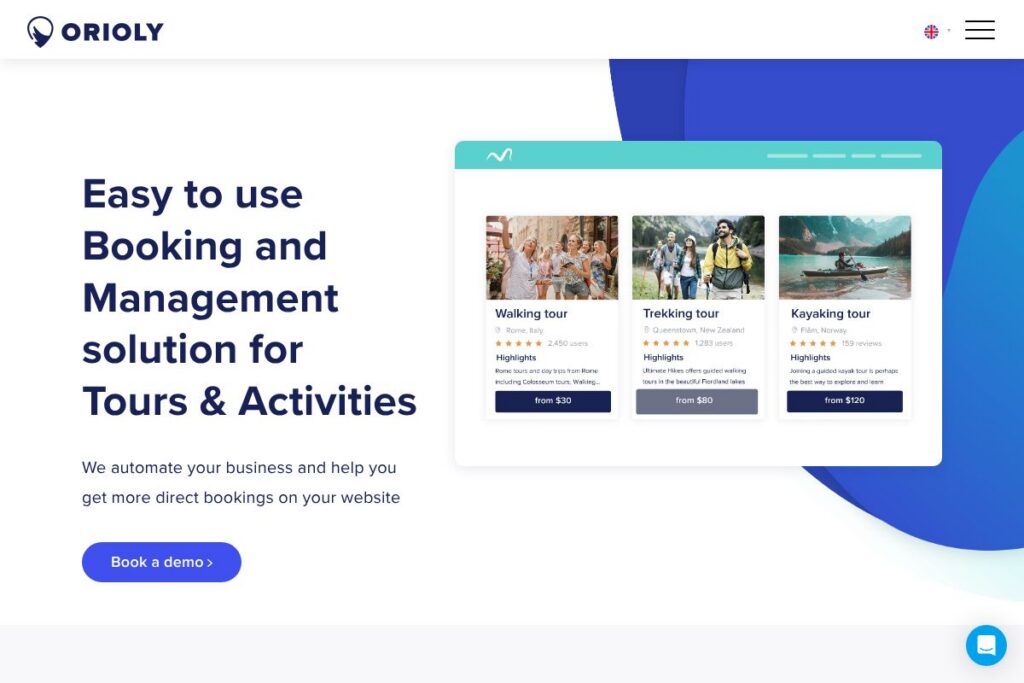
Orioly is a booking and management solution designed for tour operators, activity providers, and small-to-medium travel businesses. It combines an embeddable booking engine for direct website sales with back-office tools for scheduling, resource management, automated customer communications, and basic accounting workflows.
Compared with competitors, Orioly positions itself around direct bookings and operational automation. FareHarbor focuses heavily on enterprise-level channel distribution and marketplace integration, making it a strong choice for operators who need broad reseller reach. Rezdy emphasizes channel management and third-party distribution partners, while Peek Pro targets streamlined customer-facing booking flows and marketplace listings.
All of this makes Orioly well suited to operators who want to reduce manual tasks and grow direct revenue from their own site. It does particularly well at combining a lightweight channel manager, automated emails and vouchers, and analytics into a single interface that fits small and growing tour companies.
How Orioly Works
The platform runs as a cloud-based SaaS product that you access through a web dashboard and optional booking widget embedded on your website. Booking flows capture customer details and payments, generate vouchers and invoices automatically, and update availability in the internal resource calendar.
On the operations side, Orioly routes bookings to your resource manager so guides, vehicles, and seats are allocated automatically. Automated emails and SMS messages are triggered for confirmations, pre-trip instructions, and post-trip follow-ups, reducing manual communication work. For distribution, Orioly syncs with selected channel partners and supports manual imports for offline bookings.
Orioly features
Orioly groups core capabilities around bookings, operations, and analytics. Core features include a website booking widget, resource and schedule management, automated customer communications, voucher and invoice generation, and reporting tools. The product continues to expand management tools aimed at improving daily operations and increasing direct bookings.
Booking engine and website widget
The booking engine embeds on your website to capture direct reservations with customizable booking forms, availability calendars, and optional add-ons. This reduces reliance on third-party marketplaces and keeps conversion data on your property, which helps improve marketing ROI and customer retention.
Resource manager and scheduling
A centralized calendar and resource allocation tool lets you assign guides, vehicles, and equipment to bookings and block availability for maintenance or private events. This helps operators avoid double-bookings and manage capacity across multiple activities or locations.
Channel management and distribution
Orioly offers connections to a limited set of distribution channels and supports manual imports from third-party booking sources, helping maintain consistent availability across partners. The channel features are designed for smaller operators who need basic distribution without full enterprise complexity.
Automation for emails, vouchers, and invoices
Automated templates deliver confirmations, vouchers, and invoices to customers based on booking triggers, which reduces repetitive administrative tasks. Templates are customizable so operators can include pre-trip instructions, waiver links, or upsell offers automatically.
Payments and deposit handling
Built-in payment handling supports deposits and full payments at booking, and integrates with common payment gateways for card processing. The system tracks payment status, pending balances, and can generate receipts for accounting reconciliation.
Reporting and analytics
A set of reporting tools aggregates bookings, revenue, and occupancy metrics to help operators monitor performance and spot trends. These analytics feed into planning decisions like staffing, marketing focus, and schedule adjustments.
The biggest benefit of Orioly is that it ties front-end booking to back-office operations in one place, which simplifies daily workflows and reduces time spent on manual confirmations and scheduling.
Orioly pricing
Orioly uses a subscription pricing model tailored to tour and activity businesses of different sizes, with tiers adjusted by feature set and business needs. For current plan details or custom quotes, check Orioly’s homepage for the most up-to-date pricing and package options.
What is Orioly Used For?
Orioly is commonly used to accept direct bookings from a business website, manage daily schedules, and automate customer communications for tours, activities, and experiences. Operators rely on it to centralize reservations that would otherwise be split across spreadsheets, email, and multiple marketplaces.
It is also used for capacity planning and resource allocation, where guides, equipment, and transport must be assigned reliably to each booking. Small tour operators and local activity providers benefit most from its combination of booking automation and lightweight analytics.
Pros and Cons of Orioly
Pros
- Booking widget that increases direct sales: The embeddable booking engine captures reservations on your own site, which can reduce marketplace fees and improve conversion tracking.
- Operational automation: Automated emails, vouchers, and invoice generation cut down daily administrative work and help maintain consistent customer communications.
- Resource and schedule management: Built-in resource allocation reduces double-bookings and simplifies assigning staff and equipment to services.
- Simplified reporting: Aggregated booking and revenue reports make it easier to spot trends and plan staffing or marketing efforts.
Cons
- Limited enterprise distribution features: The channel management capabilities are less extensive than some enterprise platforms, which may be a drawback for operators relying heavily on third-party resellers.
- Customization limits for complex operations: Very large or highly customized operators may find the platform less flexible than fully bespoke or enterprise-grade systems.
- Public pricing not centralized: Pricing detail is tailored and often requires contacting sales for exact costs, which can slow initial evaluation.
Does Orioly Offer a Free Trial?
Orioly offers a free trial for new users so operators can test the booking engine, resource manager, and automation features before committing to a paid subscription; sign-up and trial details are available from Orioly’s homepage.
Orioly API and Integrations
Orioly provides API access and documentation for developers to automate workflows and exchange booking data with external systems; see the Orioly API documentation for endpoint details and usage examples. Integrations typically include payment gateways such as Stripe and PayPal, calendar sync, and automation platforms like Zapier to connect with CRM and accounting tools.
10 Orioly alternatives
Paid alternatives to Orioly
- FareHarbor — A mature bookings and operations platform aimed at larger operators and marketplace distribution with advanced channel features.
- Rezdy — Focuses on channel management and reseller distribution for tour operators and wholesalers.
- Peek Pro — Provides customer-facing booking flows and marketplace exposure alongside operator management tools.
- TrekkSoft — Offers booking, POS, and distribution capabilities designed for tour operators with multi-location needs.
- Checkfront — A bookings and reservation system with strong website integration and add-ons for accommodation and activities.
- Xola — Combines booking management with marketing and distribution tools targeted at tour operators.
- Regiondo — A bookings platform built for attractions and activities with marketplace options and a booking widget.
Open source alternatives to Orioly
- Booked (phpScheduleIt) — An open source scheduling system that can be adapted for simple booking needs and resource scheduling.
- Solidres — A reservation solution originally for hospitality that can be extended for activities through plugins and customizations.
- QloApps — An open-source hotel booking system that can be adapted for experiences and custom booking flows.
Frequently asked questions about Orioly
What is Orioly used for?
Orioly is used for booking management and operations for tours and activities. Operators use it to accept direct bookings, manage resources, and automate customer communications.
Does Orioly have an API?
Yes, Orioly provides API access for developers. The Orioly API documentation outlines endpoints for booking creation, resource management, and reporting integration.
Does Orioly integrate with payment gateways?
Yes, Orioly integrates with common payment gateways such as Stripe and PayPal. These integrations support deposits, full payments, and receipt generation for accounting reconciliation.
How much does Orioly cost?
Orioly uses subscription pricing tailored to business size and needs. For current plan options and custom quotes, consult Orioly’s homepage to view available packages and contact sales.
Can Orioly handle multiple languages and currencies?
Orioly supports multi-currency and has options to localize booking flows. These features help operators sell to international customers and present prices in local currency.
Final verdict: Orioly
Orioly is a practical booking and operations tool for tour and activity operators that need a focused solution for direct bookings, resource allocation, and automated customer workflows. It reduces manual admin work with automated vouchers, invoices, and email templates, and its embeddable booking engine helps grow direct web sales.
Compared with Rezdy, Orioly is stronger on lightweight operational automation and direct booking workflows, while Rezdy places more emphasis on channel distribution and reseller networks. Pricing for Orioly is provided via tailored subscription tiers; operators who prioritize simple direct-booking growth and day-to-day efficiency will find Orioly to be a good fit. For distribution-heavy businesses, consider comparing feature sets and distribution fees before deciding.
For more details and to test features, visit Orioly’s homepage or review the Orioly API documentation to see how it would integrate into your operations.