What is Amplitude
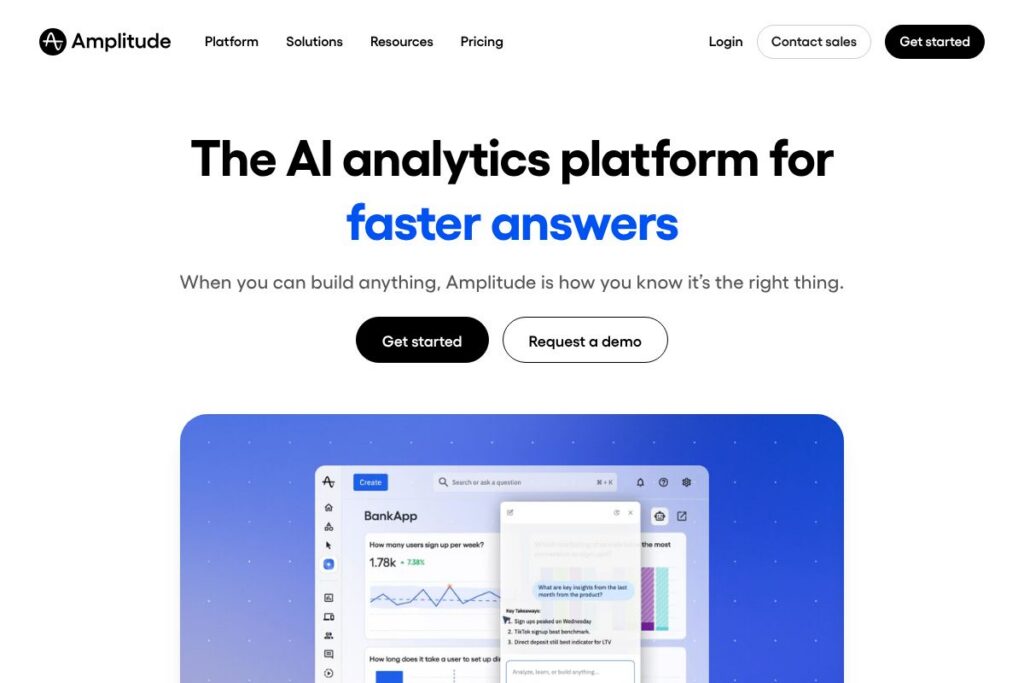
Amplitude is a product analytics platform built to help teams understand how users interact with digital products and to validate product decisions with experiments. It combines event-based analytics, session replay, and experimentation tools so teams can trace feature changes to measurable outcomes.
Amplitude sits in the same category as other product analytics platforms but focuses on scale and experimentation. Compared with Mixpanel, Amplitude emphasizes built-in experimentation and enterprise governance, while Heap highlights automatic event capture and Pendo focuses on in-app guidance and product engagement. Teams choosing Amplitude typically value a unified analytics and experimentation solution that connects user behavior to retention and revenue metrics.
All of this makes Amplitude particularly well suited for product teams at growth-stage and enterprise companies that need to run many controlled tests, manage data governance, and share metrics across teams with a single platform.
How Amplitude Works
Amplitude collects event-level data from web and mobile apps using SDKs and server-side APIs, then organizes that data into user journeys, funnels, cohorts, and retention charts. Analysts and product managers can define events, build charts, and create cohorts without engineering changes, using a self-serve interface for exploration and visualization.
For experimentation, Amplitude links feature flags and experiments to analytics outcomes so teams can analyze lift, segment results, and determine statistical significance. Practical workflows often include instrumenting events, creating a hypothesis, launching an experiment, and monitoring experiment dashboards to decide on rollouts.
What does Amplitude do?
Amplitude’s platform centers on product analytics and experimentation, with complementary capabilities for session replay, surveys, and data governance. Core tools help teams answer why users behave a certain way, test changes, and measure business impact across channels.
Product Analytics
Event-based analysis lets teams track user flows, funnels, and retention to find drop-off points and feature adoption patterns. These insights help product managers prioritize work based on behavioral signals and revenue impact.
Web Analytics
Amplitude provides web-focused metrics and reporting that integrate with event data to measure conversions, page performance, and cross-platform journeys. It supports real-time and historical queries for CRO and growth teams.
Session Replay
Session replay pairs behavioral events with recorded user sessions to reproduce issues and understand context behind user actions. This feature helps product and support teams troubleshoot UX problems faster.
Feature Experimentation
Built-in experimentation connects feature flags and cohorts to outcome metrics so teams can run A/B tests and feature rollouts with statistical analysis. Experimentation results are linked to product metrics to measure lift and unintended side effects.
Web Experimentation
Web-specific testing tools facilitate client-side experiments and personalization for landing pages and funnels. Teams can target segments and measure impact on conversion and engagement metrics.
Guides and Surveys
In-app guides and surveys let teams collect qualitative feedback and onboard users while tying responses to behavioral events. Combining feedback with usage data improves product prioritization and user research.
Data Governance
Governance controls include schema management, event validation, and access controls that help maintain data quality as analytics scale across teams. These controls reduce tagging drift and ensure consistent metrics.
Integrations
Amplitude connects to data warehouses, customer data platforms, and marketing stacks to enable downstream analytics and activation. Common integrations include data pipelines to BigQuery or Snowflake and connectors for CDPs and BI tools.
With these features, Amplitude helps teams move from exploration to validated launches faster by linking behavioral data to experimentation and delivery workflows.
Amplitude pricing
Amplitude uses a subscription pricing model with options for free usage and tiered paid plans, plus enterprise agreements for large organizations; specific plan details and quotes are provided by the vendor. For current plan descriptions, terms, and custom enterprise options visit Amplitude’s pricing and plan information on their site.
What is Amplitude used for?
Product teams use Amplitude to analyze user behavior, identify friction points, quantify feature impact, and prioritize roadmaps based on observed user journeys. Marketing and growth teams use it to measure funnel performance, attribute campaigns to user outcomes, and segment audiences for targeted experiments.
Engineering and data teams use Amplitude to validate instrumentation, push events to data warehouses, and support reproducible analytics through governance. The platform suits companies that need a single source of truth tying experimentation to product metrics and business KPIs.
Pros and cons of Amplitude
Pros
- Unified analytics and experimentation platform: Combines event-based analytics, A/B testing, session replay, and in-app feedback in one product which reduces the need for point solutions and simplifies cross-team collaboration.
- Depth of behavioral insights: Advanced cohorting, retention, and funnel tools let teams dig into user journeys and identify causal patterns behind metrics for more informed product decisions.
- Enterprise-grade governance: Schema controls, access management, and data pipelines support scale and consistency across large organizations which reduces tagging errors and metric divergence.
Cons
- Learning curve for power users: The platform offers many capabilities which can require time and onboarding for non-technical users to use advanced analysis and experiment setups effectively.
- Integration and implementation effort: Robust implementations that feed clean event data into Amplitude often require engineering coordination and time which can slow initial value capture.
Does Amplitude Offer a Free Trial?
Amplitude offers a free plan with limited usage and paid plans for expanded needs. The free tier provides basic analytics capabilities suitable for evaluation and small projects, while paid and enterprise plans unlock larger event volumes, advanced experimentation, and governance features. For signup options and plan comparisons see Amplitude’s signup and plan information.
Amplitude API and Integrations
Amplitude provides developer APIs and SDKs for web, mobile, and server environments; the documentation details event ingestion, user identification, and export APIs in depth. See Amplitude’s developer documentation for API endpoints and SDK guides.
The platform includes integrations with data warehouses and ETL tools, customer data platforms, messaging systems, and collaboration tools. Typical integrations include connectors to BigQuery, Snowflake, Segment, and alerting or collaboration tools used by product teams.
10 Amplitude alternatives
Paid alternatives to Amplitude
- Mixpanel — Product analytics focused on event-based insights and user funnels, often chosen by growth teams for quick setup and pricing suited to startups.
- Heap — Automatic event capture with retroactive analysis which reduces upfront instrumentation needs for teams that want immediate insights.
- Pendo — Combines product analytics with in-app guidance and onboarding, focusing on product-led growth and user engagement features.
- Adobe Analytics — Enterprise web and marketing analytics with deep customization and strong integration across the Adobe Experience Cloud.
- Google Analytics 4 — Free to start for web analytics with event-based models that integrate with Google Ads and other marketing tools.
- FullStory — Session replay and qualitative analytics that emphasize user experience diagnostics and conversion optimization.
- Hotjar — Simpler session replay and survey tooling for qualitative feedback and UX research.
Open source alternatives to Amplitude
- PostHog — Self-hosted product analytics and experimentation platform with feature flags and session replay for teams that prefer full control.
- Matomo — Privacy-focused web analytics that can be self-hosted and customized for compliance-sensitive environments.
- Snowplow — Event-level data pipeline for collecting and modeling behavioral data that teams can own and analyze in their data warehouse.
- Plausible Analytics — Lightweight, privacy-first web analytics suitable for simple traffic and referral tracking.
Frequently asked questions about Amplitude
What is Amplitude used for?
Amplitude is used for product analytics and experimentation. Teams analyze user behavior, run A/B tests, and measure retention and conversion to inform product decisions.
Does Amplitude offer a free plan?
Yes, Amplitude provides a free tier for basic analytics. The free plan supports initial evaluation and small projects while paid plans add higher event volumes and advanced features.
Can Amplitude run experiments and feature flags?
Yes, Amplitude includes built-in experimentation and feature flag capabilities. Experiment results are tied to analytics outcomes so teams can measure lift and segment performance.
Does Amplitude have an API for event ingestion and exports?
Yes, Amplitude provides SDKs and APIs for event ingestion and data export. Developers can instrument web, mobile, and server events and consult the developer documentation for integration examples.
How does Amplitude integrate with data warehouses?
Amplitude supports integrations and connectors to data warehouses. Teams commonly export event streams to destinations like BigQuery or Snowflake for advanced analysis or BI reporting.
Final verdict: Amplitude
Amplitude excels at linking detailed behavioral analytics with structured experimentation, which helps product teams validate hypotheses and measure impact on retention or revenue. Its governance features make it a strong choice for organizations that need consistent, auditable metrics across multiple teams.
Compared with Mixpanel, Amplitude leans more toward enterprise workflows and integrated experimentation, while Mixpanel can be faster to adopt for smaller teams. For organizations that require experiments tied directly to product metrics and want a consolidated analytics and experimentation stack, Amplitude is a compelling option.
For more details on plans, features, and implementation, explore Amplitude’s product pages and developer documentation to match the platform to your team’s needs.