What is FullStory
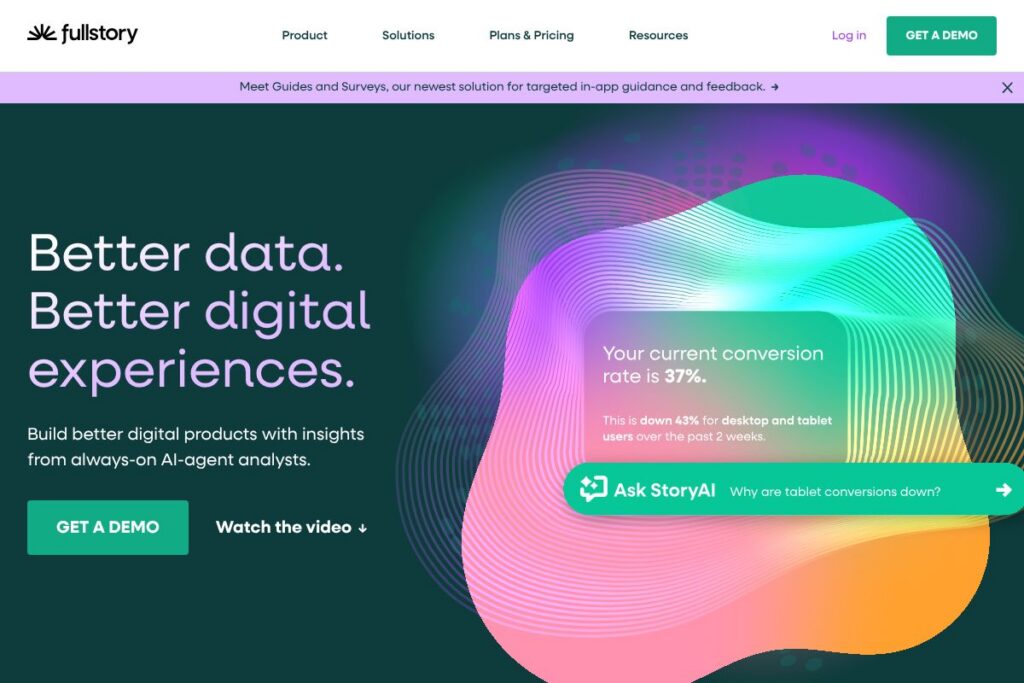
FullStory is a behavioral data platform that records user interactions and applies machine learning to surface patterns, sentiment, and friction points for product and experience teams. It captures a complete, privacy-aware session record so teams can replay user journeys, quantify issues, and validate changes against actual behavior.
FullStory sits between session replay tools and classic product analytics platforms by combining granular session data with analytics and activation features. Compared with Hotjar, which focuses on heatmaps and lightweight session replay, FullStory emphasizes scaled behavioral data and AI-driven insights. Against Mixpanel, FullStory provides richer qualitative context through session capture and in-product guidance rather than just event-based funnel analysis.
All of this makes FullStory particularly well suited for product managers, UX researchers, and digital analytics teams who need precise behavioral context to prioritize work and measure impact. Its strengths are complete interaction capture, AI-driven answers, and capabilities for in-product guidance and real-time activation.
How FullStory Works
FullStory installs a lightweight capture script that records interactions, DOM changes, clicks, and user flows in a privacy-first manner, producing a searchable session record called Fullcapture. Teams can replay sessions, filter by behavior, and correlate qualitative playback with quantitative metrics to diagnose issues faster.
StoryAI analyzes Fullcapture data to generate answers to business questions, highlight user sentiment, and identify patterns without manual event tagging. Product teams typically start with session replay to investigate a problem, use StoryAI to find common causes, and then deploy Guides and Surveys to validate fixes with in-product messaging.
Deployment workflows commonly include integrating FullStory with analytics and data warehouses, configuring privacy filters for sensitive fields, and enabling real-time activation through FullStory Anywhere to trigger personalization or automation based on live behavior.
FullStory features
FullStory centers on always-on behavioral capture, AI-driven insight, and tools to act on user behavior. Core capabilities combine session replay, behavioral analytics, automated insights via StoryAI, and in-product guidance through Guides and Surveys. Recent product emphasis highlights Fullcapture for privacy-first recording and StoryAI for behavior-based answers.
Let’s talk FullStory’s Features
Session Replay and Fullcapture
FullStory records complete interaction traces that let you replay user sessions at scale, including clicks, scrolls, inputs, and navigation paths. This provides direct context for bugs, UX friction, and conversion drop-offs, helping teams reproduce issues without lengthy back-and-forth with customers.
StoryAI
StoryAI turns behavioral data into concise answers and insights, reducing manual analysis time by automatically surfacing trends, anomalies, and sentiment tied to specific segments. It helps teams prioritize fixes by highlighting high-impact user behaviors and root causes.
Funnels and Conversion Analysis
FullStory builds funnels from captured interactions so you can quantify drop-off points and test hypotheses with real session examples. Combining funnel metrics with session detail speeds up A/B testing and optimization cycles.
Guides and Surveys
In-product Guides and Surveys let teams deliver contextual help, product tours, and NPS or custom feedback flows to users. These features enable rapid validation of design changes and collect qualitative feedback where it matters, inside the experience.
Real-time Activation (FullStory Anywhere)
FullStory Anywhere enables real-time triggers and activations based on live behavioral signals, so you can personalize experiences, route users to assistants, or fire backend automations when specific events occur. This closes the loop between insight and action.
Integrations and Data Export
FullStory integrates with analytics, tag managers, CDPs, and CRMs to sync behavioral context with downstream systems for funnel analysis, customer support, and data science work. It also offers export options and APIs to push event streams to warehouses for long-term analysis.
Privacy and Security Controls
FullStory emphasizes privacy with configurable masking, PII filters, and compliance controls to limit captured data and meet organizational requirements. These controls let teams capture useful context while respecting user privacy and regulatory constraints.
With these capabilities, FullStory helps teams move from anecdote to evidence by combining playback, automated analysis, and activation tools that shorten the feedback loop between users and product teams.
FullStory pricing
FullStory uses a subscription model with tiered and enterprise offerings, and pricing is typically tailored to an organization’s usage and feature needs rather than listed as a single public price. Plans scale based on session volume, features, and support level, with enterprise options for advanced security and integrations.
For specific plan comparisons, seat counts, or to request a quote, see FullStory’s contact and pricing details on the FullStory site at the FullStory contact page.
What is FullStory used for
FullStory is used for diagnosing UX issues, improving conversion funnels, and validating product changes with real user behavior. Product and design teams rely on its session replay and AI insights to prioritize work, fix bugs faster, and measure the impact of releases.
It is also used by support and customer success teams to understand user problems from a first-person perspective, and by analysts to combine behavioral data with product metrics for deeper funnel and retention analysis.
Pros and cons of FullStory
Pros
- Comprehensive session capture: FullStory’s Fullcapture provides granular replayable records of interactions, making it easier to reproduce and diagnose issues from real user sessions.
- AI-driven insights: StoryAI reduces time spent slicing data by automatically surfacing trends, sentiment, and likely root causes that matter to product decisions.
- In-product action and feedback: Guides and Surveys let teams collect contextual feedback and deploy in-app guidance without separate tooling, shortening validation cycles.
- Privacy-first controls: Configurable masking and PII filters enable large-scale capture while addressing compliance and data minimization needs.
Cons
- Enterprise pricing model: Pricing is typically custom and oriented toward teams with measurable usage, which can be a barrier for very small teams looking for transparent, low-cost tiers.
- Learning curve for advanced features: Extracting maximum value from StoryAI and real-time activation requires configuration and alignment with analytics workflows, which can take time for teams new to behavior-driven tooling.
Does FullStory Offer a Free Trial?
FullStory offers a free plan and trial options for paid tiers. The free tier provides basic session capture and replay so teams can evaluate core capabilities, while trials or demos for paid plans are available through FullStory’s sales team for testing advanced features and enterprise controls.
FullStory API and Integrations
FullStory provides developer APIs and SDKs for data export, event-level access, and integration with analytics pipelines; detailed developer guidance is available in the FullStory developer documentation. These APIs enable custom exports, event forwarding, and enrichment of behavioral data for internal systems.
Key native integrations include connectors for Slack, Segment, Google Analytics, Salesforce, and warehouse exports to platforms like Snowflake and BigQuery, allowing you to combine behavioral records with product metrics and customer data.
10 FullStory alternatives
Paid alternatives to FullStory
- Hotjar — A behavior analytics tool focused on heatmaps, session recordings, and surveys for qualitative UX research and lightweight feedback collection.
- Mixpanel — Event-based analytics that emphasizes product metrics, cohort analysis, and user journeys with a strong self-serve analytics focus.
- Amplitude — Product analytics for behavioral cohorting and retention analysis, with advanced behavioral queries and experimentation support.
- Contentsquare — A digital experience analytics platform that provides visualizations, zone-based heatmaps, and enterprise-scale behavioral insights.
- Heap — Auto-capture analytics that collects clicks and events without manual instrumentation and supports retroactive analysis.
- Crazy Egg — Heatmaps and session recordings aimed at conversion optimization and A/B testing insights.
Open source alternatives to FullStory
- PostHog — An open source product analytics and session recording platform that can be self-hosted, with event analytics and feature flags.
- Matomo — A privacy-focused analytics suite offering self-hosted options, event tracking, and user privacy controls.
- OpenReplay — An open source session replay tool that developers can self-host to capture and replay user interactions for debugging and UX analysis.
- Countly — An analytics platform offering an open source edition for product analytics and user behavior tracking.
Frequently asked questions about FullStory
What is FullStory used for?
FullStory is used to capture and analyze user behavior to diagnose UX issues, optimize funnels, and validate product changes. Teams use session replay, automated insights, and in-product guidance to reduce friction and improve conversion.
Does FullStory have an API for exporting data?
Yes, FullStory provides developer APIs and SDKs for data export and integration. See the FullStory developer documentation for endpoints, SDK guides, and export options.
Can FullStory help with privacy and compliance?
Yes, FullStory includes configurable masking and privacy controls to minimize PII capture. Those controls let teams tailor capture settings to meet privacy and regulatory requirements while retaining useful behavioral context.
How does FullStory’s StoryAI work?
StoryAI analyzes Fullcapture behavioral data to surface trends, anomalies, and sentiment automatically. It generates concise answers and recommended areas to investigate so product teams can act without extensive manual analysis.
Is FullStory suitable for small teams?
FullStory can be useful to small teams, especially through its free tier for basic session capture. For advanced analytics and enterprise controls, larger teams may prefer paid plans or enterprise arrangements tailored to their usage needs.
Final verdict: FullStory
FullStory excels at combining complete session capture with AI-driven interpretation to give teams both the qualitative detail and quantitative signals needed to improve digital experiences. Its strengths lie in Fullcapture, StoryAI, and the ability to act on insights via in-product guidance and real-time activation.
Compared with Mixpanel, which focuses on event-based metrics and tiered self-serve pricing, FullStory leans into session context and enterprise-grade behavioral capture with custom pricing aligned to usage and features. If your work depends on reproducing user issues and understanding why users behave a certain way, FullStory provides a focused set of tools that make behavioral evidence a central part of product decisions.