What is Demandbase
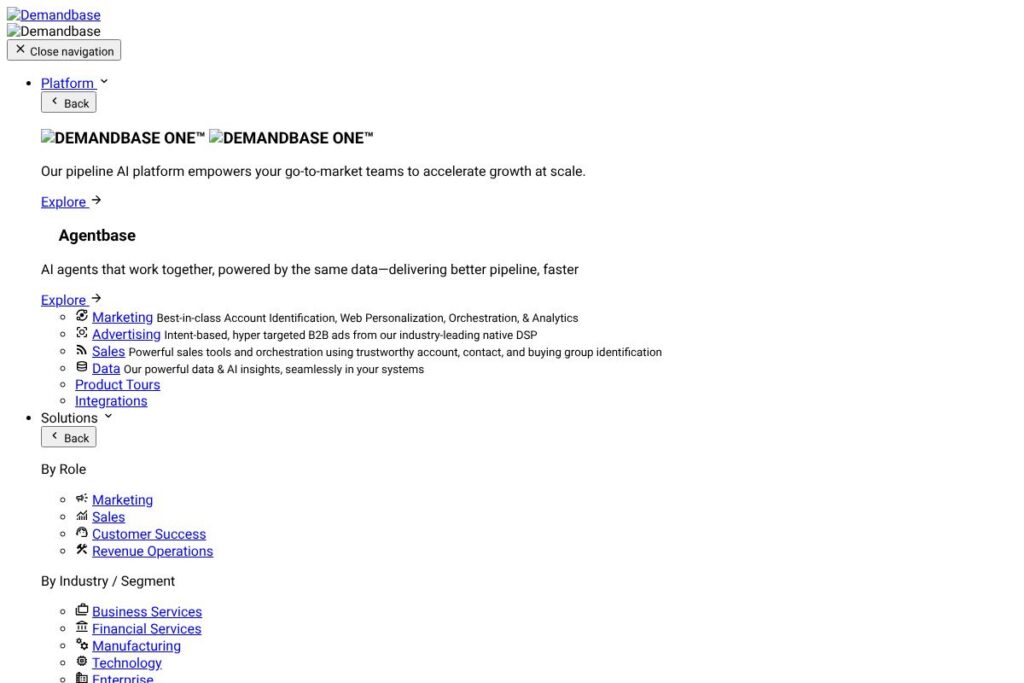
Demandbase is an account-based marketing platform designed for B2B sales and marketing teams focused on generating higher-quality pipeline and accelerating deals. The platform centralizes first-party sources such as CRM and marketing automation, enriches them with third-party firmographic and intent signals, and applies AI to prioritize accounts and recommend next actions.
Demandbase competes directly with other enterprise ABM and pipeline intelligence platforms such as 6sense, Terminus, and RollWorks. Compared with 6sense, which emphasizes predictive intent modeling and orchestration, Demandbase places stronger emphasis on buying-group resolution and a unified data foundation that feeds advertising, sales engagement, and personalization. Against Terminus, Demandbase offers more advanced AI-driven pipeline capabilities and broader integrations with enterprise systems, while RollWorks provides a lighter-weight, lower-cost ABM entry point for smaller teams.
All of this makes Demandbase well suited to enterprise B2B GTM teams that need account-level insights tied directly to activation. It is particularly useful for revenue operations, sales, and marketing teams that require reliable account identification, measurable ad and personalization programs, and coordinated cross-channel campaigns.
How Demandbase Works
Demandbase ingests and consolidates data from CRM, marketing automation, web activity, chat, email, calendar, and other first-party sources, then enriches records with third-party account, contact, buying-group, firmographic, technographic, and intent signals. The unified data model maps people to accounts and buying groups so this intelligence can be used consistently across marketing, advertising, and sales workflows.
AI and machine learning analyze those signals to score account intent, surface purchase-ready accounts, and recommend the next-best actions. Teams then activate those insights through connected channels: targeted advertising, website personalization, sales outreach, and automated marketing sequences, with controls and reporting to measure pipeline influence and conversion.
Demandbase features
Demandbase groups features around data unification, AI-driven pipeline insights, and activation across channels. Core capabilities include account identification and intent data, Pipeline AI for prioritization, cross-channel activation, and integrations that let revenue teams act on the same signals from advertising to CRM.
Let’s talk Demandbase’s Features
Data Unification and Identity
Demandbase merges first-party signals from CRM, MAP, web behavior, chat, email, and calendar with third-party datasets to build reliable account and buying-group profiles. That unified identity reduces fragmentation between sales and marketing systems, enabling consistent targeting and measurement across campaigns and touchpoints.
Pipeline AI and Predictive Scoring
Pipeline AI applies machine learning to combined signals to rank accounts by likelihood to convert and to identify ideal moments for outreach. Scores are tunable and explainable, helping teams understand why an account is prioritized and what signals drove the prediction.
Intent and Buying Group Resolution
The platform identifies intent signals and maps engaged contacts back to buying groups so teams know who is influencing purchase decisions. This buying-group focus helps align outreach to the actual decision makers rather than to isolated contacts.
Activation and Orchestration
Demandbase provides automation and controls to push insights into ads, marketing automation, and sales engagement, so teams can act quickly on intent and scoring. Campaign orchestration tools allow marketers to sequence personalization, advertising, and outreach with unified measurement across channels.
Advertising and Personalization
Integrated advertising capabilities let teams target accounts programmatically and measure ad-driven pipeline. Web and content personalization features deliver tailored experiences for prioritized accounts, improving engagement and conversion rates.
Integrations and Open APIs
The platform connects to CRMs, MAPs, ad platforms, web personalization tools, and sales engagement systems to enable end-to-end workflows. Built-in connectors and APIs allow teams to move enriched data and signals into the tools they already use for activation and reporting.
Measurement and Reporting
Demandbase ties campaign and ad activity back to pipeline and revenue metrics so teams can quantify impact. Reporting surfaces which accounts, buying groups, and channels drove conversions, enabling data-driven budget and strategy decisions.
With these capabilities, Demandbase’s biggest advantage is turning account-level signals into measurable GTM actions. Teams get a single source of truth for account identity, AI-backed prioritization, and the activation tools needed to convert intent into pipeline.
Demandbase pricing
Demandbase uses a custom enterprise pricing model that is tailored to account volume, feature mix, data enrichment needs, and required integrations; pricing is not published as fixed plans. Enterprise ABM platforms typically price based on a mix of seat-based licenses, account tiers, data enrichment, and advertising spend, and Demandbase structures agreements to match those factors.
For specifics on contract options, trial availability, and feature bundles, review Demandbase’s contact and pricing options on their homepage or reach out to sales for a custom quote. See Demandbase’s contact and pricing options to request a demo or detailed proposal.
What is Demandbase used for
Demandbase is used to identify and prioritize accounts that are most likely to convert, based on a combination of first-party engagement and third-party intent signals. Teams use those prioritized lists to target ad campaigns, personalize website content, sequence marketing nurture, and focus sales outreach on engaged buying groups.
Common users include GTM teams at enterprise B2B companies: sales reps and managers who need higher-quality account leads, marketing teams running ABM campaigns, revenue operations groups that manage data flows and measurement, and customer success teams focused on renewal risk and expansion opportunities.
Pros and cons of Demandbase
Pros
- Strong account identity and buying-group mapping: Demandbase links people, contacts, and intent signals to account buying groups, which improves targeting accuracy and sales alignment.
- AI-driven pipeline prioritization: Pipeline AI provides explainable rankings and next-best actions that help sales and marketing focus effort on accounts that matter most.
- Broad activation and integrations: Native integrations with advertising platforms, CRMs, MAPs, and personalization tools let teams act on insights across the full GTM stack.
- Measurable pipeline influence: Reporting ties campaigns and ad spend back to pipeline and revenue, helping justify ABM budgets and optimize channel mix.
Cons
- Enterprise pricing model: Pricing is tailored and typically aimed at mid-market to enterprise buyers, which can be a barrier for small teams and startups.
- Implementation complexity: Full value depends on integrating multiple data sources and tuning AI models, which can require time and dedicated revenue operations resources.
- Learning curve for some teams: Teams new to account-based approaches may need process changes to align around buying-group based workflows and activation paths.
Does Demandbase Offer a Free Trial?
Demandbase offers custom enterprise licensing with demos and trial options arranged through sales. Prospective customers can request a demo or pilot to validate data connections, intent signals, and activation workflows; contact sales through Demandbase’s enterprise contact options to discuss trial details and eligibility.
Demandbase API and Integrations
Demandbase provides APIs and a partner ecosystem to move enriched account and intent data into CRMs, marketing automation, advertising platforms, personalization tools, and sales engagement systems. Explore Demandbase’s integrations and partner ecosystem for connector details and partner capabilities on the official site.
For developer teams, Demandbase publishes integration guides and documentation to help map fields, automate syncs, and extend activation; contact Demandbase for access to API documentation and developer support during implementation.
10 Demandbase alternatives
Paid alternatives to Demandbase
- 6sense — An account intelligence and orchestration platform with strong predictive intent modeling and revenue orchestration features for enterprise teams.
- Terminus — An ABM platform focused on account-based advertising, engagement, and measurement with solutions for mid-market and enterprise teams.
- RollWorks — A scalable ABM solution that combines account scoring, targeting, and orchestration, positioned for B2B revenue teams of varying sizes.
- Bombora — Specializes in intent data and audience signals that many ABM platforms integrate to better identify in-market accounts.
- Engagio — Now part of broader ABM solutions, historically known for engagement and orchestration workflows tailored to account-based strategies.
- HubSpot — Offers ABM features within a broader CRM and marketing suite, suitable for teams that want ABM paired with inbound tools.
- Marketo Engage — A marketing automation platform with ABM capabilities and deep campaign orchestration for enterprise marketers.
Open source alternatives to Demandbase
- Mautic — Open-source marketing automation that can be extended for account-focused campaigns and integrated with external intent datasets.
- SuiteCRM — A self-hosted CRM that can be customized for account-based workflows and integrated with third-party intent providers.
- Apache Unomi — A customer data platform project that can collect, unify, and expose profile and behavioral data for personalization and targeting.
- OroCRM — Open-source CRM focused on B2B scenarios that can be adapted for account-level sales and marketing coordination.
Frequently asked questions about Demandbase
What is Demandbase used for?
Demandbase is used to run account-based marketing and sales programs that identify purchase-ready accounts, prioritize outreach, and measure pipeline impact. Teams use it to unify data, score accounts with AI, and activate cross-channel campaigns.
Does Demandbase integrate with Salesforce?
Yes, Demandbase connects with Salesforce and other major CRMs. Integrations sync account and contact enrichment, intent signals, and priority scores into CRM records for sales action.
How does Demandbase’s Pipeline AI help sales teams?
Pipeline AI ranks accounts and surfaces next-best actions based on combined first- and third-party signals. Sales teams get prioritized account lists, explanations for each score, and recommended outreach timing.
Can Demandbase be used for website personalization?
Yes, Demandbase supports web personalization targeted to prioritized accounts. Personalized content and messaging can be served to specific accounts or buying groups to improve engagement.
Is Demandbase suitable for small businesses?
Demandbase is primarily designed for mid-market and enterprise B2B teams. Small businesses may find the platform powerful but should evaluate scope and implementation needs before committing.
Final verdict: Demandbase
Demandbase stands out for its account-level identity, buying-group resolution, and AI-driven pipeline scoring tied directly to activation across advertising, personalization, and sales workflows. Its strength is the unified data model that ensures marketing, sales, and revenue operations act from the same signals and measurement framework.
Compared with 6sense, which also offers robust intent and predictive capabilities, Demandbase is often the better fit for teams that prioritize buying-group mapping and broad activation across ad and personalization channels; both vendors use custom enterprise pricing and require a sales conversation to determine costs. For large B2B organizations that need a single platform to move from signals to measurable pipeline, Demandbase provides a comprehensive ABM solution that emphasizes data quality and actionability.